It's getting hot in here ... and it ain't just the January Thaw
Plus: Colorado River Chronicles; Big Bend Border Wall boondoggle
đ„” Aridification Watch đ«
Back in the late 1990s and early 2000s, when I lived in Silverton, Colorado, elevation 9,318 feet, we often experienced a âJanuary thaw.â It was a period of a few sunny, warm days between storms that usually fell in January but could also occur in February. If you could find a south-facing deck that was protected from the wind and free of dangling, skull-piercing icicles, you could sit out in shirtsleeves, soak up some vitamin D, and maybe even get a little bit of a suntan. Then winter, below zero temperatures, and super snowy San Juaners would return, finally and grudgingly departing sometime in late May.
A pretty big swath of the Southwest is about to experience a February thaw of its own, according to National Weather Service forecasts, including in these hot spots:
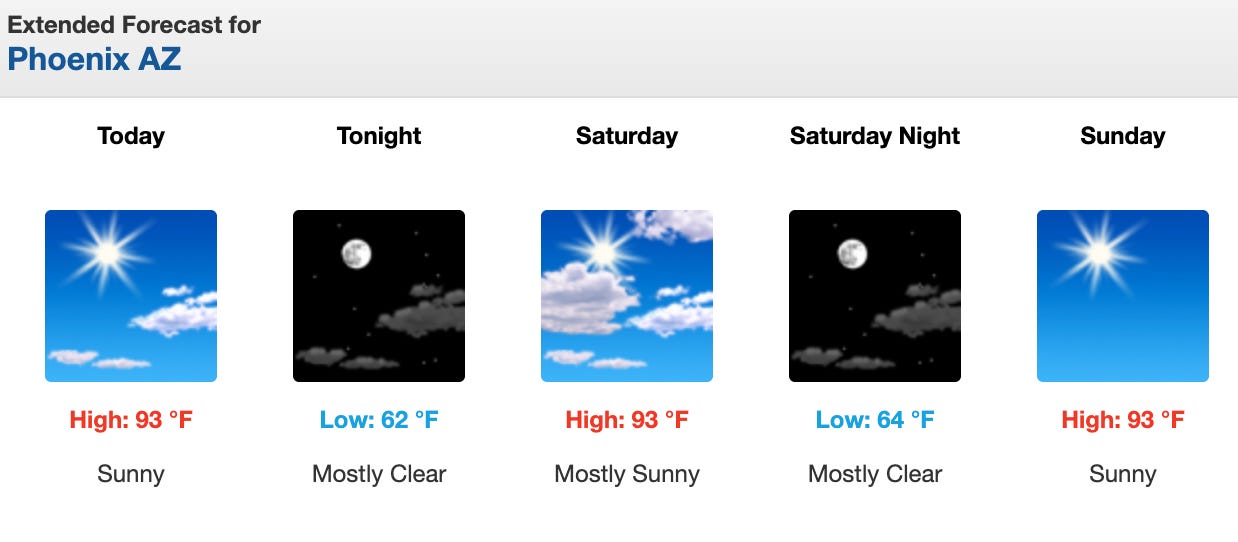
Phoenixâs mercury could climb into the low- to mid-90s this weekend, with overnight lows in the 60s.
Durango, Colorado, is expecting to hit 66° F on Sunday (with lows staying above freezing).
It will be prime bike-riding weather in Moab, where the highs could climb into the low 70s.
And even Silverton will get up into the 50s, with the overnight lows dipping only a few degrees below freezing â bad news for the snow.
Denver is under a red flag warning for fire danger today, and will see temperatures in the high 60s.
During a ânormalâ winter, this wouldnât be alarming in the slightest. In fact, it would be a welcome respite from winter. Now it threatens to wipe out any indication that it even is winter by potentially erasing the snowpack gained during last weekâs storms. The Upper Colorado River Basinâs snowpack is exactly at the same level as it was on this date in 2002. Ohhh boy, if those March storms donât arrive itâs going to be a long, dry summer.
đ§ Colorado River Chronicles đ
As a deal between the seven Colorado states for how to divvy up massive consumption cuts seems less and less likely, Arizona is getting a bit more aggressive. This week the Protecting Arizonaâs Lifeline Coalition launched a PR campaign, complete with videos, attempting to pressure the Upper Basin states to let more water flow downstream to its Lower Basin neighbors.
Arizona is understandably worried: The Central Arizona Projectâs water rights are junior to most of the other large users in the Lower Basin, meaning they would be among the first to take cuts if there were a shortage. The window for a dramatic improvement in Upper Basin snowpack is rapidly closing, thereby increasing the likelihood of a shortage later this year.
The campaign includes a series of videos with various officials making their case. There are also a few educational ones that do a nice job of explaining the Colorado River Compact, and are really worth a watch. However, I should warn you that they are coming from a Lower Basin perspective, meaning they interpret one clause of the Compact, Article III(d), significantly differently than the Upper Basin states. And yet, thatâs what their entire argument relies on.
That clause states that the Upper Basin must ânot cause the flow of the river at Lee Ferry to be depleted below an aggregate of 75 million acre-feetâ for any 10-year period.
The Upper Basin sees this as a ânon-depletion obligation,â meaning it blocks them from exceeding their 7.5 MAF/year allocation if it causes the Lee Ferry flow to fall below a 7.5 MAF/year average. The Lower Basin sees it as a âminimum delivery obligation,â meaning that the Upper Basin is obliged to send an average of 7.5 MAF past Lee Ferry no matter what, even if that means draining all of its reservoirs and drying out its fields and cities.
Keeping that in mind, check out the video:
đ€Ż Oh, the Humans! đ±
In a comment on Tuesdayâs dispatch, reader Steve Harris suggested a story on the U.S. Customs and Border Protection fast-tracking a 200-mile segment of border wall through Big Bend National Park.
This is a super important issue. And itâs not only in Big Bend: The entire border wall is an environmental disaster, slashing through biologically diverse, beautiful country and cutting off migratory routes and movement for mountain lions, javelina, coyotes, ocelot, deer, desert bighorns, and even jaguars. Keep in mind that itâs not just a fence, itâs a giant piece of infrastructure that requires bulldozing all the vegetation and even blasting through the landscape. Besides that, we taxpayers are forking out billions of dollars for something that isnât all that great at doing what itâs supposed to do.
For me itâs especially heartbreaking to see the wall cut through the borderlands south of Tucson, down in the Patagonia Mountains. Many years ago my dad took my brother and I along some little road through there right up against the border, which at the time was just a barbed wire fence. It was incredible country, so quiet and mostly humanity-free.
The stakes are equally as high in the Big Bend area, where both ecological and cultural treasures are at risk. Unfortunately Iâve never been to Big Bend, and itâs a little ways outside the region I normally cover, so Iâm not going to try to pretend to know whatâs going on there. But a lot of other smart folks have written about it and are trying to block the new stretch of wall, so Iâll share some of that here:
Border Patrol map of existing, planned, and awarded segments of wall, including the stretch through Big Bend â which consists of about 100 miles of actual physical wall plus segments of âdetection technologyâ in the most rugged areas.
The Border Wall Map with videos showing whatâs at stake.
The Texas Observer has a good story on the wall plans and the way the âBig Beautiful Billâ not only allocates $46.5 billion to build the monstrosity, but also erased existing protections for some areas.
The Texas Tribune and Inside Climate News worked together on a story that talks about local opposition.
Peer-reviewed study on how the border wall impedes wildlife movement.
đ” Public Lands đČ
Environmental groups and environmentally-oriented media outlets are making a pretty big stink over the confirmation hearings for Steve Pearce, Trumpâs pick to lead the Bureau of Land Management. Thereâs a good reason for this: Pearce is well known for his hostility toward the BLM and the public lands it oversees, and he has also indicated a desire to sell off public land â a stance he failed to renounce during this weekâs hearings.
Pearce is a bad choice for this job. But is it worth spending a lot of resources to get him ousted? Probably not.
If the Senate does not confirm Pearce, then the administration will just find some other bozo to do the job, which in this case is basically a middle manager tasked with carrying out the agenda of Interior Secretary Doug Burgum. Burgum, in turn, is merely executing the Trump administrationâs, i.e. Project 2025, policies.
Which I have to say is disappointing and sad. Before he was a cabinet member, Burgum seemed like a reasonable enough guy. Sure he has ties to oil and gas interests, but he also appeared to be a Teddy Roosevelt Republican â an old school conservative and conservationist who valued public lands. He even managed to garner the endorsement of outdoor retailer REIâs board along with that of the hook and bullet crowd.
Instead, he has prostrated himself to the extractive industries, embraced coal mining and oil and gas drilling, and shattered environmental protections for public lands left and right. His distinguishing features as a cabinet member have been his unwavering sneer-like grin and his tendency to fawn over Trump â and coal.
***
Your energy and outrage might be better spent on convincing Congress to shoot down Sen. Mike Leeâs, R-Utah, attempt to use the Congressional Review Act to revoke the Grand Staircase-Escalante National Monument management plan. If the âresolution of disapprovalâ passes both chambers of Congress with a simple majority vote, it would erase the plan and bar the Bureau of Land Management from issuing another plan that is âsubstantially the sameâ in the future.
Republicans in the current Congress used the CRA â which allows Congress to revoke recently implemented administrative rules â to do away with resource management plans in Alaska, Montana, and North Dakota. Thatâs in spite of the fact that RMPs are not considered ârules,â according to a January 2025 opinion by the Interior Departmentâs Solicitor. National monument management plans arenât rules, either, but thatâs not a hindrance for Lee.
This wouldnât change the boundaries of the monument, but would likely cause management of the area to revert back to the 2020, Trump I-era plan. That plan was not only less protective than the newer one, but only applied to a much smaller area, since in 2017 Trump had significantly shrunk the national monument. Revoking the current management plan, then, would leave vast areas of the monument in a sort of management limbo.
It would also open the door to revoking other national monument management plans (e.g. Bears Ears), allowing the GOP to carry out Project 2025âs goal of shrinking or eliminating national monuments in a less visible, more underhanded manner.
đž Parting Shot đïž


It continually blows my mind how rapidly the regular order of our democratic republic just vanished. One guy gets into the White House who doesn't want to follow our norms and constitutional order and... poof! 250 years tossed out the window. How the border wall can slice a gash through a much loved and ecologically important national park with no public recourse is stunning. What's the point of a national park anyway when protections are chucked at the drop off hat. Lordy.
A visit to Tucson (from where we live in green/wet Connecticut) last week was uncomfortably hot, and your informative essay really hit home. If we realistically consider our American lands one body with connected limbs, we must work toward the health and fitness of all our arteries and organs to make the whole thing work. Long term devastation of our wild and precious lands for the short term gain to ultimately benefit wealthy people is not a good sustainable plan. It never has been and those lands are shrinking to the detriment of the survival of humans, flora, and fauna. "Survival of the fittest"is a Darwinian term that bears out but cannot be the ultimate acceptable end to all of us. We must save ourselves from the iteration of our worst selves. The "fittest" are not leading us now and we cannot let them stand.