

🔭 OVERSIGHT (or lack thereof) 👮🏼
The U.S. Senate just voted today to proceed with debate on the Bipartisan American Affordability and Jobs Act, aimed at streamlining and accelerating federal environmental reviews and permitting for major projects.
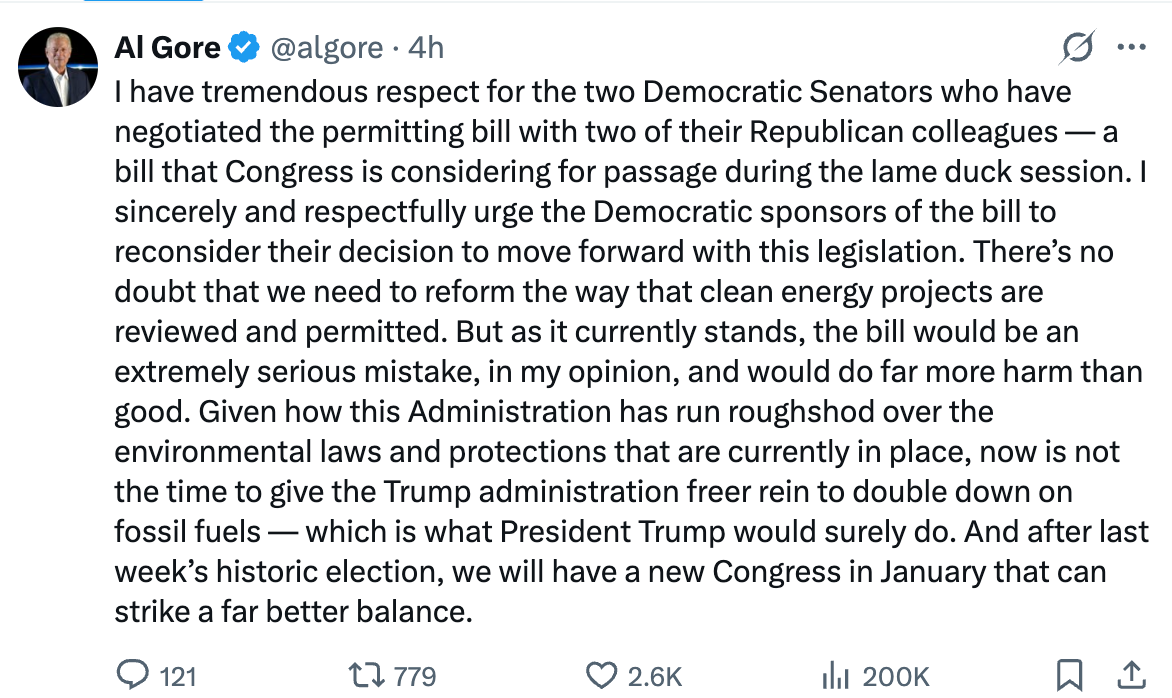
The legislation has opened a nasty rift within the environmental movement, one that was not soothed by the bill’s sponsor’s recent amendment attempting to address concerns. In recent days, opposition has mounted, with even Al Gore coming out against the legislation as it’s currently written. Meanwhile, President Donald Trump urged the bill’s passage in a social media post, calling it a “BIG WIN for U.S. ENERGY INDEPENDENCE and DOMINANCE.”
After the bill was first introduced, many climate hawks, Abundance adherents, and clean energy industry leaders threw their weight behind the bill, saying it is necessary to rapidly decarbonize the power grid and address the climate crisis. But more traditional green groups, tribal nations, and historic preservation advocates have pushed back hard on the legislation’s provisions that weaken bedrock environmental laws and the National Historic Preservation Act.
While the legislation likely would make it easier and quicker to build solar and wind projects and the transmission needed to ferry that energy from where it’s generated to where it’s needed, it would do the same for fossil fuel projects, such as natural gas or oil pipelines. It would also bar a future administration from nixing a project that a previous administration authorized. This would have blocked the Trump administration from cancelling permitted wind projects, but also would have kept the Biden administration from axing the Keystone XL pipeline.
As more of these details have emerged, prominent clean energy advocates, such as Bill McKibben, and climate activists, including Al Gore, have come out in opposition to the legislation. A major concern is that the Trump administration would use the reforms to push through destructive energy projects.
At its core, the legislation tweaks major laws, including the Endangered Species Act, the National Environmental Policy Act, and the Clean Water Act, and even the 1872 General Mining Law in ways that not only accelerate permitting timelines for major projects, but also makes it more difficult for tribes, states, advocacy groups, and the general public to stop or force changes to the proposed development.
I wrote about some of this for High Country News last week.
For an expanded version of the HCN piece, and one that wades a little deeper into the weeds of wonk, click on the button below.
In May of 2023, the Biden administration’s Bureau of Land Management issued a final approval to Pattern Energy to construct its long-planned SunZia transmission line, which was designed to carry wind power from eastern New Mexico to a major grid hub in the Phoenix area, where it could then be transmitted across the Southwest. Clean energy advocates lauded the move, since it would enable Southwestern states to tame the solar “duck curve” — or fill in the power gap left when the sun goes down — with wind power rather than natural gas generation, thus reducing the grid’s carbon footprint.
But SunZia was also held up as a prime example for why permitting reform for these kinds of projects is necessary. The approval came after 17 years of review by various federal agencies, and after a previous 2015 BLM approval was scrapped and the project sent back to the drawing board after New Mexico regulators balked due to potential impacts to migratory birds. The climate crisis needs to be addressed now, advocates said, and there wasn’t time for these clean energy-enabling projects to wade through the bureaucracy for a decade or more — only to be potentially blocked by a post-approval lawsuit. They called on Congress to clear a path through the morass of red tape to speed up such projects.
The call was heeded in September, when a group of Republican and Democratic senators, including public lands champion Sen. Martin Heinrich (D-NM) and hard right Sen. Mike Lee (R-UT), introduced the Bipartisan American Affordability and Jobs Act, aimed at streamlining and accelerating federal environmental reviews and permitting for major projects. Groups as disparate as Americans for a Clean Energy Grid and the American Petroleum Institute got together to support the legislation in concert with the Abundance movement and climate hawks. The Breakthrough Institute’s Marc Levitt called it “a heroic breakthrough for permitting reform … that opens the door to a new era of climate policy, infrastructure, and long-term price stabilization.” The NRDC praised the bill’s transmission-related provisions, saying the red-tape-slashing policies, which the Columbia Center on Global Energy Policy estimates would cut the average transmission permitting timeline by 96 months, “are an essential component of accelerating the electrification and decarbonization of the power sector and achieving greenhouse gas reduction targets.”
Yet one person’s red tape is another person’s environmental safeguards. In order to achieve its goal of accelerating transmission and other energy projects, the legislation takes aim at bedrock environmental laws such as the National Environmental Policy Act, the Endangered Species Act, the Clean Water Act, and the National Historic Protection Act. And to get Republicans on board, the bill’s provisions had to be extended to apply not just to clean energy projects, but also fossil fuel ones. To more ecology-minded green groups, tribal nations, and more progressive federal lawmakers, the gutting of these laws goes too far, and could result in damage to communities, landscapes, and cultural sites. Western Environmental Law Center’s Erik Schlenker-Goodrich called the bill a “turd grenade.” Even the NRDC called these provisions “deeply flawed,” and vowed to get them changed before the bill goes to a vote on Nov. 9.
Here’s a rundown of some of the more significant changes under the proposed bill, and what they might mean:
National Environmental Policy Act (NEPA)
NEPA, signed into law in 1970, requires federal agencies to consider the potential environmental impacts of major federal developments through environmental impact statements (EIS) or environmental analyses (EA). It is considered the bedrock environmental law, is most often blamed for project delays and would be subject to the most significant changes under BAAJA. Those include:
While the 2023 Fiscal Responsibility Act put a two-year time limit on completion of an EIS and one year for an EA, it did not set a limit for a final decision. BAAJA would require the lead NEPA agency to issue a decision within 45 days of the EIS’s completion, and also speed up federal authorizations for other participating agencies. If the agencies failed to meet the deadline, the lead officers on the review would essentially be tied to their desks until the analysis was completed. This would significantly accelerate timelines, as the median completion time for an EIS is currently about 4.5 years.
BAAJA would limit organizations’ ability to file lawsuits against NEPA decisions and for what reasons, and sets a higher bar for who has “standing” to bring such a suit. It also significantly shortens the statute of limitations for lawsuits, and would skip district courts and go straight to the D.C. Circuit Court of Appeals, potentially putting plaintiffs at a disadvantage.
A court would not be allowed to put an injunction on a project based only on a violation of NEPA or the National Historical Protection Act (NHPA). This means construction could go forward — and the environmental, human health or cultural impact realized — even while a lawsuit was pending. And even if a court rules against the agency and finds it has violated NEPA, it will merely send the EIS or EA back to the agency and ask for fixes, not vacate the approval, meaning, again, that development could continue along with its impacts.
BAAJA would exempt from NEPA: projects already subjected to state or tribal reviews; repair, maintenance, replacement, upgrading, rebuilding, or modification of electricity transmission or distribution lines or substations and natural gas facilities; energy storage projects if built “at or near” a transmission line.
“In short, BAAJA would pull NEPA’s principal teeth—the possibility of a court order blocking a project for violating NEPA,” writes Michael B. Gerrard, Andrew Sabin Professor of Professional Practice at Columbia Law School.
National Historic Preservation Act (NHPA)
Congress passed NHPA in 1966 to protect historic, cultural and archaeological sites, and requires the jurisdictional agency to determine whether a proposed development might affect historic properties. If so, it triggers Section 106 of the law, often called “identify and avoid,” which requires the agency to consult with tribal nations or other potential stakeholders to identify potentially affected properties, and to work to avoid, minimize or mitigate adverse effects on those properties. Section 106 is often the only thing standing between a bulldozer blade and an ancient pueblo or other cultural site. Changes under BAAJA include:
The bill would require that Section 106 reviews are finished by the deadline for the NEPA EIS or EA, potentially significantly shortening the timeline for tribal consultation and cultural inventories and archaeological surveys, which can take years for major projects such as pipelines or transmission lines. Also, if a tribal historic preservation officer misses the deadline, they could be penalized and the tribal nation could lose federal funding.
BAAJA would raise the threshold for triggering Section 106 reviews, effectively limiting the scope of and exempting some projects from the analyses, while also removing the requirement that tribal nations be consulted before identifying a historic property (they would only be consulted after the determination). That, in turn, would limit tribal nations’ involvement in reviews of proposed developments that may adversely affect their lands or cultural sites.
As with NEPA, the bill would block courts from issuing injunctions or vacating approvals for proposed projects, even if the court finds against the agency.
The National Congress of American Indians, along with other tribal organizations, in an Oct. 9 letter, called on the legislation’s sponsors to withdraw Title III — the section concerning NHPA — from the bill altogether, saying these provisions are “in deep conflict with federal trust and treaty obligations to engage sovereign Tribal Nations in government-to-government Tribal consultation and to protect our irreplaceable cultural heritage. … Tribal Nations should not be forced to bear the brunt of these cultural and spiritual harms so the nation can further develop and transport its energy resources. We have already sacrificed the majority of our lands and natural resources—oftentimes through force or coercion—upon which the United States has become the world power it is today.”
Clean Water Act:
When a pipeline, transmission line or other project crosses over, under or otherwise affects a jurisdictional body of water, the Clean Water Act’s Section 401 requires that the development be certified by the relevant states or tribal nations to protect water quality. States and tribes have used this authority to block projects or to push the developers to reroute them or redesign them to mitigate impacts. BAAJA would:
Limit Section 401 powers by narrowly defining the kinds of water quality impacts that could trigger a state’s or tribal nation’s denial. It puts the burden of proof on the state or tribe to show that the proposed project would harm water quality regardless of modifications or mitigation.
Curtail the amount of time the Environmental Protection Agency has to veto Army Corps of Engineers Clean Water Act permits for major projects. The EPA used this veto power to halt the Pebble Mine in Alaska. By shortening the time frame, it would preclude a new administration from blocking a project approved under a previous one.
Endangered Species Act (ESA)
BAAJA would:
Reduce the Fish and Wildlife Services ESA consultation time limit from 90 days to 60 days.
Exempt activities within rights of way of certain federally funded highways from the ESA, and allow states to take over the consultation process. This would create inconsistency from state to state, sometimes even for the same project, and could imperil endangered species in states that are hostile to environmental protections.
Hamper judicial review via tighter timelines and sending any lawsuits straight to the D.C. Circuit Court of Appeals.
General Mining Law
This is not an environmental protection law. It’s quite the opposite, actually, having allowed mining companies to ravage public lands since 1872. However, in 2022 a federal judge blocked the proposed Rosemont copper mine in Arizona from dumping tailings and waste rock on public land on which it had staked mining claims.
The Rosemont Decision, as it has come to be known, relied on a provision in the law that says a mining claim is not valid unless the claimant proves it contains valuable minerals, and therefore cannot be used for those purposes. The exception are a type of claim called mill sites, which are no larger than five acres and intended to be used for mills or other mining-support facilities (including waste disposal), must be non-contiguous with the mineral claims, and to which the valuable mineral requirement does not apply. A mine is usually limited to just one mill site.
BAAJA would allow a mining firm to stake as many mill sites as “reasonably necessary for its operations … and … use or occupy public land in accordance with approved plan of operations.” This would effectively nullify the Rosemont Decision and allow large mining companies to claim hundreds or even thousands of acres of public land for waste disposal and storage.
Project Certainty
BAAJA would block a president from cancelling energy projects approved by a previous administration by prohibiting “any new action that would revoke, rescind, withdraw, terminate, suspend, amend, or alter a Federal authorization or permit in effect on or after Sept. 16, 2026, or take any other action to interfere with or prevent the construction or operation at full capacity of a project that has secured all necessary Federal authorizations.”
This is clearly aimed at the Trump administration’s penchant for cancelling onshore and offshore wind projects and solar projects on public land. But it also would have prevented the Biden administration, for example, from cancelling the contested Keystone XL pipeline on his first days in the Oval Office.
Also, the provision barring an agency from taking “any other action” to prevent “operation at full capacity” could be used to block regulators from enforcing pollution limits, worker safety rules and human health and safety protections.
Is Permitting Reform Really Necessary?
The aforementioned SunZia project is certainly a good example of how long the NEPA process can take. But it also demonstrates how the currently arduous permitting path can improve a project and yet still not be rigorous enough to protect important cultural and environmental sites. In New Mexico, for example, conservationists and state officials were able to use the process to push the developers to reroute the path to avoid harming migratory bird flyways, garnering the project — and the process — Audubon Southwest’s endorsement as a case study of how permitting works.
But in Arizona, when Indigenous nations and conservation groups tried to get SunZia to reroute the line away from the fragile, biodiverse San Pedro River Valley to protect birds and other wildlife along with culturally significant sites, Arizona regulators shrugged them off — not surprisingly, since they tend to be more amenable to such projects and less responsive to environmental concerns than their New Mexican counterparts.
So when Arizona regulators unanimously approved the project in November 2022, they removed any incentive for SunZia to reroute the line in Arizona the way it did in New Mexico. The BLM’s preferred route remained alongside the San Pedro River, despite the objections of tribal nations and conservationists. An ensuing lawsuit continues to work its way through the courts, but has failed to stop or pause construction — even under the current, more rigorous permitting regime.
Now the San Pedro River faces another challenge: A proposed natural gas pipeline called Desert Southwest, which would carry methane from the Permian Basin to Arizona, passing right through the Pedro River Valley north of Tucson. Under the current permitting regime, the project would be subjected to rigorous NEPA and National Historic Preservation Act reviews, while tribes and states would have more say under the Clean Water Act. But if the permitting reform legislation becomes law, the project could be exempted from these reviews, meant to protect people and places, altogether.
⛈️ WACKY WEATHER WATCH⚡️
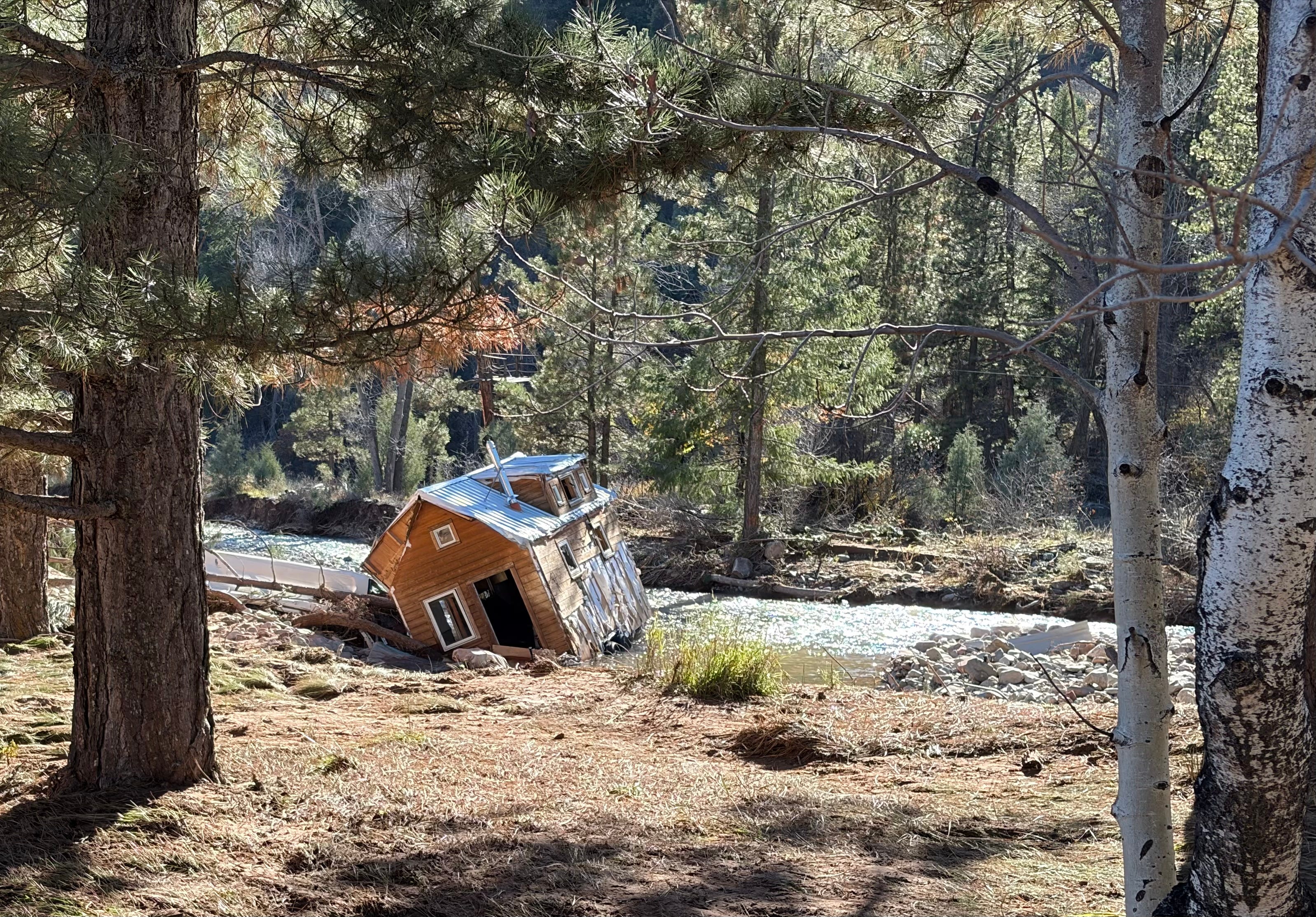
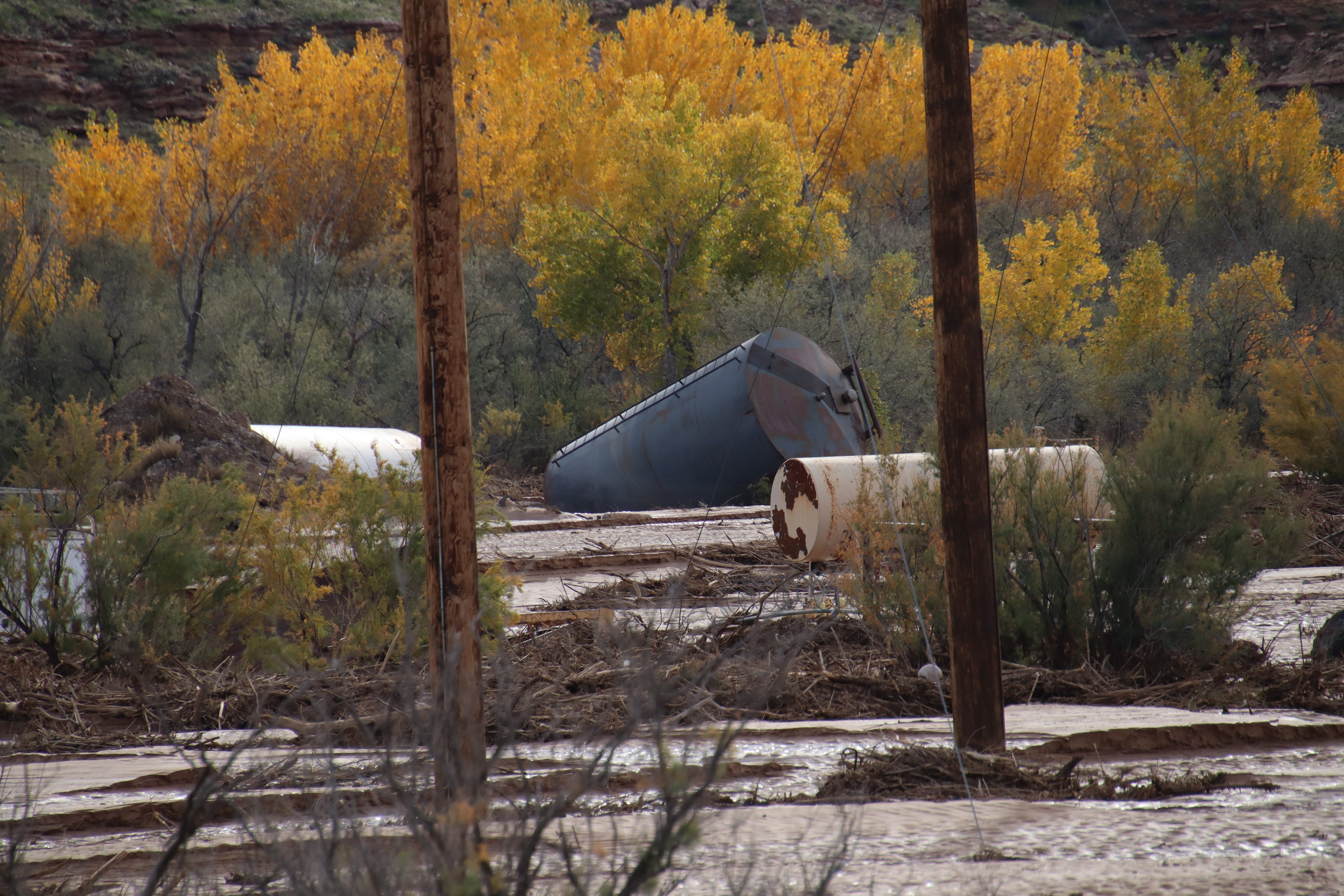
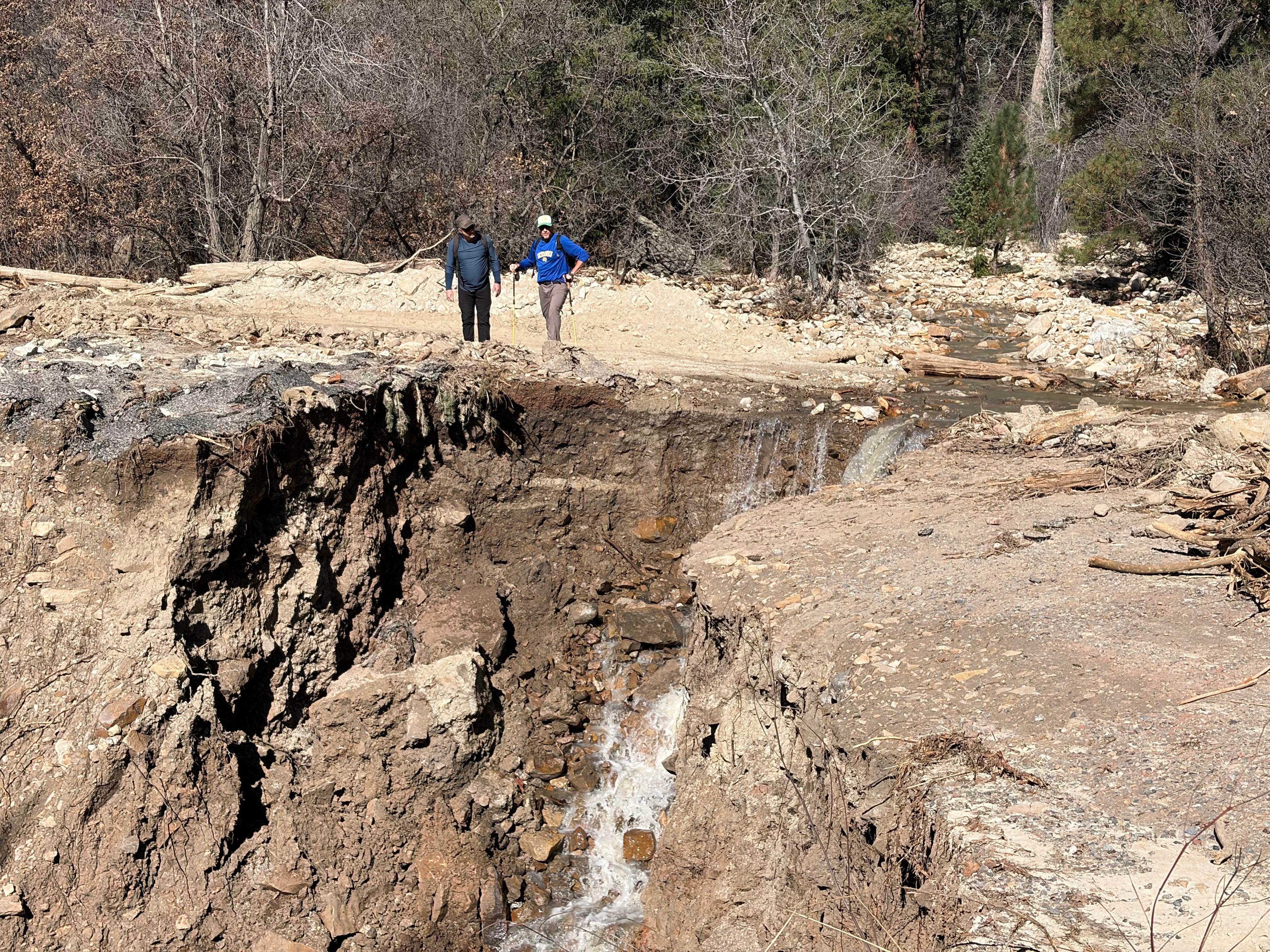
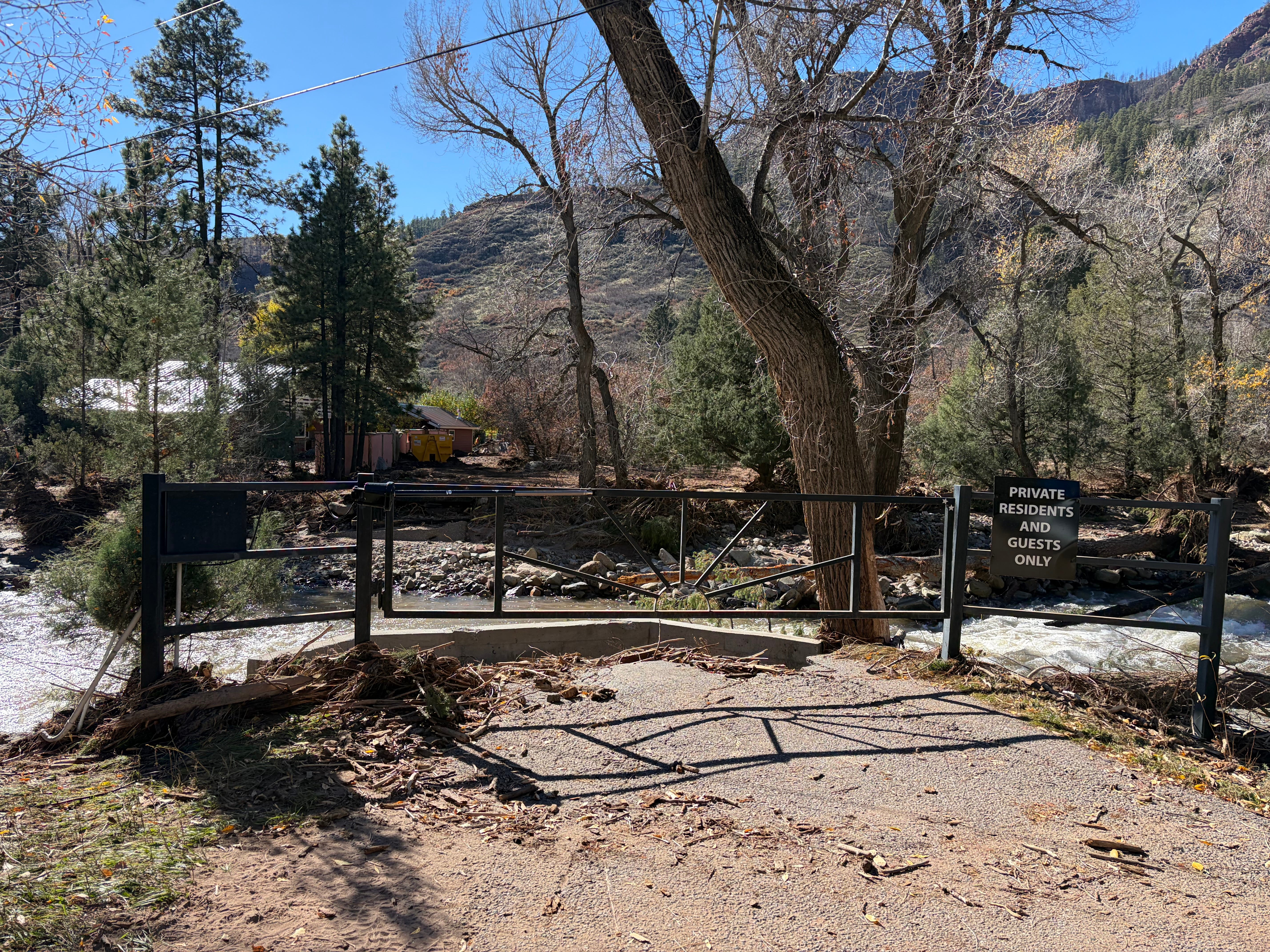
I’ll be doing a big overview/data dump/historical context dispatch on the Four Corners flooding in a dispatch later this week. But for now, here are a few images I captured while traveling around the region, gazing with awe and dismay at the destruction inflicted.
Can we get the list of how senators voted?
I have never gotten so many "likes" (BTW how do I get substack to not flood my e-mail when people simply click on the heart?) on substack as when I opined on another site that Heinrich's narcissism (personal experience) prevented him from seeing his own biases, power motivations (pun unintended), etc.