

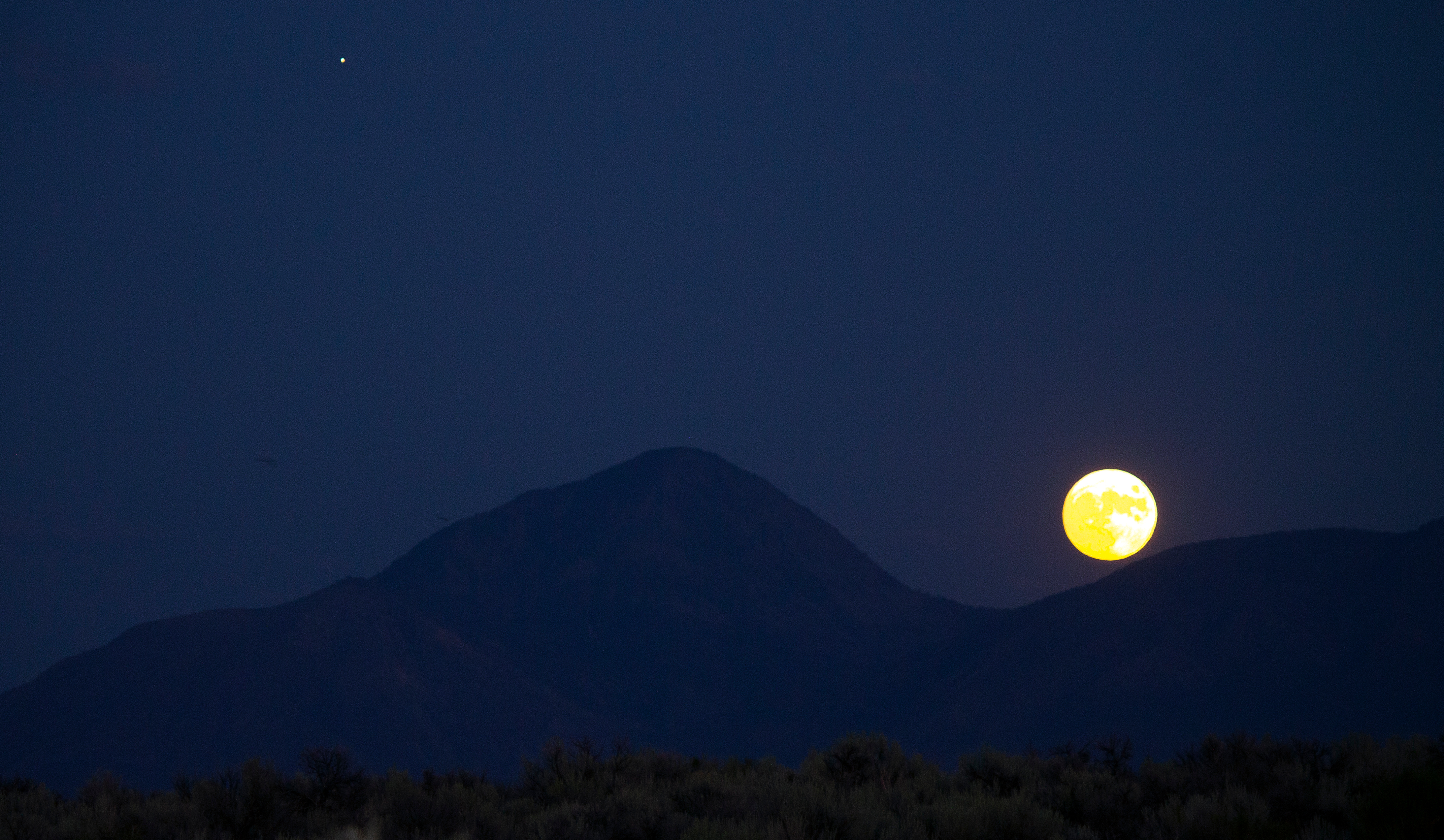
Editor’s Note: This story, or whatever it is, arrived by post at the Land Desk offices earlier this week. It was purportedly sent by Malcolm Brautigan, which seems strange, since Brautigan is a fictional character in the serialized novel, SNOWSCREEN. But we* decided to publish it anyway, because, well … it’s the winter solstice, and we’ll do anything to ensure the sun reverses course and the light returns. It is, I assure you, fiction. (*A reader, noticing my use of “we” in Land Desk dispatches, asked if I have a team of writers working here. The answer is no. It’s only I. Or me. I just like using the royal “we” — or maybe the media outlet “we” — because it makes me feel less lonely.)
So there you have it. May you all have a lovely solstice and holiday season and may the light return. We — the Land Desk and me, Jonathan — will see you in January.
FICTION, by Malcolm Brautigan
Be in advance of all leave-taking, as if it were already behind you,
Like a winter which has already gone.
For of all the winters, there is one so endless,
that your heart, through enduring that winter at last overcomes it.— Rainer Maria Rilke
It must have been a couple dozen years ago, maybe more, when I set out from the office of the Dandelion Times to photograph ice. It was the afternoon of the winter solstice, when the sun seems afraid to linger too far from the horizon. There wasn’t much snow yet, and not a cloud in the sky, but it was colder than hell. Or at least I thought so. Of course I was new to Silverton then and still not acclimated, a rookie reporter who still didn’t understand that photographs of frozen water wouldn’t go over so well with my readership.
But I was too shy to ask people if I could take their photos. It just seemed intrusive to me. And pictures of the snow-covered mountains felt too cliche, so I spent a lot of film and my editor’s patience on images of shadows and aspen-tree closeups and old doorknobs and the patina on rusted out cars and, yes, ice.
This wasn’t just any ice, but river ice. In cold places like this rivers freeze in odd ways: The ice actually stacks up on itself over time in a way that I can’t really explain and that makes very little sense to me. I’m sure there’s an explanation, but I’m not sure I really want to know it.
I loaded my camera with film and hoofed it up Greene Street to the end of town before cutting back across to the river. I walked up the rocky river bank watching the water — or rather, the ice — as I went. When a pattern caught my eye — maybe a spiral in the ice, or frost that had somehow grown into a crystalline column several inches high — I stopped, pulled off my thick gloves, wound the camera, focused, chose what I guessed was an appropriate f-stop, and pushed the button, relishing in the satisfying click of the shutter opening and closing.
I tiptoed across the ochre-tinged ice over Cement Creek (but didn’t bother photographing it since I only had black and white film), crossed the bridge at the ski hill, and continued upstream. The sun vanished. The temperature plummeted.
I doubled back across the river and hurried toward home, a drafty little miner’s shack with no foundation and single-pane windows smudged with the oily residue of coal smoke. What it lacked in insulation or comfort, it made up for with the television the previous tenant had left behind and the free cable. Almost everyone in town had free cable back then; you’d sign up, they’d connect you, and then when you stopped paying the bill they never disconnected you (and if they did, it was easy to climb up on the roof and reconnect it yourself). Maybe the technician was negligent or maybe he knew that this particular form of welfare could quell cannibalism and other symptoms of February.
So, looking forward to a frozen pizza and It’s a Wonderful Life, I opted to take a short cut through the brush. I soon became lost in a maze of beaver ponds and waterways and wetlands. Willows tore at my face. I stepped on what looked like a solid piece of ice and broke through into a thigh deep canal. Panic gripped me. I was alone, it was getting dark, and I was hungry.
And when I finally thrashed my way out of the brush I found myself face to face with a weathered, baby blue single-wide trailer with a stream of white smoke billowing from its chimney. I had a choice: Re-commence the bushwhack or pass within several feet of the trailer’s rickety-looking stoop. I chose the latter.
Just as I was even with the front door, it swung open with a squeal, and a strange looking character with a huge, reddish-blonde afro appeared. "What are you doin' on my property. Who are you working for,” he said, an accusation more than a question.
"I'm sorry, I was just checking out the beaver ponds and I broke through the ice and I got kinda lost and I’m just trying to go home.”
He looked me up and down, his gaze fixing on the camera in my right hand. Something in his demeanor changed. "What are you photographing?" he asked and looked back toward the river.
"The ice," I replied, not knowing what else to say but the truth to this near-naked wild man pelted from head to toe with thick, golden hair.
His face scrunched up in a squint — maybe menacing, maybe just curious — and he said nothing. The silence hurt almost as much as the cold.
Finally, a giant grin crackled his demeanor, his eyes scrunched up, and deep lines formed around his mouth. "The ice," he said, grinning that Cheshire grin that I will always identify with Whitman in the moments when he felt most alive. "You're taking pictures of the ice."
I stood there and pulled my jacket more tightly around me, more out of fear than because of the cold. Flashbacks of my childhood flooded my brain, of those times when my parents would bring me up to Silverton for Hardrockers Holidays or to get lunch at the Pickle Barrel and we’d encounter the miner kids out on the street and they were so damned tough and ornery — or at least they seemed that way to me, a city-slicker lowlander from way down in Durango.
"You look cold. Come on inside and get warm and have a drink," he said, still smiling.
“I, umm, I kinda gotta get home …”
“Uh huh. Believe me, the Charlie Brown Christmas Special will be on another night. Come on.”
I had no choice but to follow him into the dark abode. It was a little trailer, a single-wide in the true sense of the word, but it was warm and every piece of available wall space was covered with black and white photographs and elaborate, intricately detailed pen and ink drawings. Speechless, I stared at the walls, wondering where these things had come from, what mind had created them.
So absorbed in the strangeness was I that I literally jumped when a voice rang out from the dark innards of the trailer.
"Who is it, Greg?" the voice asked, slow and sleepy.
I turned around to see a woman, completely naked, her hair a mess, leaning against the wood paneling in the narrow hallway — the look on her face both placid and curious. She didn't seem to mind that I stared, unable to take my eyes off of her.
"Put some clothes on, Nance, show our guest some manners. This here is Ansel Adams. He’s out photographing the ice on this balmy, San Juan afternoon, and he's decided to join us for a drink, if you don't mind."
“Hi,” I said, trying to look at her face without making too much eye contact. “I’m Malcolm. I was just … I guess I got lost and …”
“Lost? I’m Nancy. That’s Greg. He probably hasn’t told you that yet.”
Greg opened a cupboard and pulled out a couple bottles of Pabst Blue Ribbon and handed me one. It was cold, despite the lack of refrigeration. I drank it, probably too quickly given my nervousness and all, and another one after that. We talked, Greg and I, and we drank, and Greg heated up some potato soup that tasted far better than it looked. Nancy sat in an old chair in the corner, now wearing a loose robe, and read Foucault, occasionally looking up and correcting one of our statements. The more we drank, the more we talked — or really, Greg talked. I learned that Greg had taken the photographs; his big, calloused hands had drawn the pen and inks; and he had even constructed the sculptures that sat in the front yard.
The more he talked, the more riled up he got about the world and those goddamned politicians and the stupidity and we blasted the mines for industrializing the mountains and killing the fish and we mourned the death of the mining culture and railed on the soullessness of tourism and gentrification. And then Greg’s voice changed as he told me about his neighbor, some redneck motor-head from Arkansas or Tennessee or Texas, who had bought up all the placer mining claims along the river there, the ones I had bushwhacked through, planted a Confederate flag, and was planning on building some sort of ATV campground or some other bullshit. But first he had to get rid of the beavers and the wetlands. “So you know what that asshole did?” His voice was almost a whisper, and I swear the man’s eyes brimmed with tears. “He dynamited that beaver lodge. Can you believe that?”
Greg’s rage was infectious. I could feel it seeping into my chest and belly. Greg, still in his underwear, stood up and walked outside. I, in shirtsleeves and bare feet, followed. And, in the direction of the neighbor’s log cabin, we launched into a tirade, punctuated by the sound of beer bottles shattering against the cabin’s pro-panel roof.
"Kill all the beavers you want, you sonofabitch," hollered my new found compadre. "This guy takes pictures of ice, and he's gonna lead the revolution!" Then he looked back at me. “Hey, tomorrow’s the Solstice. You gotta join Nancy and me for the sacrifice.”
“The what?! I’m not doin’ any weird shit like that. Besides, tonight’s the solstice.”
Greg looked at me with alarm. “Tonight? Tonight! Fuck! Naaancy! Why didn’t you tell me tonight’s the solstice? It’s time! We gotta go. Come on Ansel or whoever you are. We’ll swing by your place and pick up your skis and something to sacrifice.”
The mood, and the last beer, had worn off. “I don’t think so … I gotta work tomorrow and stuff, so…”
“It’s the solstice, you dipshit!” he yelled. “We have to sacrifice for the sun!”
We all piled into the front seat of Whitman’s old car. Nancy told me it was a 1969 Plymouth Roadrunner, which seemed to have deep significance to her and to Greg but was meaningless to me. All I knew is that we could all fit on the front bench seat, which was a good thing since the backseat was occupied by a pile of books, loose papers, clothing, beer cans, and the other detritus of Greg Whitman’s life.
Whitman insisted on driving. He must have seen the wariness in my eyes because he assured me the boat of a vehicle was equipped with chains, so I needn’t worry about crashing. “But if we did, that would be the ultimate sacrifice, no?” he added, before explaining that if we didn’t sacrifice something on the solstice, the earth wouldn’t reverse its seasonal tilt, and the sun would continue sliding down the horizon until it disappeared altogether, plunging the planet into darkness, derailing the cycle of the seasons, and throwing the universe out of balance.
I waited for a punch line. It did not arrive. When I suggested we just go to the Miner’s Tavern instead of wherever it was he planned to take me, Nancy elbowed me in the ribs to drop it and Greg grumbled something about being eighty-sixed back in eighty six. That seemed to alter my companions’ mood. I felt as if they were my parents and they were just aching to get into a brawl but stayed silent on my account and that just added to my own trepidation.
“Do you think it’s a good idea to be skiing in the backcountry? What about avalanches?”
“Don’t be daft,” Nancy said. “The snow’s all rotten. Faceted. You should be more worried about face-planting into a rock.”
I was a little drunk and generally disoriented by all that had transpired that evening, so I still have no idea where we went, exactly. Maybe we skied up Ophir Pass or somewhere near McMillan Peak. I don’t remember. All I know is that the snow was like sugar, the air cold, the blue-tinged darkness punctured only by the scattered stars and the sliver of a moon.
Nancy silently broke trail, and with each powerful kick, glitter shot up from the tails of her skis. I struggled to keep up, telling myself that it was my choice of wax, but knew it was more likely a lack of fitness and finesse that dragged me down. Somewhere behind us Greg shuffled along at his own pace. Either that or he’d turned around and gone home and was sitting and enjoying a warming tumbler of Scotch, like a civilized human being.
Nancy and I reached the top of the ridge and sat on a rock outcropping that had been scoured clean and snowless by the wind. The quiet was complete, as if the cold had stilled the sound waves, frozen them in place, turned them into delicate threads of ice hanging in the dark air. I felt a temptation to reach out and shatter them, kind of like you might pop a sheet of bubble wrap.
“I think you were right. About the wax, I mean,” I said, trying to break the awkward silence, but only feeling awkward, myself. “I was sticking pretty bad back there with the extra blue.”
“No shit, Sherlock. Extra blue? That’s lowland stuff. Special blue was almost too much.” Nancy kept looking back down the slope in the direction we’d come, as if worried that Greg might never arrive.
I had known Nancy and Greg for about seven hours. And in that short period of time I had already fallen helplessly in love with Nancy, and hopelessly enthralled with Greg. They were smart, charismatic, vibrant, eccentric, maybe a little crazy. And yet, even then I sensed something else, something dark lurking under the laid-back Bohemian vibe. I searched for something else to say when the silence was interrupted.
BANG
A gunshot, somewhere below us. BANG-BANG-BANG. We both jumped, I think, but Nancy had a look on her face that was deeper than mere surprise. Even in the darkness I could see the rosiness drain from her cheeks.
“Meh. Just some redneck out shooting at things,” I said, trying to reassure.
“You didn’t …” she muttered, not to me, but to the darkness below us. “No, no, no, no.” She stood, put her skis on, and pushed off hard with her poles, then gliding down the slope in the tracks we had made. I scrambled to pull myself together and follow, though I didn’t understand what was happening and could not even start to keep up. I navigated through a copse of trees and encountered a scene I will always remember. Greg stood on his skis in the snow. He was smiling, but something was off, too. His left arm hung loosely at his side, and in his hand was a very large gun, I’m guessing a semi-auto .45. Several feet away a small fir tree lay on the snow like a corpse.
“I got it,” Greg said. “I killed it.” Then he just stared at the tree, like a kid who got carried away with his bb gun and injured a robin. “You said you wanted a Christmas tree, Nance. Well … I got it.”
Nancy: “What the fuck, Greg? Why do you have a gun?”
“No, no, it’s not like that, honey. It was my brother’s. I was going to sacrifice it tonight. The gun. And then I saw the tree and it was so beautiful and perfect and … I don’t know. I just …” Greg’s cheeks were shiny with tears.
“You shot a Christmas tree?” Nancy seemed as if she were about to implode. “You. Shot. A tree.”
“Yeah? I’m sorry?”
“Woah, awesome,” I said, my anxiety getting the best of me. “That shit is fucked up, dude.”
Greg grinned. Nancy seemed to relax. We huffed it back to the top of the ridge and continued the ceremony. Greg sacrificed the pistol by tossing it off the cliff into a steep talus slope where no one but bears and marmots would ever find it, which sparked an interesting image in my head of a revolutionary band of pikas taking hefting the gun and taking vengeance on some unsuspecting human hiker. Nancy burned a pile of letters that she refused to let us see. And I opened the bottle of Italian wine Lorenzo had given me as a welcome-to-Silverton gift. We each took a big swig and I dumped the rest over the edge. As we descended back down the slope, I swore I felt lighter, both literally and figuratively, even though I ended up being the one to drag the Christmas tree to the car.
Over the next several years, I joined Whitman and sometimes Nancy every winter solstice for the ritual. I even convinced them to do it on the summer solstice, since the thought of constant daylight is just as terrifying as constant darkness. Although really I did it because I liked having a reason to hang out with Whitman and I think Whitman needed it, too, because it injected a little structure into the chaos of his mind.
In those early days the sacrifices were somewhat playful, more celebration than sombre ceremony. Often they were infused with alcohol, good food, maybe some pot. They were always in the outdoors and tended to include fear, my fear, as we hung our asses out over an abyss or climbed to the swaying tip of a towering ponderosa or plummeted down a mountainside on a giant toboggan I’d found in my landlord’s shed.
One night Greg regaled me with a story about the Shenandoah-Dives Mine outside of Silverton and about how the manager, notorious union-buster Charles Chase, was in cahoots with the Nazis — yes, the German ones — and had stopped his miners from working some high grade veins during the war to preserve them for the rise of the Aryan American nation. When that failed to materialize, according to Whitman’s account, a bitter Chase decided to shutter the mine and leave the ore there, so he could come back and recover it later. He never did. The gold was still there.
I knew what was coming next and I didn’t like it.
We went in at night. Greg wasn’t a career miner. But he had worked at the Sunnyside for a while. So, knowing no better, I trusted him to get me in and out of the Dives alive. With giant bold cutters Greg cut the lock on the metal grate on the portal in Arrastra Gulch and soon we were inside the mountain, drippy and eerie. We walked and walked and climbed ladders and walked. Finally we emerged, not where we’d entered but in the basin above, at Silver Lake. The sky was lavender with dawn, and Venus sat tantalizing on the horizon. We never found the gold, but Greg swears it’s in there, just waiting for him to find it.
I've seen a lot of the landscape that makes up this beautiful and desolate corner of the world. I've hiked it and skied it and driven every backroad I can find. Mostly I've just sat still in it, and listened, and have tried to decipher the secrets told by the trees and the grass and the rocks and the ominous mountain peaks.
I've struggled to find my place in this place; struggled to find where I fit in and how I belong. But reconciling my humanity and my need for society with my love for the land has never been easy. It's been impossible, in fact, and I've always come up short. When I look back at my life, it becomes clear to me that the closest I have come to any sort of unity with place, any sort of belonging, was on those nights with Greg, when I was scared out of my wits, rushing down a steep, powdery slope or scrambling our way through the innards of a mountain.
I’ve been able to compartmentalize this struggle, to shove it aside and be a semi-functional member of society. Not Greg. He experienced the world in a way that few others can understand. Detachment was impossible for him. He lived and felt and suffered everything. He was an empath to the extreme, I guess you’d say, which brought him moments of sublime transcendence and long stretches of crippling pain.
Once, on one of our long skis, when Nancy and I were way ahead of Whitman, Nancy told me a story: A few years back, Whitman had gone out to the Escalante country in Utah for the sacrifice, only this time he wasn’t sacrificing a piece of art or a gun or anything like that. He was going to rid the world of an interstate pipeline that he had encountered when hiking a few years earlier. He camped nearby a major valve he’d seen sticking up, hiked into the valve with seventy-five pounds of tools and other paraphernalia on his back, cut into the fence, cut the cable on the valve, and proceeded to shut off the flow of petroleum, locking the valve in place with a tangle of cables and bike locks and a homemade explosive device.
On the dark drive home, as Whitman barreled down the gravel Kodachrome Basin road somewhere south of midnight, he topped a hill, and the beams of his headlights illuminated a rattlesnake stretched from one side of the road to the other. Whitman yanked the wheel violently, causing the pickup to careen across the gravel and crater into the barrow ditch, the steering column crushing a number of ribs and puncturing his lung. For several hours he sat in the inverted truck, flitting in and out of consciousness, trapped by a crushed cage of steel, unable to reach the radio switch to turn off the warbling AM country station. When the rancher from Escalante came down the road the next morning to check on his cattle, Whitman was nearly dead, but he was also chuckling maniacally. The rancher was able to extract Whitman with a crowbar and bolt cutters, transfer him to his own truck’s bench seat, and drive him all the way to the clinic in Kanab, saving his life.
Whitman spent the next three weeks in intensive care over in St. George, and would always have a nagging pain in his side and a constant hankering for opioid-based painkillers, but he had stuck it to the oil company. It took days to restore the flow of crude, caused a brief shortage at a Salt Lake City refinery, and ignited general panic regarding the vulnerability of the nation’s infrastructure to terrorism. More importantly he had avoided killing the rattlesnake.
I asked Greg about it once. He grunted and said Nancy was exaggerating. Then he smiled mischievously.
I got married, had a couple kids, took over the Dandelion Times — the full catastrophe, as they say. Greg continued to do his thing, working just enough carpentry to pay the bills and otherwise remaining a misanthropic quasi-hermit in his little trailer by the river. Nancy finally got fed up I guess and moved out and into a yurt on her claim above Howardsville. I think I was more angry about it than Greg was. I resented her for hurting my friend, of course, but I was also confounded: Why would anyone not want to be with Greg all the time and soak up that energy, that zest for life — if you could call it that. Of course, I never asked her about it, never talked to her about the relationship at all, really. But I was friendly to her when I saw her around town, even if she was with one of the many “friends” — i.e. lovers of various genders — that came to visit her.
After I moved away, Whitman and I continued meeting up for the sacrifice every December and sometimes in June, too. Time and repetition had dulled the edge of the celebration though, and it became more of a chore, at least for me. Greg’s playfulness had faded, replaced by a certain meanness. We still railed at gentrification and billionaires and corporations and the fucked up health care system, but he also had a tendency to scream obscenities at anyone who looked like they might be unhoused or panhandling. He became obsessed with rates of immigration, with population growth, with chemtrails, and the “technocratic state and their fucking 5G wind turbines.” He’d mourn the loss of high country snowpack and then insist that climate change was a hoax perpetrated by a shadowy carbon capture cabal. Old friends from Silverton said he kept to himself and seemed to be suspicious of everyone and maybe was having an affair with a nineteen year old, something which I prayed was untrue.
Spending time with him was dizzying and exhausting. I found more and more excuses not to meet up with him on the solstice and we drifted apart.
Then, last December, the phone rang and Greg’s name popped up on the screen and after a bit of hesitation I answered it with a cringe. “Hey, man, long time no see,” I said.
“Hey, Malcolm, it’s almost that time. You in? It’s an important one this year. The most important one. If we don’t turn things around, well … You know.”
I didn’t know, actually. But I guess he was talking about the state of the world. The killing continued in Ukraine and the Middle East. Extreme heat and drought killed 100 elephants in Zimbabwe. Trump was moving up in the polls. U.S. oil production and petroleum company profits had reached record high levels. And as of early December the mountains were bare of snow, a mid-October storm being offset by a freakishly warm November. The Southwest’s air was perpetually filled with dust. Hantavirus was running rampant in New Mexico, and a Valley Fever epidemic broke out in the Phoenix area.
Do you believe in climate change now? I wanted to ask Greg, but I restrained myself.
“So, I was thinking we can meet at The Point the day before the solstice, camp out there, and then head up here to Silverton for the real sacrifice.”
“Yeah. No, it sounds fun, Greg, but I don’t think I’ll be able to make it. Gotta go up to Denver for the family thing. It’s the holidays and all. You know?” And in that moment it occurred to me that maybe Greg didn’t know — about families and holidays and so forth. Did he even have a family? Had I ever asked him about it? And what had happened to the brother with the gun? But after so much time, what could I say now?
Greg said nothing, and I figured he was so disgusted by my domesticity that he had hung up. I was about to do the same when I discerned the sound of a stifled sob.
“Greg? Hey, man, what’s wrong?”
“I just want it to snow, goddamnit! I just want it to snow!” And then he really did hang up.
That night, over dinner, I told my wife Melissa about the weird conversation, including how Greg had sobbed then hung up and about how I didn’t bother calling back or even messaging the guy to see if he was okay because he was kind of crazy and mean. She listened, wordlessly, then stood up and walked away from the table, only pausing to grab her wine glass and the bottle. When I failed to get the hint, she returned to demand that I call him back and tell him of course I’d be at The Point, punctuated by: “Your family really doesn’t need you,” and something or something about me being “on the spectrum.” That seemed a bit harsh, but I understood where she was going with it.
The Point is one of those relatively unknown places in southeastern Utah where Whitman and I go to get away from other people. It’s usually deserted on the nicest summer day, enough so that in high school I took my girlfriend out there to make love on the naked sandstone, a lovely experience despite the incessant gnats. In winter, solitude is almost guaranteed. So on Solstice Eve, when I got to the turn-off to the Point, I was shocked to see a late-model SUV coming toward me at a too-high rate of speed. The look on the driver’s face suggested he was equally surprised to see me, and he swerved into the cryptobiotic crust, onto the gravel road, and sped off in a cloud of dust.
I proceeded down the road and found Whitman standing by his vehicle, fuming. “Fucking adventure guides,” he said, without any greeting. “That bastard hippy brought his clients here. His clients! From New York City. What kind of asshole would do that? Huh? These people are commodifying the wilderness, commodifying solitude, commodifying everything. Goddamned capitalists. And the worst thing about it? I knew him. I knew the guide. We used to run the Grand together.”
I began to ask why they left in such a hurry. But the answer was obvious. I just hoped Whitman hadn’t brandished any firearms or committed any other criminal offenses in the process of scaring them off. “Fuck ‘em if they can’t take a joke! Fuck ‘em if they can,” Whitman said, as he enveloped me in a powerful embrace.
We sat and ate black beans and green chile as the last of the light bid its farewell and the wrinkled up landscape below settled into darkness. We sipped on a bottle of top-shelf tequila I had brought. Whitfield had scoffed at it, as I knew he would, but he seemed to enjoy drinking it.
It was cold enough to require down jackets, but not nearly as cold as it should have been this time of year. “What’s happening to the world?” Whitman pleaded. “I waited for the monsoon all summer. It never came. Never. In September I went out to Lorenzo’s secret bolete stash? Nothing but dried up moss.”
The anger and defiance that had animated him when I arrived was already gone. He seemed beaten down, weary, aged beyond his years. The weather sucked, sure, but it was no reason to get all depressed. There must be something else going on, I thought. I tried to remember a New York Times article telling me what I was supposed to say to people who were struggling, but drew a blank. So I just took a guess: “Are you okay, man? You seem a bit down.”
He looked back and smiled wanly. “Okay? I really don’t know, Malcolm.” After a pause, he continued: “A while back I was hanging out in the bar, minding my own business, and this dude sat down next to me. A Frenchie, maybe a German, I don’t know. Patagonia clothes, brand new hiking boots, the works.
“Anyway, he orders a beer and starts talking at me. Introducing himself and shit and asking if I’m a local and all of that. So we get to chatting and he tells me he’s some sort of bigwig at a cement company in Europe and he’s on vacation in the American West, he called it. I had heard the economy wasn’t doing so good over there ever since the crash and all, and so I said, ‘Must be a tough business to be in these days, eh?’
“And he looks at me and says, ‘Business has never been better.’ And I looked at him and he must have seen that I thought he was full of shit and he says: Do you know what they build everything out of in Syria and Ukraine and Gaza? Concrete. And do you know what’s happening in those places right now? And I’m just thinking, holy shit, he just said the quiet part out loud.”
“What,” I asked, a hint of condescension creeping into my voice, “that war is good for the economy?”
“I guess so. But it was more than that. It was like, they’re killing all of these people in order to boost the economy, you know?”
“So what did you say?”
“Nothing. I got up and left him with my bar tab and let the air out of his tires. At least I think they were his tires. I’m ready for bed.”
We gently lay out our sleeping pads and bags on the dirt in the bottom of a deep pothole, careful not to disturb the soil or the life dwelling in there. Whitman repeated the story of that life, and how it would awake from its slumber this summer, when the monsoon came. Thunderheads would rush like spaceships over the land and dump their loads, filling up the tinajas in the sandstone with deep, cool water. Life would bloom in the mud, almost instantly, as if it were carried down from the heavens inside each drop of rain. The cool desert water would swell with organisms that had defied both time and logic by lying dormant in the dusty pothole bed, awaiting the signal to self-resurrect: tiny brine shrimp wriggling through the water, alien-like blobs known as ostracods, and much larger tadpole shrimp, one of the oldest species on earth, a prehistoric creature that precisely mirrors fossils left by its ancestors during the Jurassic era. The pool is a time machine made of earth and stone, activated by adding water, a precise memory of this place when it was covered by a shallow, inland sea some ninety million years ago.
Just as Whitman finished, a string of lights shot up from the horizon and scraped across the sky. “What the fuck is that!?” he cried gleefully, sitting up in his bag.
I should have let him have that mystery, that moment of magic. But, I’ve come to realize in my old age, I’m simply too cruel for that kind of thing. “Elon Musk’s satellites,” I said.
The light vanished from Whitman’s eyes; the awe destroyed.
“Fuck that guy,” he said, and I wasn’t sure if he was referring to Elon Musk, or to me.
The next morning we hiked and shimmied down to a petroglyph panel with etchings of bighorn sheep, a massive spiral with a line through the center, and duck-headed humanoids. In the past, we had always contended with ice, snow, or mud on this particular route. This time it was dry. Terrifyingly so. Which made for a much quicker trip. On the way back to camp I suggested we just stay out in the desert that night for the solstice. The weather was good, and we had enough food, and I was actually enjoying my time with Whitman. He was subdued, sure, and maybe a little depressed, but he also seemed at peace with things — at least relatively so.
But he wouldn’t budge. He had to go to Silverton for the solstice, he said. I wondered if it had to do with Nancy, or maybe the fabled nineteen year-old. But I didn’t ask. Instead, I simply packed up, got in my car, and followed him down the dirt road to the highway and on to Cortez, where we stopped at Sonic for an early dinner. We sat in the cab of his pickup and munched on tater tots and green-chile burgers and laughed as the window steamed up. I asked him how Silverton was these days.
“It’s over. Gentrified. Filled with beautiful people. The mayor’s a real estate developer for chrissakes, turned the Benson into a boutique hotel that charges three hundred a night or something.”
“The Benson?”
“Yeah, and get this: The guy offered me one and a half million for my property. Wants to build some sort of adventure lodge.”
“And … ? Did you take it?”
“Hmmmph,” he said, and then he looked at me, making eye contact and said, “You’re a good guy, Malcolm. I’ve always looked up to you. When we get to Silverton remind me: I have something for you.”
I snickered uncomfortably and had nothing to say. I had always looked up to him. He was my mentor and role model. How could he say something like that to me?
I followed his truck in my old, beat up car, and wondered what the hell was in store for the night. The roads were clear of snow and ice but the traffic was heavy between Mancos and Durango, and as we drove through town I saw Whitman gesturing wildly in the cab of his truck. I could only imagine the string of epithets pouring from his mouth.
As soon as we passed Purgatory, Greg sped up as he always did. He was cautious when other cars were around, but riding with him on the open road — even a curvy, potentially icy one — was always a sphincter-clenching experience. I struggled to keep up, but felt some need to. Perhaps it was my competitive urge, or my constant desire to live up to Whitman. I dared to take my eyes off the road up on Molas to gaze out at the Grenadiers silhouetted against the dark blue sky.
We rounded Deadman's Curve and Whitman got a gap on me, though his taillights were still in sight when he reached the Champions. Maybe there was some ice on the road, maybe a rock, or maybe he was just trying to avoid hitting a marmot or a fox. The asphalt curved to the left. Whitman’s truck did not. And as his truck left the roadway his taillights seemed to freeze out there in space, like in a cartoon when a guy walks off the cliff and doesn't realize it for a moment and keeps walking.
Then the taillights slowly tipped up, skyward, and disappeared into the darkness.
There was a moment in which inertia almost took me with him, almost prodded me to follow Whitman over the edge one last time. But then instinct took over, my hands turned the wheel and my foot pumped the brake.
A strange calm came over me as if I’d rehearsed for this moment dozens of times. I pulled over to the side of the road, shut off the engine, turned on my hazard lights, set the parking brake, and stepped into the cold night. I looked over the edge. Whitman had been saved from plummeting all the way to the Animas River by a mine dump that protruded out from the rocky slope. His headlights were still on.
I found a place where I could descend somewhat safely, and scrambled down the talus until I reached the vehicle. It had come to a stop, upright, on the mine dump, and as I approached I kept expecting Greg to stick his head out and say something crazy and wise about moths and flames and charred wings. But he didn't. The radio still blared from the vehicle. One of the headlights was broken, the other shone out into the emptiness.
He sat in the driver's seat, his head slightly askew. His eyes were open. The engine clicked like engines click when you stop by a backroad on a dark night and get out and look up at the stars. The taillights caused the rocks to glow red.
I climbed through the broken windshield and settled into the passenger seat. I reached across his body and turned off the lights and the radio. I stared out into the darkness.
The first flake was so cold and unexpected it stung my face. Then there was another, and another. And then the snow fell from the darkened sky. Softly, oh so softly.
Tomorrow, the sun will return.
An enjoyable read - for sure! What happens next?
Thanks for the solstice story Jonathan. I wish you all the best in the new year.