

🌵 PUBLIC LANDS 🌲
ALERT! Oct. 6 is the last day to comment on the Trump administration’s proposal to rescind the 2001 Roadless Rule. So so go here and say your piece.

☢️ NUKE NOTICE ⚛
NPR is reporting that Valar Atomics is looking to build a massive data center and nuclear reactor complex — complete with fuel production and radioactive waste dump facilities — on more than 9,000 acres of public land east of Price, Utah. The complex would be powered by 456 small modular reactors with a mind-boggling generation capacity of 9.6 gigawatts, nearly three times the capacity of Palo Verde nuclear plant near Phoenix.
Valar is one of several startups looking to advance a new generation of reactors that are smaller, portable, require less up-front capital, and supposedly not weighed down with all of the baggage of the old-school conventional reactors, which not only cost a lot to build, but also tend to evoke visions of Chernobyl, Three Mile Island, or Fukushima.
While these small modular reactors go by slick, newfangled names, they still rely on the same nuclear reaction as the old, conventional reactors. Meaning they are still expensive to build, require dangerous and damaging mining to extract uranium for fuel, produce toxic and radioactive waste, and could potentially melt down. Furthermore, none of these new reactors has been proven on a commercial scale.
To fuel a single reactor — small modular, advanced, or conventional — requires extracting hundreds of thousands of tons of ore from the earth, milling the ore to produce yellowcake (triuranium octoxide), converting the yellowcake to uranium hexafluoride gas, enriching it to concentrate the uranium-235, and fabricating the fuel pellets and rods.
Each of these steps generates ample volumes of toxic waste products. Mining leaves behind lightly radioactive waste rock; milling produces mill tailings containing radium, thorium, radon, lead, arsenic, and other nasty stuff; and enrichment and fabrication both produce liquid and solid waste. The reaction, itself, generates the most dangerous form of leftovers, containing radioactive fission products such as iodine, strontium, caesium, and transuranic elements, including plutonium.
If Valar is indeed looking to fabricate fuel on-site, as NPR is reporting, then it will also use that public land to store the fuel enrichment waste as well as the “spent nuclear fuel,” or radioactive waste, that is removed from the reactor during refueling. It would turn a large swath of public land not only into a high-tech industrial site and nuclear power plant, but also a radioactive waste depository.
“If we have facilities like this on public land for waste storage, for massive nuclear development, for data centers,” Lexi Tuddenham, HEAL Utah’s executive director told NPR, “that’s going to have tremendous implications for how public lands are used.”
The Bureau of Land Management told NPR that it was reviewing Valar’s application for “Project Beehive” and that as soon as the application is completed the agency would launch an environmental review that would include opportunities for public input. The project will also need Nuclear Regulatory Commission licensing and permits from the state of Utah. Under a normal regime, this process for a project of this scope would take years to complete.
Under the Trump administration, almost anything could happen, even Valar’s wildly ambitious goal to bring the facility online in 2028. President Donald Trump, Interior Secretary Doug Burgum, and Energy Secretary Chris Wright all are gung-ho for AI data centers and nuclear energy, as is Utah Gov. Spencer Cox. Just as the administration fast-tracked permitting for a Utah uranium mine, so could it invoke the Defense Production Act or the purported “energy emergency” to push this project through licensing and permitting — even if doing so would be illegal.
Valar, which has partnered with the Department of Energy to test its reactor, is a plaintiff in a lawsuit filed by Utah, Arizona lawmakers, and other parties seeking to weaken or remove federal licensing requirements for small reactors. The nascent firm’s CEO, Isaiah Taylor, has been linked to an Idaho Christian nationalist church, Russian oligarchs, and even Jeffrey Epstein.

⛏️ MINING MONITOR ⛏️
I briefly mentioned last dispatch that Land Survey Advisors had staked an additional 36 mining claims in areas that President Donald Trump had removed from Bears Ears National Monument. At first glance, these new claims didn’t seem much different than the 30-something claims located in the former national monument by Kimmerle Mining.
But as I looked more closely, I noticed some curious details that may or may not mean anything at all. Still, I figured they were worth noting.
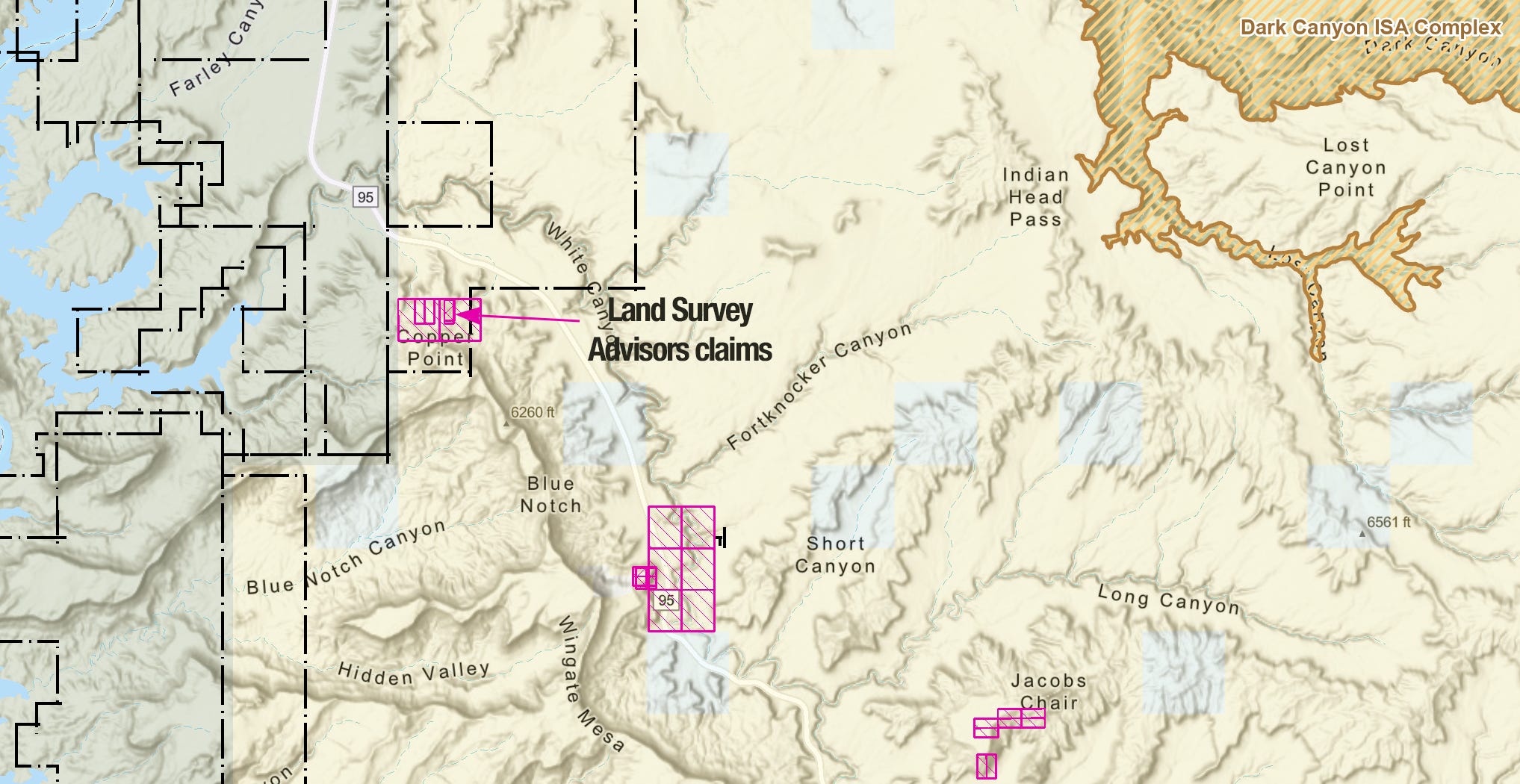
The 36 claims located (that’s the agency’s term for “staked”) by Land Survey Advisors were not only filed with the San Juan County Recorder, like Kimmerle’s claims, but they were also filed with the Bureau of Land Management and are now in the federal agency’s system and database. Of the 72 claims filed in the former national monument since Sept. 11, Land Survey Advisors are the only ones on file with the BLM.
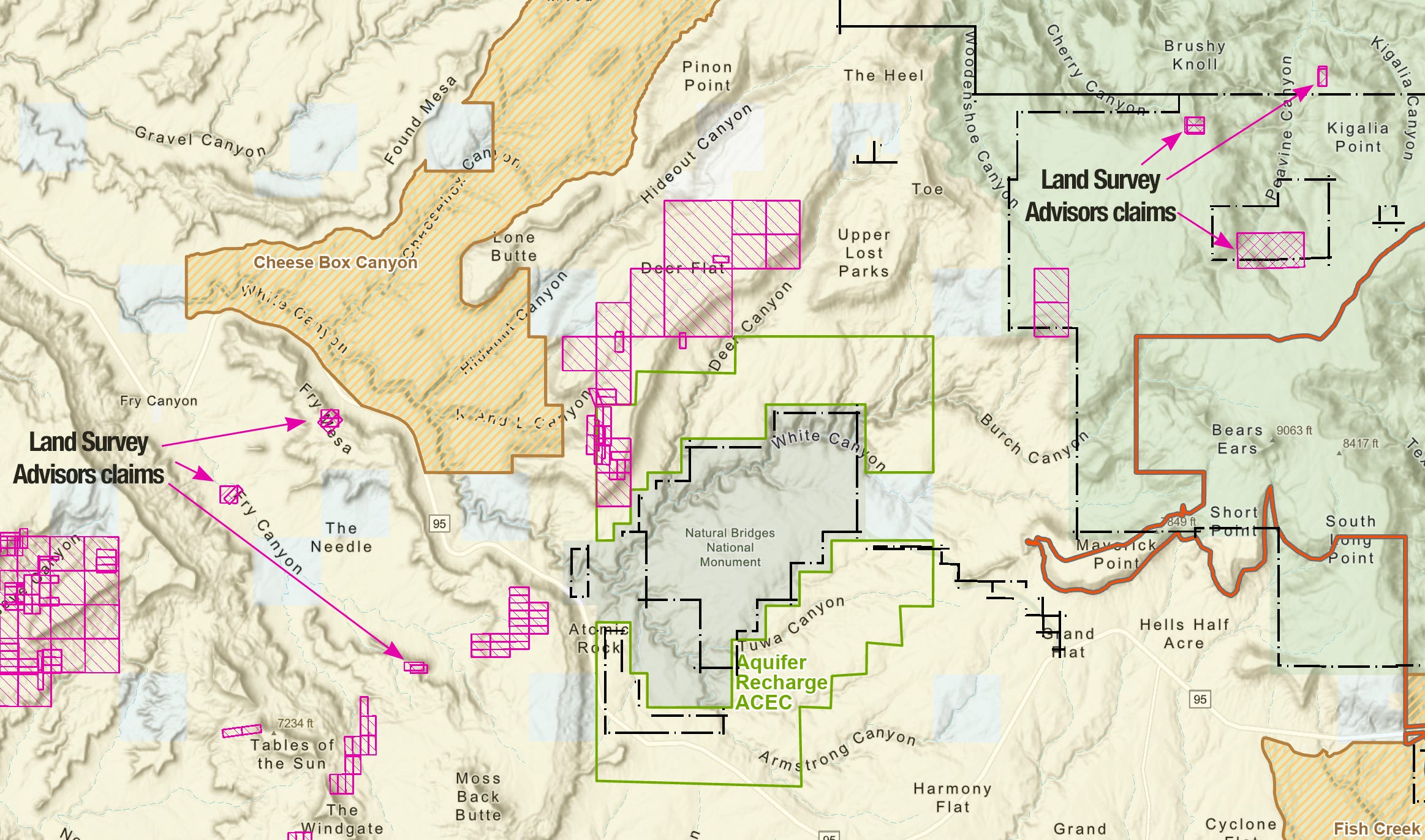
Land Survey Advisors is not a mining company, it is a consulting firm, made up of landmen, who help clients stake mineral claims, acquire mineral rights, and conduct surveys. It is run by Michael Murphy out of Heber, Utah, and was incorporated in 2023. So even though Land Survey Advisors (LSA) is listed as the claimant, it is likely that they are acting on the behalf of a client, which could be a mining firm or an individual.
Some news stories and advocates have portrayed the claimants as “hobbyists,” as opposed to serious mining firms. This may be the case: It’s absurdly easy to file a mining claim, and some folks do it just to “own” a little piece of a cherished landscape, or perhaps with thoughts of doing some gold panning when they retire. But keep in mind that it costs $200 to locate a claim and the same amount annually to keep it active. So this claimant forked out $7,200, plus the cost to hire a landman, to stake these claims. That’s an expensive hobby.
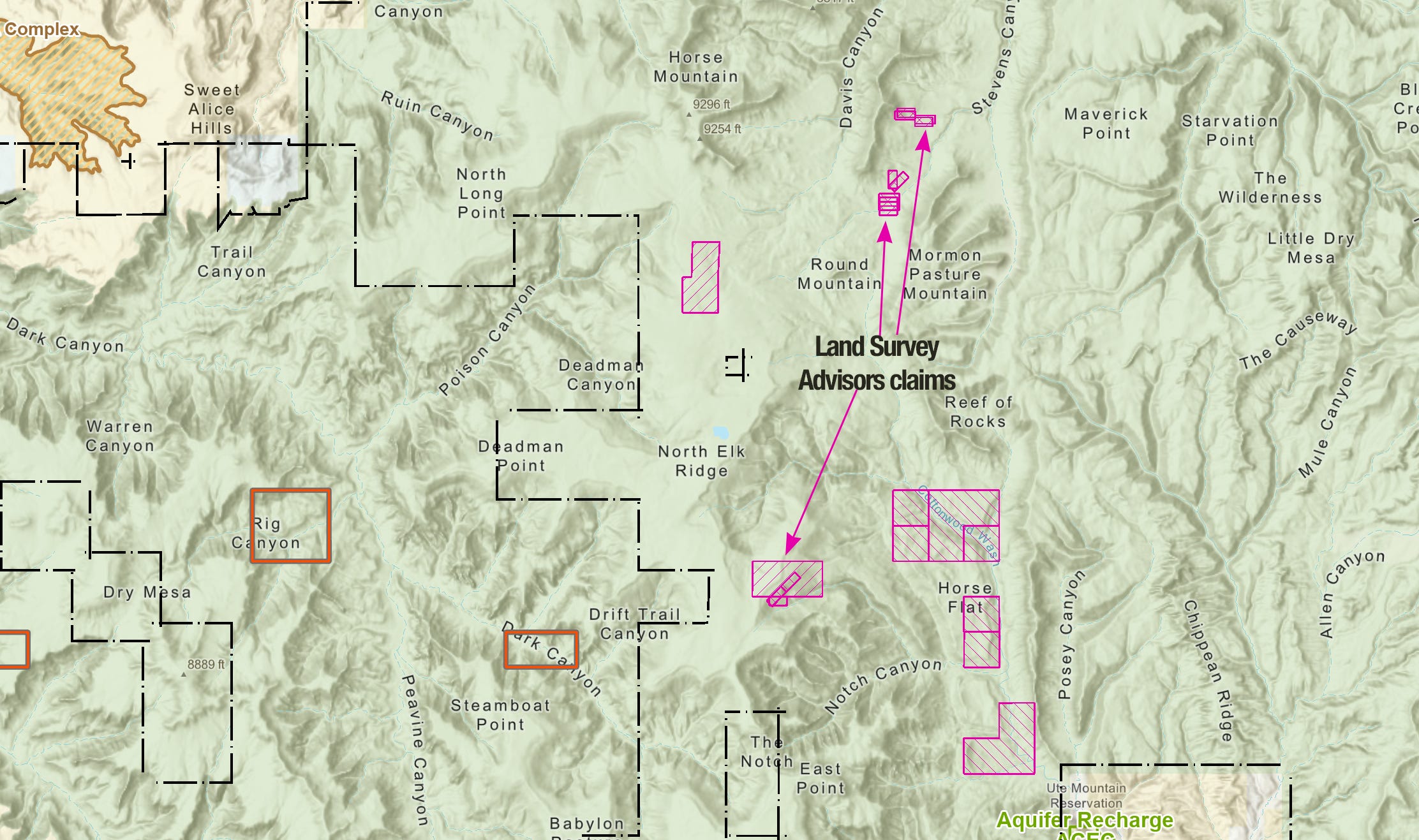
The 36 claims are in nine separate clusters, spread out from lower White Canyon, to the Mormon Pasture area, with no discernible pattern except that they are all within the boundaries of the original BENM. Land Survey Advisors has not staked any claims in San Juan County outside those boundaries.
Curiously, most of the clusters of claims include both placer and lode claims, usually overlapping each other. Lode claims are for classic hard rock mining, when you’re digging into rock and following a vein. Placer claims are typically for hydraulic or slurry mining, when you’re using water and gravity to extract minerals from gravel or sand. In southeastern Utah, nearly all uranium-targeting claims are lode. Placer claims in this area are typically for lithium or potash extraction (and historically were used for placer gold mining in creeks and riverbeds).
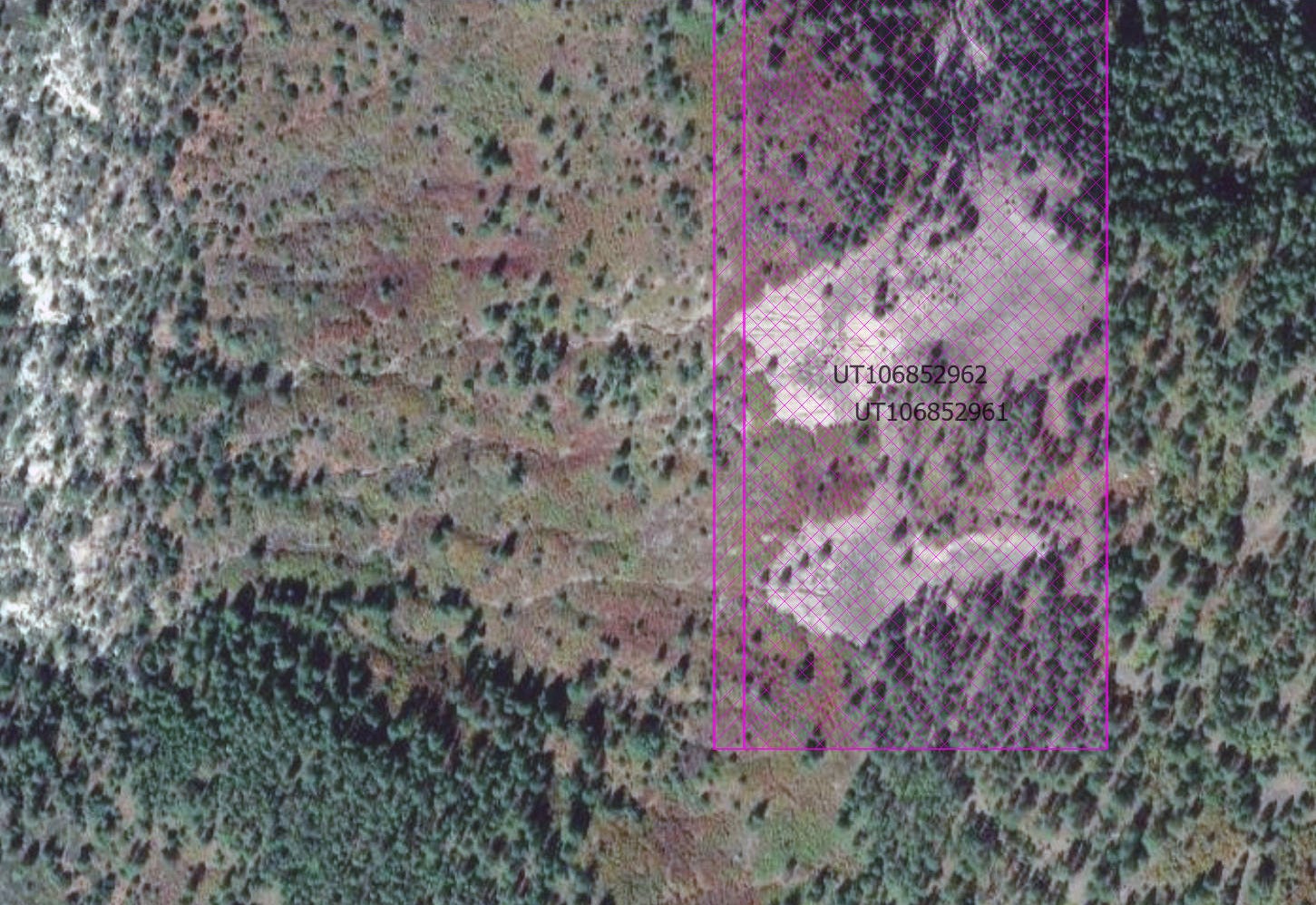
When I zoomed in on LSA’s new claims, I noticed that they all were located on previously mined or prospected areas, including on once-producing mines with associated waste rock piles. In most cases, the claims are named for the former mines: The new Ace claim sits atop the old Four Aces mine; the new PVQ claim is at the old Peavine Queen Mine1; the WDW claim is at the abandoned Widowmaker Mine, and so forth. One pair of claims, the FCL lode and placer, include on the old waste/tailings pile from the long-defunct ore upgrading mill and copper heap leaching operation. While old mines might be an obvious place to seek ore reserves, staking a claim on them risks assuming any liability for the mess left by the long-gone former owners and operators.
So what does it all mean? Maybe nothing. Maybe someone was just jumping on the mining-claim-in-a-former-national-monument bandwagon. But I have another, wildly speculative, absolutely unconfirmed hypothesis: This claimant is not a hobbyist, but an emerging mining firm that is looking to use highly pressurized water to extract minerals from abandoned mine waste piles. This would explain the placer claims and the presence of waste dumps within all of the claims. I have an email into the company that I’m hypothesizing about, and will let you all know what they say or don’t say.
Regardless, one thing is clear: the people who said a national monument designation was unnecessary because no one is interested in staking mining claims in the area anymore were wrong.
🦫 WILDLIFE WATCH 🦅
Colorado Parks & Wildlife temporarily suspends its “chronic depredation directive,” which gives the agency guidance for killing gray wolves that prey on livestock, saying it plans on evaluating “additional requests for lethal removal on a more conservative basis” to address concerns the wolf population may not grow this biological year. The CPW has killed five wolves this year under the directive. (CPW news release)
📸 PARTING SHOT 🎞️
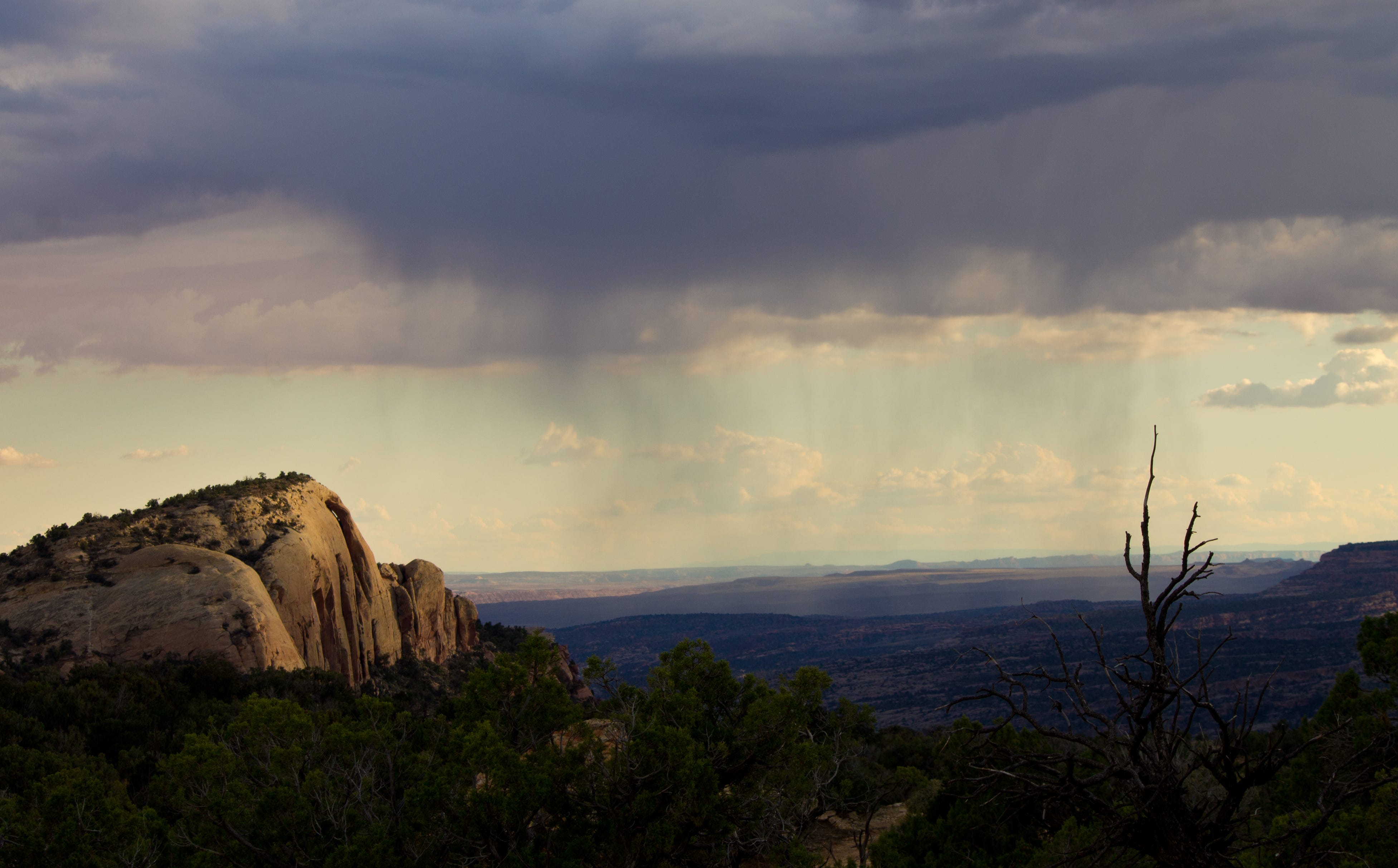
The Peavine Queen Mine was first staked in 1953 by Howard Kimmerle, who first produced ore from it in 1961. Kimmerle
Article 25! PLEASE. But of course that only gives us JD. Not a good option. Just less terrible. I guess that’s where we’ve gotten to.
"NPR is reporting Valar Atomics is looking to build..." We'll see. I guess their reactors have put out some bit of heat for some bit of time. Not clear. But indeed it's technically possible. What it costs to build and run for years is another matter.
These are supposedly air-cooled, and using HTGR (high temp gas cooled), which is the helium cycle tried and failed at Fort St. Vrain CO in the 70s-80s. There is a nifty sarcophagus on the site, still storing/cooling the decaying waste/fuel, I guess forever. They also reqire this special "TRISO" fuel with "HALEU" uranium, and so on. https://coloradosun.com/2026/05/27/colorado-nuclear-power-waste-33000-pounds/
"Project Beehive," gotta love it. Valar can probably build and run, at least for a few days/years, some of these things. If someone is willing to give them $50/Watt to build 'em and buy juice for $1.00/kWh+, sure, whatever. The German and Irish guys on the "Redefining Energy" pod called the US SMR startups, "Powerpoint and lobbying companies." I think "pump and dump," may have crossed their lips too.
Oh yeah. Between the SMR powerplants' air-cooling/heat rejection and the data centers' heat rejection, that would be pushing getting near 100 billion Btus/hr into the valley. Maybe those busy Utah bees can start growing bananas.