🌵 Public Lands 🌲
Sometimes it feels like the deeper the Trump administration sinks into various quagmires of its own making, the more it lashes out at politically popular protections for public lands. Each passing day brings a new assault on the environment, the climate, and, well, humanity.
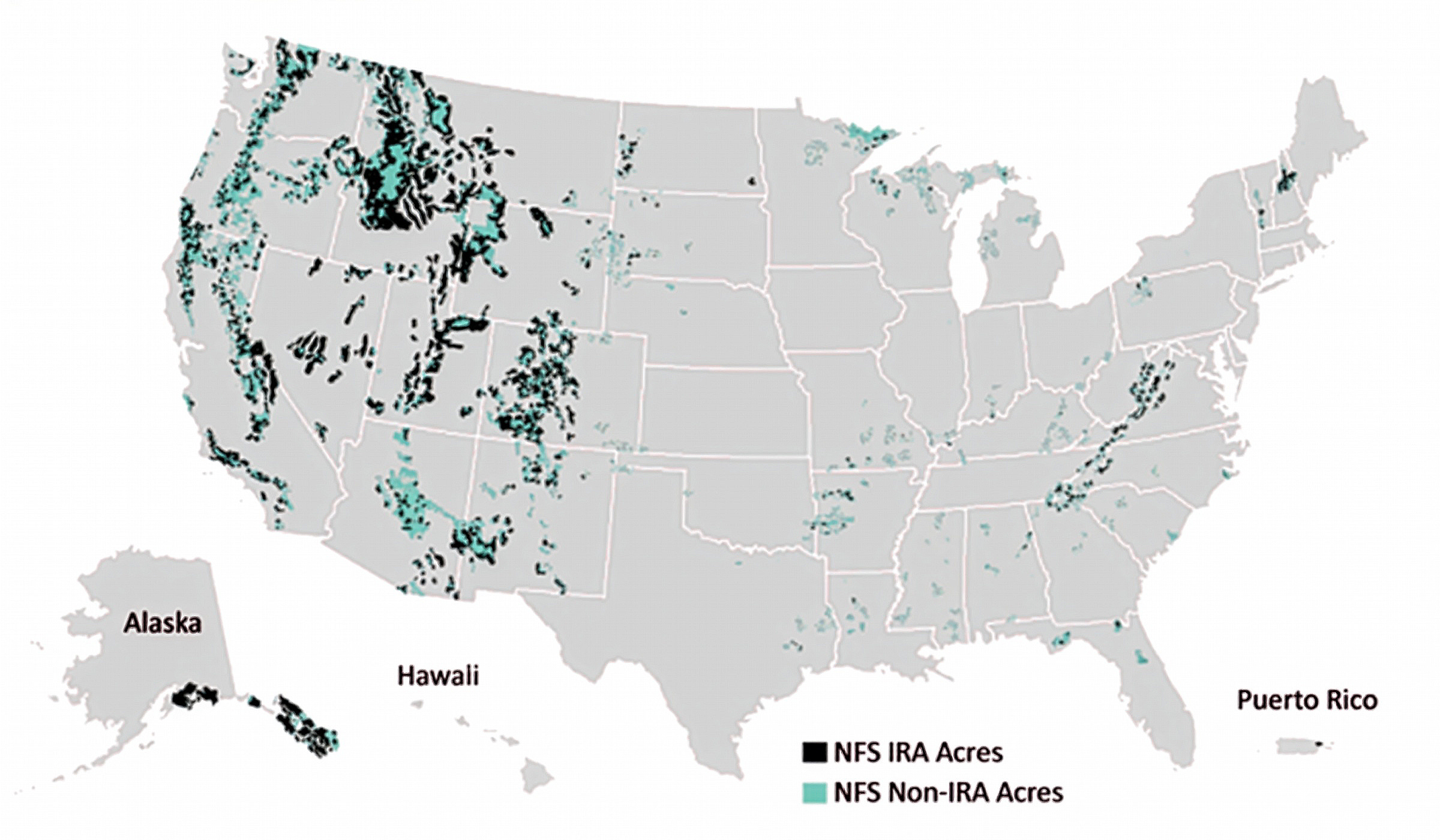
This time, the U.S. Department of Agriculture has moved (again) to rescind the Roadless Rule, which protects some 45 million acres of U.S. Forest Service land from new roadbuilding and logging. Agriculture Secretary Brooke Rollins predictably and baselessly claimed that the rule has hampered forest management and fire-fighting capabilities. This is untrue.
When the Bill Clinton administration implemented the Roadless Rule in 2001, it culminated a multi-decade effort to identify and set aside forest lands that hadn’t been disturbed by roads for possible designation as wilderness. At the time, management of inventoried roadless areas was carried out by individual Forest Service offices. The Roadless Rule put a nationwide prohibition on timber harvesting, road construction, and road reconstruction in inventoried roadless areas, with a number of exceptions. The intent was not only to conserve these relatively undisturbed areas, but also to save money: By 2001, the Forest Service’s existing road network was over 386,000 miles long, with an estimated $8.4 billion in deferred maintenance and reconstruction. Building more roads would just exacerbate that deficit.
While inventoried roadless areas have many of the same characteristics as wilderness areas, the Roadless Rule stops far short of offering wilderness-level protections, and expressly allows for motorized uses of existing roads, off-highway motorized use in specified areas, livestock grazing, and energy and mineral development.
So it’s hard to take Rollins seriously when she says the rule is hampering access for fire prevention and fighting efforts. In fact, the rule clearly allows for road-building to fight fires. It also allows for cutting, removing, and selling “generally small diameter timber” for various reasons, including “reducing the likelihood of uncharacteristic wildfire.”
In a Senate hearing this spring concerning Sen. Mike Lee’s (MAGA-UT) amendment aiming to repeal the Roadless rule, Sen. Alex Padilla, D-California, pointed out that 240,000 acres of inventoried roadless areas in his state alone had been treated for wildfire hazard mitigation treatment, showing the dubiousness of Lee’s (and now Rollins’) claims. And the Trump administration, for better or worse, has lagged on forest thinning: A Center for Western Priorities analysis found the Forest Service treated 35% less acreage in 2025 than it did under Biden in 2024. That suggests that vegetation management is being stifled not by regulations, but by a lack of resources — the Trump administration has slashed Forest Service staffing and budgets considerably since taking office.
In fact, the evidence suggests that the Roadless Rule has actually helped deter wildfires. A 2007 Pacific Biodiversity Institute study found that 88% of the nation’s wildfires are sparked by humans, and 95% of human-ignited blazes occur within a half-mile from a road. Roads act like syringes, injecting humanity — along with their errant cigarette butts, untended campfires or grills, sparks from machinery or hot catalytic converters — further into the backcountry than they would go by trail.
The Roadless Rule originally applied to almost 60 million acres, but in the years following its implementation, it was bandied about by presidential administrations and the courts. In 2005, the George W. Bush White House revoked the rule and replaced it with the alternate roadless rule, which allowed states to petition the Forest Service to create their own standards; Colorado and Idaho chose to do so. When the Tenth Circuit court later reinstated the 2001 rule, the 2005 rule was nullified, but Idaho and Colorado’s rules remained in effect. As a result the administration’s proposed repeal would not affect Colorado and Idaho’s plans.
The rule and its moderate protections for habitat, wildlife, forests, and watersheds have proven deeply popular across a wide demographic swath of the public. Last June, Rollins moved to repeal the Roadless Rule for the first time, resulting in intense backlash not only from environmentalists, but also from the more conservative-leaning hook and bullet crowd and general public, which barraged the department with comments supporting the rule. It’s worth noting that even Project 2025, the ultra-right-wing “blueprint” for the Trump administration, called for repealing only the portion of the Roadless Rule that pertained to Alaska’s Tongass National Forest. This spring, when Lee tacked a Roadless Rule-repealing amendment onto bipartisan wildfire legislation, he annihilated the cross-aisle support for the larger bill, effectively ruining its chances of passing.
Now the public has a chance to weigh in once again. The USDA is accepting comments until Sept. 21, so go here and say your piece.
⛈️ Wacky Weather Watch⚡️
The summer of nightmare heat continues as yet another heat dome settles over parts of the West. Parts of southern California, Las Vegas, Phoenix, and most areas in-between are under heat watches or extreme heat warnings for the next several days. There is also a chance of thunderstorms, which may bring a bit of relief, but if the summer so far is any indication, they’re just as likely to bring catastrophic flash flooding, damaging winds, fire-starting lightning, and huge dust storms, a.k.a. haboobs.
🛢️ Hydrocarbon Hoedown 📈
I know that many of you have been hating on data centers lately, especially the ones used to process all that AI slop so that billionaires can become trillionaires (through some process that defies all logic). But please, I beg you, save some of your disdain for the oil and gas companies, too! After all, they are using the data center energy-use scare to justify drilling for natural gas to power the damned things. Not only that, but every day that our president screws up negotiations to end his war on Iran is another day that the Strait of Hormuz remains closed to oil tankers, another day of rising oil prices, and another day of record-high profits for petro-corporations, their executives, and their shareholders.
For example: ExxonMobil reported adjusted earnings of $23.5 billion for the first half of 2026; Chevron’s adjusted earnings were $14.7 billion; Valero raked in a $5.4 billion profit … you get the picture.
🗺️ Messing with Maps 🧭
If you want to know what’s happening on the U.S.-Mexico border, you go to the Border Chronicle. And now, if you want to know what’s happening with Trump’s border wall, which is just a monumental piece of environmental disaster, you can go to the Border Chronicle’s new Wall Watch, the publication’s community-reported interactive map tracking construction of the barrier.
Say you want to know what sort of wall is being built in the Big Bend region? Or what sort of structure already exists near Lochiel, Arizona, where border wall contractors have destroyed old-growth cottonwood trees and are threatening the remainder of the grove? You can toggle the map to the satellite view, zoom in on the place of interest, and click on the border and get a pop-up informing you of what work is taking place, who the contractor is, and the expected cost.
📝 Hoback Report
A guest post by Bob Frodeman
Could the West be the place where America finally gives up its belief in endless growth? Probably not, but you can imagine different triggers. For instance, drought, a shrinking snowpack, and a parched Colorado River could halt growth in Phoenix. Or overwhelming numbers of tourists in Yellowstone or Arches National Park could force the establishment of timed entry (which Arches had, until the Trump Administration decreed that this was oppressing the right of people to sit in traffic). Or climate change-driven wildfires threatening entire cities (see Spokane) could put a crimp in sprawl.
But in my neck of the woods traffic may be the trigger.
Traffic is getting absurd in Jackson. The chaos used to be limited to the summer months; now it’s pretty much year-round. Climate change has extended the hiking season on both ends: this May a new record was set for visitation in Grand Teton National Park. And while the valley floor was denuded of snow last winter (a brown Christmas – in Jackson?!), the snow fell higher up, giving us some of the best skiing in the West during a generally horrific snow year.
Policy, history, and geography all contribute to the situation. First, it’s just plain hard to get here: there are only three roads into the valley. The spectacular mountains and forests mean that more than 97% of Teton County is publicly owned – Teton and Yellowstone National Parks, Bridger-Teton National Forest, and the National Elk Refuge. The Elk Refuge offers a striking visual: created in 1912, when Jackson had a population of a few hundred, the Refuge now hems town in on the north side, preserving land that would otherwise be jammed with hundreds of homes. Another 1% of the land is covered by conservation easements.
Caught between public land, various bumps and ridges, and the Snake River, there’s only one artery in town, called Highway 89 when it runs north-south, and Broadway when it turns east-west. Pressed up against Saddle Butte, Broadway already is five lanes and would be hell to expand. Highway 22, a two-lane spur that runs up and over Teton Pass that WYDOT wants to expand to five lanes, is already a traffic nightmare morning and night. And all the other roads in town are suburban streets lined with homes.
Nonetheless, the Town of Jackson currently has 825,000 square feet of additional development in the works. This includes the 245,000 (down from the original 400,000) square-foot Mogul development, a humungous hotel and condo complex planned for the northern entrance to Jackson (traffic already backs up a mile or two every afternoon on that road coming into town). The Jackson Town Council has approved the sketch plan for the complex. The other 600,000 square feet are scattered across the downtown area. On top of this, on the southern edge of town – on what will essentially become an extension of town – a new subdivision called Northern South Park has begun construction. Situated on ranch land, Teton County has approved a neighborhood of 1,437 homes, which would add 23% to the existing housing stock of Jackson.
What’s bizarre is the lack of self-consciousness about what’s happening. A few weeks ago I wrote a town council member asking for the list of ongoing projects. There isn’t one. I generated the 825,000 number by calling up the town clerk and asking her to go through the various applications. We added it up together.
Given all this, plus the 4 million annual tourists, it’s hard to see how Jackson will avoid utter and complete gridlock. But wait—it gets better, by which I mean worse. Because land is so scarce in Teton County, and home prices so high (median price $2.5 million, eight times the Wyoming average), workers drive in from Star Valley (30 miles to the south) and Teton Valley, Idaho (30 miles to the west). Both areas are primed for more growth: the population of Teton Valley doubled from 2000 to 2020 (to 10,000) and is projected to be the fastest growing part of Idaho. And this is to say nothing about the dangers of traveling Teton Pass – there was a landslide there two summer ago that diverted traffic for three weeks, and this summer a runaway truck killed two people.
Most of these people, as well as the commuters from Star Valley, come to Jackson for work and play. It adds up to a traffic apocalypse. Alas, Jackson and Teton County has no control over these outlying areas. The obvious move is to create a regional authority to work on the problem. But no such authority exists, and the political culture of these areas is quite different from Jackson, which makes conversations hard.
In Jackson you hear a lot of talk about managing growth. What you don’t hear is talk about the necessity of stopping growth. But this is the conversation that Jackson needs to have – as well as many other places across the West that are bumping up against limits.


Yeah ...
When I lived in Paonia(!), a friend made a decent living as a logger. The actual trees had nothing to do with it - he gloated to me that the Forest Service paid him money to cut roads and that was his profit. This revelation was totally bizarre; few know that the traditional industries are massively subsidized by taxpayers. Recreation generates X5, X10, maybe X20 the number of jobs and local revenue compared with logging and ranching. That revenue stream is supported by leaving the trees and rivers alone, but somehow the old school has been painfully slow to adopt this unequivocal formula.
When in the Course of human events, it becomes necessary for people to dissolve the political bands which have connected them with another, and to assume among the powers of the earth, the separate and equal station to which the Laws of Nature and of Nature's Good entitle them, a decent respect to the opinions of mankind requires that they should declare the causes which impel them to the separation.
We hold these truths to be self-evident, that all humans are created equal, that they are endowed with certain unalienable Rights, that among these are Life, Liberty and the pursuit of Happiness.--That to secure these rights, Governments are instituted among Men, deriving their just powers from the consent of the governed, --That whenever any Form of Government becomes destructive of these ends, it is the Right of the People to alter or to abolish it, and to institute new Government, laying its foundation on such principles and organizing its powers in such form, as to them shall seem most likely to effect their Safety and Happiness. Prudence, indeed, will dictate that Governments long established should not be changed for light and transient causes; and accordingly all experience hath shewn, that mankind are more disposed to suffer, while evils are sufferable, than to right themselves by abolishing the forms to which they are accustomed.
The Biggish are coming! The Biggish are coming! Get your rifles!