🦫 WILDLIFE WATCH 🦅
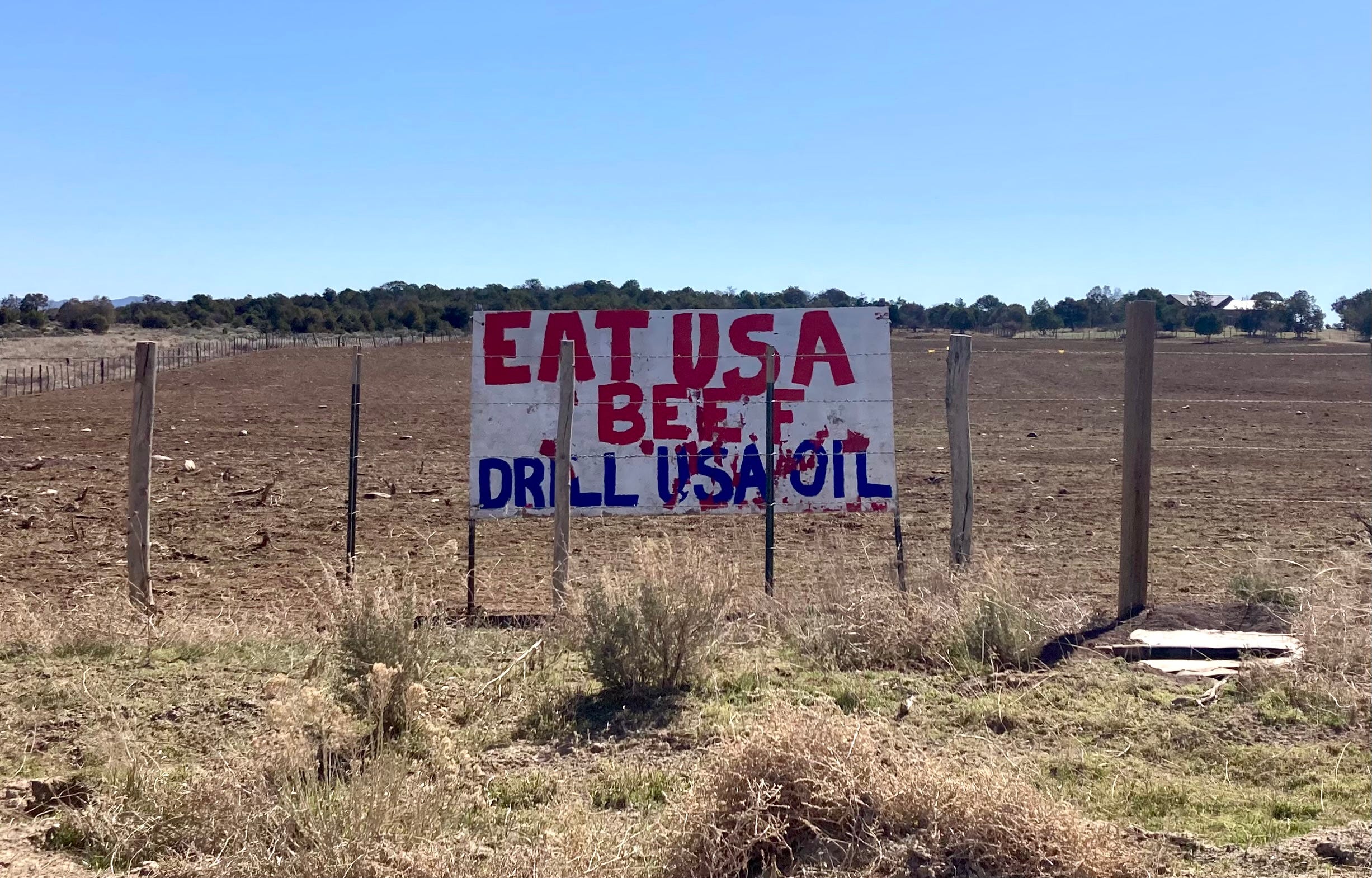
Just days after President Donald Trump angered U.S. ranchers by waiving tariffs on 300,000 metric tons of foreign beef (and whatever other meat-adjacent-material may pass as beef), he threw the livestock industry a bone by ordering a “review” of federal Endangered Species Act protections for gray and Mexican wolves. The order also instructs the Interior Department to push states into removing any state-specific protections and to “revise their standards for lethal takings of gray wolves and Mexican wolves to assist ranchers in combating predation.”
In other words, Trump wants to revive the late 19th and early 20th century campaign to exterminate wild predators to benefit ranchers. Will this please a handful of public lands livestock operators who are ideologically inclined to hate wolves, whether they affect their operations or not? Sure. Will it save the American rancher, or even offset the influx of foreign beef? Nope.
Wolves do kill cattle if they are not adequately protected (and the rancher is compensated for the lost livestock), and they can have other impacts on ranching operations in wild areas. But study after study has shown that other factors — from weather and climate, to sickness and disease — account for a far greater share of cattle and calf mortalities.
This is the administration’s latest ploy in its quest to boost the number of cattle on public lands. It is also peddling vacated grazing allotments and easing the already decidedly lax regulations on grazing.
Federal staffing rosters show the U.S. Fish and Wildlife Service has lost 36% of its staff under the Trump administration, dripping from 9,957 staffers to 6,333 between 2024 and 2026, likely exacerbating a backlog of Endangered Species Act listing decisions. (news release)
🐟 COLORADO RIVER CHRONICLES 💧

The irrigation canals, laterals, and ditches are going dry in the Colorado River’s Upper Basin weeks before the growing season comes to an end, forcing farmers to rely on September rains or their own storage to get their crops to harvest time. It goes to show that even without mandatory cuts, many Upper Basin water users experience water shortages during dry years.
The biggest and latest user to get cut off by low river flows was the Grand Valley Water Users Association, which began drawing down its Government Highline Canal as “the river flows drop to undeliverable levels.” Flows in that canal fell from almost 1,500 cfs at the end of August to about 725 cfs early this week. The more senior Orchard Mesa Irrigation District and Grand Valley Irrigation Company continued to pull water from the river and deliver it to irrigators.
In the North Fork Valley, all but the most senior ditches were shut off weeks ago, after Paonia Reservoir hit dead pool. And on the Dolores River, even the most senior water rights holders — the Montezuma Valley Irrigation District — lost their water at the beginning of this month. Usually it holds out for at least another couple of weeks. (Other water users received dramatically curtailed amounts throughout the irrigating season).
In the Grand Valley, the canal’s loss was the river’s gain: The Colorado River near Palisade, after running as low as 42 cfs this summer, bounced back to around 300 cfs at the end of August. A corresponding increase in flow can be seen at the USGS gage1 near Cisco. This little boost, combined with a few intense, but patchy storms, and a slight increase in releases from Flaming Gorge Reservoir, have brought up inflows into Lake Powell, somewhat slowing the drop in surface levels.
The Dolores River, on the other hand, remains virtually dry downstream of McPhee Dam, and McPhee Reservoir’s surface level is currently about 12 feet lower than it was a year ago.
A tale of water inequality in the West
I wrote the essay below—about my parents’ farm’s ditch in the North Fork Valley of Western Colorado—in 2018, which was one of the region’s driest years on record. The essay is every bit as pertinent today, an equally dry time for most of the Western Slope, even if some details have changed: My sister owns the farm now—along with the robust water rights—…
The Central Arizona Project’s board of directors authorizes its attorneys to take legal action “if necessary” to protect its allotment of Colorado River against the Bureau of Reclamation’s plans for operating the river’s infrastructure in the coming decade. The CAP stands to lose the most water under a shortage, as Arizona agreed to junior water rights in exchange for federal funding for the vast plumbing project that delivers river water to the central and southern parts of the state. Nevada already sued the federal government over potential cuts to its share of water. (Arizona Republic)
Western Colorado anglers and boaters call on the Bureau of Reclamation to increase water releases from Blue Mesa, Morrow Point, and Crystal Reservoirs to preserve streamflows in the Gunnison River in the Black Canyon, the Gunnison Gorge, and further downstream, saying the decision to reduce releases to protect reservoir levels has “exerted a toll on a vital and cherished natural resource.” (Aspen Journalism)
🤖 DATA CENTER WATCH 👾
The Big Data Center Buildup drives up electricity demand in Wyoming and spurs a wave of proposed gas plants, some of which would serve the grid and others dedicated to powering server farm facilities. (WyoFile)
⛏️ MINING MONITOR ⛏️
The Southern Ute Indian Tribe says it will pull out all of the stops to block potential mining projects in the La Plata Mountains in southwestern Colorado, adding to the list of entities opposing Metallic Minerals’ exploratory drilling project on the western side of the range. (Durango Herald)
New Mexico Land Commissioner Stephanie Garcia Richard puts state trust lands off-limits to new uranium mining leases, and orders her office to instead focus on cleaning up the more than 1,000 former uranium mining-related sites in the state. The order does not affect private or federal lands. (news release)
Anfield Energy looks to raise at least $50 million to finance its plan to refurbish and reopen the Shootaring uranium mill — which has been idle since 1982 — near Ticaboo, Utah. Anfield is the firm behind the Velvet-Wood uranium mine in the Lisbon Valley and has designs on mining near Slick Rock, Colorado. (Northern Miner)
🌵 PUBLIC LANDS 🌲
A federal judge temporarily blocks the Trump administration’s effort to evict bison from public lands in Montana, finding that the Bureau of Land Management’s decision to kick the animals off American Prairie-held grazing leases was likely “arbitrary, capricious, an abuse of discretion, and otherwise not in accordance with the law.” (Public Domain)
The U.S. Department of Agriculture releases its final Forest Service reorganization plan, which includes moving the headquarters to Salt Lake City and shuttering 23 facilities nationwide, including four in California, one in New Mexico, and one in Oregon, with the remainder being in non-Western states. The USDA says “less than 200” of the agency’s 30,000 employees are expected to need to relocate, mostly from Washington, D.C. to Fort Collins, Salt Lake City, or a newly established center. (news release, OPB)
The Center for Western Priorities fact-checks Interior Secretary Doug Burgum’s numerous erroneous statements about the administration’s dramatic reduction of Grand Staircase-Escalante and Bears Ears National Monuments, finding that on this topic (and others) the cabinet member is a serial liar. (Westwise)
🏠 RANDOM REAL ESTATE ROOM 🤑
Anita Verma-Lallian, a real estate investor who made her name buying and selling multi-million-dollar Phoenix-area properties for data centers, unveils a plan for a massive development in Tonopah, Arizona. Tentative plans for the $6 billion to $10 billion development include a movie studio, amusement park, hotels, retail, and a data center complex. The property is adjacent to one where Bill Gates’ investment firm is planning a “futuristic smart city.” (Phoenix Business Journal via KTAR)
🛻 TRANSPORTATION 🚂
The Utah Department of Transportation completes the $152 million Energy Corridor highway improvement project on State Routes 162 and 262 in San Juan County. The routes pass through the Aneth Oil Field and could potentially be used for uranium ore haul trucks traveling from New Mexico mines to the White Mesa Mill near Blanding. (ABC4)
🤯 ANNALS OF INANITY 🤡
When will it stop!?! Amid a flurry of inane, bizarre, and cognitively-impaired social media posts, President Donald Trump on Sunday suggested New Mexico’s name should be changed to “New America.” (CNN)
📈 TODAY’s DATAVIZ 📊
Are coal and electricity consumption getting back together? For the latter half of the 20th century, U.S. coal consumption climbed in tandem with electricity demand: As Americans used more power, more coal was burned to generate that power, and vice versa. In 2008, electricity demand plummeted due to the financial crisis, dragging coal consumption down with it.
While electricity demand rebounded along with the economy, and then plateaued, coal-burning continued dropping precipitously; the two phenomena had been decoupled from one another. But over the last three years electricity demand has shot back up, in large part due to data centers’ guzzling up a lot of power, but also because of electrification of transportation and buildings, and an increasing need for air-conditioning to fend off rising temperatures. And last year the electric power sector’s coal consumption shot back up as well. Is the decoupling being undone? Or is this just a minor blip? Only time will tell.
📸 PARTING SHOT 🎞️
Yes, I use the archaic “gage” instead of “gauge” when referring to USGS streamflow monitors, not just because I’m archaic, but because that’s what the USGS does.


