The Big Data Center Buildup comes for ... public lands?
🤖 Data Center Watch 👾 🌵 Public Lands 🌲
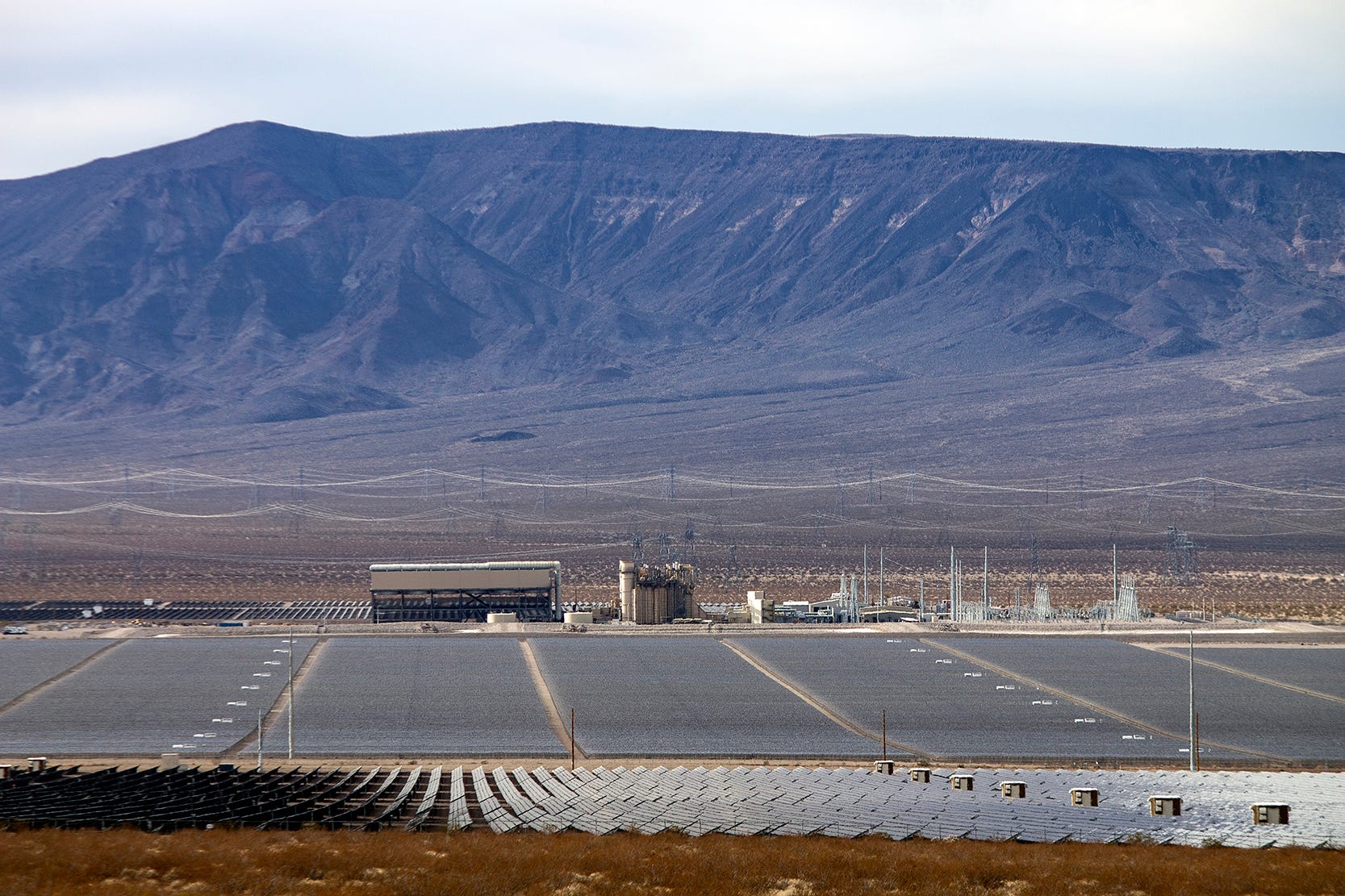
First they came for your electricity, then they came for your water, then they came for your brains, and now the AI data centers are coming for your public lands.
Okay, that’s a bit dramatic, but it is true, at least in one case. This summer, the Bureau of Land Management quietly approved a Texas natural gas and power market-focused hedge fund’s proposal to build a large data center on public land outside Boulder City, Nevada. The agency did not seek public input on the decision, nor did it subject the project to an environmental review, drawing pushback and criticism from Boulder City residents and officials as well as state and federal lawmakers.
This is the only known incidence of the BLM approving a data center on public land. But it may not be for long. Cities, towns, and counties are growing increasingly wary of the facilities, imposing stricter regulations and even outright bans that could push developers to seek cheaper, friendlier places to build. Under the Trump administration, which is looking to win the AI “war,” federal lands may be the cheapest and most regulation-free place to put a server farm. Both the Biden and Trump administrations invited data center developers to look to Department of Energy lands, but there hasn’t been an open call to do the same with BLM lands.
The Boulder City saga started years ago, when Skylar Energy Resources, a subsidiary of Skylar Capital Management, proposed the 19-megawatt Townsite Solar 2 facility on 76 acres of BLM land four miles southwest of Boulder City, the town created in the 1920s to house Hoover Dam construction workers. The project would have been adjacent to the existing Townsite solar facility, which was developed by Skylar but is now owned by Arevon Energy. In 2023 the BLM approved the project, though construction has yet to begin.
Late last year, Skylar — operating as Townsite Solar 2 (TS2) — proposed a 170 MW, “high-density,” AI data center campus on 88.5 acres of land owned by Boulder City that is also near the existing solar facilities. TS2 had previously planned to build a solar-plus-battery-storage installation on this parcel. That proposal was met with strong opposition from Boulder City residents, who worried about the facility’s outsized energy use and its potential water consumption. Following the backlash, developers said they would use a hybrid closed-loop “ultra-low or zero liquid discharge” cooling system, which would use treated effluent rather than potable water (also increasing energy consumption). The lease would generate approximately $1.47 million annually for the city, plus property taxes and permit fees.
At the same time that it applied to the city, however, Skylar also went to the BLM, requesting an amendment to its solar facility right-of-way so that it could build a data center on the public land, instead. In June the BLM granted its approval, sans environmental review or public input, and withdrew its application for the city-owned property.
I’ve written here frequently about the Big Data Center Buildup, as tech firms build bigger and bigger — and more and more water- and energy-intensive — server farms in Phoenix, Tucson, southeastern New Mexico, on the shores of the Great Salt Lake, outside Cheyenne, and even in Page, Arizona, and Alaska. Perhaps inevitably, the Big Buildup is now confronting an even bigger backlash.
People from across the political and demographic spectrum are rising up and opposing these facilities for a variety of reasons. All data centers use a lot of energy, with the newer “hyperscale” facilities gobbling up even more power. Some are purchasing solar, wind, or geothermal energy to power the facilities, but even many of the greenest-leaning ones rely on dirty natural gas generators for backup. Meanwhile, the natural gas and coal industries are licking their chops at the prospect of rising demand for fossil fuel-generated power, since renewables alone can’t keep up with the skyrocketing rise in demand. Also, data centers can exacerbate urban heat islands, which sucks if you happen to live next door to one.
Data centers also use quite a bit of water, but the amount varies depending on what type of cooling system is used. Closed-loop systems need to be filled up only occasionally, and are less water-intensive, while evaporative systems use far more water. The catch is that using less water for cooling often means using more energy for the same; if the energy comes from a thermal plant fired by gas or coal, power-generation can also use a lot of water. Still, the volumes pale compared to some other uses, most notably agriculture.
🥵 Aridification Watch 🐫
When a region suffers through a hot and dry winter a quarter century into the worst megadrought to hit the area in 1,200 years, many of us will intuitively link it to climate change and global warming. But intuition is not science, and there may be other plausible explanations.

But now the science has spoken — in the form of a peer-reviewed paper* out of the Colorado School of Mines — and it has determined that this year’s snow drought was almost certainly the result of human-caused climate change.
The authors used a probabilistic approach to assessing climate change’s role in the West’s 2026 snow drought. And they found that across the West as a whole, the 2026 snow drought was about four times more likely to occur in the current climate than during the 1850-1900 comparison period. In the Upper Colorado River Basin, where the drought was most severe, this year’s dire conditions were about 14 times more likely in our current climate than in pre-industrial times, “with the uncertainty range reaching into conditions so extreme that probabilities are difficult to estimate with confidence.”
This isn’t just confirmation of what may seem obvious to long-time observers. More critically, it indicates that this year’s lack of snow is no longer just a once in a century event, and that if the climate continues to heat up, these dry spells may become more common.
*A.M. Marshall,M. Cowherd,S. Rahimi, & Y. Ye, The 2026 western US snow drought was about four times more likely due to climate change, Proc. Natl. Acad. Sci. U.S.A. 123 (30) e2612961123, https://doi.org/10.1073/pnas.2612961123 (2026).
🛢️ Hydrocarbon Hoedown 📈
The Navajo Methane Coalition has released an animated video explaining how methane emissions from oil and gas facilities can harm Diné communities, and detailing ways to tackle the problem. It’s an especially important issue now, as the Trump administration rolls back methane waste prevention rules. Check it out:
⛈️ Wacky Weather Watch⚡️
The monsoon is here and it is causing some serious mayhem in some places, especially in western New Mexico and in Arizona.
The Gallup area received at least two inches of rain in one day, causing the Rio Puerco to go from dry to raging river in a matter of hours. And it wasn’t just the Puerco. Several Gallup streets, including Route 66, turned into virtual rivers that were more than tire-deep in some places, causing hazards for motorists. Zuni Pueblo was also was inundated with water.
The Rio Puerco does not seem to have a working streamflow gage, so I checked out the Little Colorado River near Winslow, downstream from its confluence with the Puerco, and it got really, really big.


Of course.