On Arches, timed-entry, and crowds
šµ Public Lands š²

Earlier this year, the Trump administration cancelled the timed-entry reservation system for Arches National Park. The move was inspired in part by complaints from some Moab and Grand County elected officials and business owners who claimed the system had hampered overall visitation to the area, thereby hurting businessesā bottom lines and diminishing tax revenues.
A new analysis is throwing that reasoning into doubt. And it raises the question of whether visitation to Arches is fueling Moabās tourism industry, or the community and its amenities are drawing folks to the national park, or something in between. But it also should spur a conversation on who or what a national park should be serving.
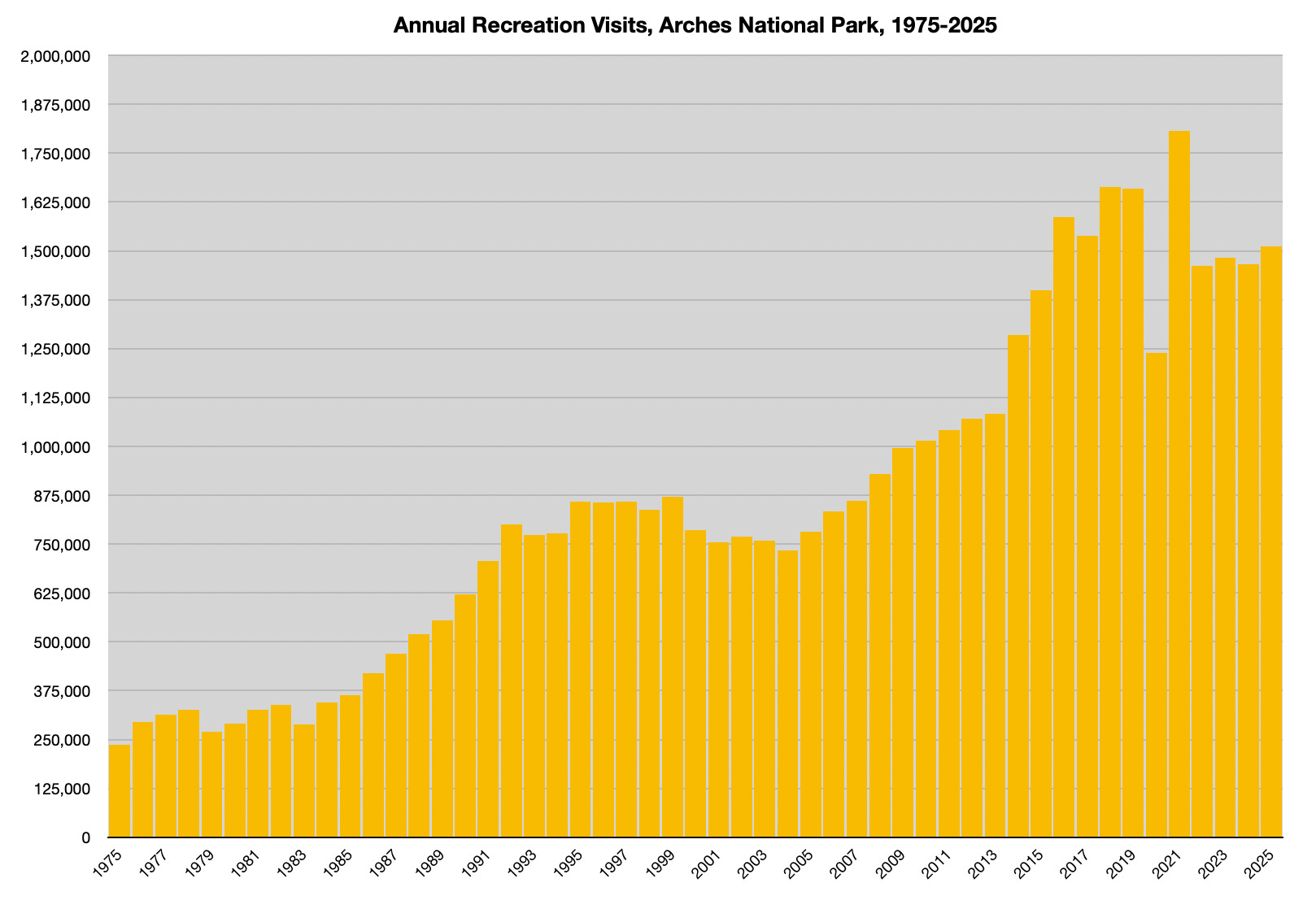
During the Cold War, when Moab was primarily a uranium mining and milling town, with a bit of sightseeing, jeep-riding, and river-floating tourism on the side, Arches National Park was relatively quiet, with an average annual visitation of about 250,000 between 1965 and 1986. Winters could be downright empty: During January 1979, the first year monthly counts were recorded, only 2,970 people ā or less than 100 per day on average ā entered the park.
Domestic uranium production peaked in 1980. In 1984, the massive Atlas uranium mill just down the road from the entrance to Arches National Park shut down, and the industry effectively perished, creating an economic vacuum into which outdoor recreation-oriented tourism could slide. The Groff brothers opened Rim Cyclery in 1983, began renting mountain bikes a year later, and hosted the first Canyonlands Fat Tire Festival and Moab Stage Race (for road bikes) in 1986. The latter included a race from Moab, into Arches National Park, and back, something that would not fly nowadays.
Arches annual visitation also exceeded the 400,000 mark for the first time that year and climbed swiftly thereafter. While itās difficult to suss out the cause and effect here, it is pretty clear that Arches visitation did not drive Moabās transformation into a mountain bike and outdoor recreation mecca. If anything, it was the other way around. Arches visitation plateaued in the early 2000s, but Moab and Grand Countyās amenities and tourism related sectors ā retail trade, real estate, and services ā continued to add jobs and in-migration remained strong.

Arches visitation and Moabās might as an amenities economy continued to mirror each other. Utahās Mighty Five marketing campaign helped drive Arches visits from less than 1 million in 2009 to 1.7 million in 2018. This led to packed parking lots, trail traffic jams, interminable waits at the entrance gates as lines of cars spilled out onto the highway for a mile or more, and dozens of instances in which rangers had to turn visitors away because the park simply couldnāt handle any more.
In 2021, a post-Covid surge drove visitation up to 1.8 million, prompting park officials to finally pull the trigger on timed entry, an idea that had been floating around for years. Requiring visitors to reserve their spot would spread the crowds out, at least, while also giving them more predictability. It sucks to drive for hours or even fly across the world to see Delicate Arch, only to get turned away at the gate. The program was launched as a pilot in April 2022, and made permanent the following year. Arches visitation tumbled soon thereafter, dropping to 1.46 million in 2022 and 1.48 million in 2023.
Last spring, Moab resident Matt Hancock presented an analysis to the Grand County commissioners purportedly showing that timed-entry led to the visitation decline, which resulted in a decrease in transient room tax collections. And that decline, he argued, was costing Moab about $45 million annually in direct visitor spending, which then rippled out into the community in the form of lost tax revenue and the services they fund.

Grand County Commissioner Brian Martinez then formulated an āAccess and Capacity Enhancement Alternativeā plan for managing Arches National Park. It favored expanding infrastructure and packing more crowds into the park, and slammed any sort of ādemand restrictionsā such as timed-entry, saying Grand County āconsiders its impact on visitation, the local economy, and the community to be unacceptable.ā
Martinez presented the plan to a group of state and federal officials at a closed State of Utah and National Park Service Workshop in Salt Lake City aimed at exploring ways to give local officials more control over public lands. A few months later, reservation systems were nixed at Arches, Yosemite, Glacier, and Rocky Mountain National Parks.
Will this boost visitation and Moabās economy? Possibly, but not likely, according to yet another look, this one by Moab resident Emily Campbell. She also finds a correlation between Arches visitor number declines and timed entry, but points out that the corresponding transient room tax decreases could be attributed to other factors, such as a shift in visitorsā lodging choices. They may be camping on public lands, for example, or staying in neighboring counties, where hotels and such tend to be less expensive.
Meanwhile, other sectors of the economy have thrived, with food services, retail, and construction taxable sales shooting up even as Arches visitation has lagged. Perhaps itās a sign that Moabās economy is diversifying slightly, if only from relying heavily on tourism to also depending on folks that actually live there, but earn their incomes from outside the county.
Rather than trying to build on this diversification, however, Grand County is continuing to throw resources at yet another study aimed at determining the economic impact of timed entry ā regardless of the fact that the reservation system has been suspended, at least for now.
Of course, all of this skirts around the deeper and bigger issue: the purpose of national parks. Is it really to bolster gateway communitiesā tourism industries and enrich local business owners? Or is it, as the National Park Serviceās mission states, to preserve āunimpaired the natural and cultural resources and values of the National Park System for the enjoyment, education, and inspiration of this and future generationsā?
Thatās what parks officials should be thinking about, first and foremost. They should manage the park for the long-term benefit of the park and the resources there. Secondary to that is its effect on the visitorsā experience. Limiting the number of people traipsing around the park by whatever means will be better for the park (or at least not worse for it). And spreading out the crowds with a reservation system will not only make Arches more enjoyable to visit, but will also make it more predictable. That, in the long run, will be better for the park, for its visitors, and, yes, for the gateway communities, too.
Moabās tourism industry might be wise to get outside the growth at all costs mindset as well. The place has been adding hotel rooms at an astounding rate, looking to capitalize on the Moab mystique. But there are limits to how much visitation can continue to increase without not only wrecking the surrounding public lands but also diminishing the experience and driving folks away. Who knows, the tourism industry could bust just as hard as uranium mining did 40 years ago.
āļø Wacky Weather Watchā”ļø
March certainly went out like a lion, though maybe not in the way that the saying is normally understood. It was hot. Damned hot. Iāll give a more thorough rundown on the heatwave and a final snowpack analysis in a later dispatch (after the next storm system moves through in hopes that it might improve the situation). But for now hereās a few stats from the heat wave.
204; 279: Number of monthly high-temperature records that were broken or tied in Arizona and Colorado, respectively, during the last two weeks of March.
102° F: Temperature at the Phoenix airport on March 18, setting a new monthly record and beating the earliest first 100-degree day by eight days.
105° F: The temperature in Phoenix on March 19, 20, and 21, breaking the March record yet again.
78.8° F: Average temperature in Phoenix for the month of March, 6.5° higher than the previous record high average temperature for the month.
109° F: Recorded temperature in Yuma, Arizona, on March 20.
78° F: Temperature in Del Norte, Colorado, on March 20, a new monthly record.
92° F: Temperature in Trinidad, Colorado, on March 21, smashing the previous monthly record high of 85° set ⦠two days earlier.