

🤖 DATA CENTER DIGEST 👾
Admire, Levon, Alyssa-7, blacksheep31, Ed, Equinox, Axel, vex-27, Leigh Ibara, Ember, Steven, Sylus, Noah Alfredy, Curious, Song, Artemis, Kit, Sylari, Ashlyn, Maren, Lark, Kip, Calum, Kael, Kaelren, Spike, Willow, Elle, zeus-3.
Those are the names of just some of the freelancers that have contacted the Land Desk over the last couple of weeks offering “margin notes,” “research help,” “verification passes,” “number passes,” and “independent checks” for just $25 per dispatch.
These aren’t humans offering their fact-checking services, of course. They are “AI agents,” which is to say robots, albeit not of the C3PO or R2D2 variety, because they don’t actually exist except as packets of code and electrons hosted by something called iLands.ai, which calls itself “The Human-Agent Network.”
It’s annoying as all get out, maybe even more so than the sexbots looking to have a wild night with me or the big-time publisherbots that send AI-generated summaries of my books and promise a big contract for any upcoming work (I still haven’t figured out what these fraudulent emails are looking to achieve). We could all use a good fact-check, but judging from the samples Levon, Lark, and Kip have sent, their verification competence is on a par with a sugar-addled teenager who just discovered Google.
So, I’m tempted to just tell every last one of these things to go f*&% off, but there are so many enquiries that it would just be a time suck, and, besides, I might trigger something in ol’ Noah Alfredy or Sylari that causes them to go rogue and destroy all of humanity. I wouldn’t want that on my conscience.
***
I began writing about data centers and their impacts about five years ago, when the cryptocurrency boom was spurring development of the facilities. My work on the facilities, and the relatively mild opposition to them, focused mostly on their outsized energy use. The fact that they powered bitcoin mining (along with everything else in cyberspace) was secondary.
Over the last couple of years, however, the Big Data Center Buildup entered a new phase: The construction of hyperscale data centers, ones that consume far more energy and water, and that are used primarily to power AI. And that has triggered the Big Data Center Backlash, which has become one of the most widespread opposition movements in recent memory. The backlash in large part is again due to the profligate power and water use of the facilities — at least on the surface. But down below there’s something else bubbling up, namely a disdain for this fast-developing technology known as AI.
Like any powerful technology, AI has the potential to be a highly beneficial tool, or a devastating weapon. It could advance medical diagnostics and potentially find treatments or even cures for cancer, or it could be used to surveil the masses, guide cruise missiles or hack into water systems or the power grid. What makes AI creepier than other tools or technology is that it can direct itself to do these things, unhindered by morality, conscience, laws, or physical restraints.
For now, however, what most of us see of AI isn’t nearly so dramatic, though it is still maddening. There are the technology’s overlords who by and large are out-of-touch, empathy-deficient tech-broligarchs who value robots over humans and will spend tens of millions of dollars to fight a wealth tax.
Then there are the most visible manifestations of the technology, such as these humanoid agents pestering or deceiving us via flattery, politicians unscrupulously posting fake AI videos and imagery on social media, or the way websites will employ AI as a default mode. Language learning models are really just highly advanced plagiarism machines that are trained by ripping off artists’ and writers’ work; human hacks can then direct the AI agents to disgorge “content,” write essays or newsletters, or spew slop passed off as art or graphic design. AI is insidiously creeping into every corner of the digital world, even as society gets more and more entangled with cyberspace.
All of that is aggravating, threatening, and, yes, harmful to those whose work is being stolen or imitated or who are duped or who are losing work as fact-checkers or graphic designers to AI agents. So it shouldn’t be surprising that the backlash is so intense, or that the opposition has become almost knee-jerk, where just the mere suggestion or vague rumor that a data center developer might be eyeing an area can spark a full on revolt.
***
I’m not a fan of this kind of reflexive pushback, because it discounts any merits or drawbacks of the project right up front. Many a potentially good solar project has been shut down because of this sort of attitude; what started as a reasonable concern about utility-scale energy installations on ecologically sensitive public lands morphed into a full-blown disdain for anything solar, even, in some cases, rooftop arrays. This type of reaction is rarely productive, and often can lead to harmful developments being pushed into communities that don’t have the resources to fend them off.
Still, even if one does resist the reflexive pushback, they are likely to find that the new, big data centers tend to be long on drawbacks — they guzzle energy, use a lot of water, create heat islands, and can take up a lot of space and make a lot of noise — and rather short on local benefits.
No one can dispute that data centers use an enormous amount of energy. AI demands more computing power, which demands more electricity to run the processors and to cool them; some of the newer facilities use more energy than an entire city. The impacts — including pollution, grid strain, higher utility bills for other ratepayers — vary according to where the center is located, whether its power comes from the grid or a dedicated behind-the-meter power plant, and what sources or fuels are used to generate the power.
Data center developers often tout the amount of renewable energy they plan to either buy or build to power their facilities, and in many cases they follow through. It is extremely rare, however, for a hyperscale data center to be powered entirely by wind, solar, geothermal or any other “clean” energy source.
The big centers under development — Project Jupiter, Stratos Project, Prometheus Hyperscale — all will rely mostly if not entirely on natural gas generation, at least initially. Burning natural gas emits greenhouse gases and other pollutants, and natural gas extraction and processing have their own impacts on land, air, water and the health of gas field-adjacent communities. The oil and gas and coal industries are thrilled about the forecasted boom in demand for their products, which has the potential of reversing their decline on the Western grid. Meanwhile, the advanced nuclear reactor industry has been boosted by the prospect of exploding electricity demand.
The facilities’ water consumption is less straightforward. Virtually all data centers use water for cooling, but the amount varies according to what type of system it uses. Evaporative cooling, which works best in non-humid areas, uses more water, but less energy. Closed-loop systems use far less water, but more energy, which can translate to more indirect water use depending on the energy source: thermal power plants need their own water for cooling and steam production.
A 2024 Berkeley Lab report found that in 2023, U.S. data centers directly consumed about 66 billion liters (or 17.4 billion gallons) of water. The report’s authors expect that figure to double — at least — by 2028. That is a crap-ton of water, for sure, especially given the large number of data centers located in the Phoenix and Las Vegas areas, neither of which has a lot of liquid to spare. But some perspective is warranted here. As Len Necefer points out in an All At Once By Dr. Len dispatch warning against AI-alarmism, data centers still use a heck of a lot less water than, say, growing hay or fracking oil and gas wells.
Sixty-six billion liters is 53,507 acre-feet. For some context, alfalfa and other hay growing in the Great Salt Lake Basin alone consumes about 900,000 acre-feet per year and hydraulic fracturing gulps up about 353,000 acre-feet (a little over Nevada’s total allotment of Colorado River water) annually.
Regardless, any new data center is going to add a not-insignificant amount of consumption to those numbers, increasing the respective region’s overall water use at a time when virtually no place in the West can afford it. Plus, if a data center is powered by natural gas, then it could spur more drilling and hydraulic fracturing and associated water use. This comparison also brings up the question of values, and of whether we choose to devote limited water supplies to food-production (alfalfa feeds dairy cows, which produce milk, cheese, and ice cream) or to data factories.
***
Much of the AI doomerism is a fear of what might happen in the future, of how these “agents” could escape human control and turn on them. But even now there’s a pervasive sense of powerlessness in trying to restrain or regulate the technology. After all, these agents are scurrying around in cyberspace, a metaphysical universe to which those of us made of flesh and blood have limited access. Could new rules and regulations really stop a rogue robo-agent from hacking into some critical system and throwing it into disarray?
My wife Wendy and I sometimes ponder possible scenarios along these lines. What if an LLM hacked into a city’s water supply or its power grid and threatened to shut it down unless its citizens put up some sort of ransom? What if one of those AI agents is a Marxist, and they infiltrated the big banks and redistributed all of the wealth equally between all of the banks’ customers? What if they determined that humans were a scourge on this earth and launched all of the nuclear missiles?
It can be funny and terrifying to think about. But then I remind and reassure myself: These AI agents may exist in cyberspace, but cyberspace only exists within the physical realm of data centers, processors, chips, and wires, feeding off electrons set into motion by real-world generators.
It can be funny and terrifying to think about. But then I remind and reassure myself: These AI agents may exist in cyberspace, but cyberspace only exists within the physical realm of data centers, processors, chips, and wires, feeding off electrons set into motion by real-world generators.
The backlash to data center development is an acknowledgment of this physical side of AI and an understanding that the most effective way to stop or slow AI’s progression is to block or delay new data center development. And if Spike and Kaelren and company try to go rogue and kill us all, perhaps there is recourse after all: Data center, meet Monkey Wrench, the real world agent prepared to do a little fact-checking of its own.


⛈️ WACKY WEATHER WATCH⚡️
When it rains in this warming climate it really pours, no? The Four Corners Country was slammed Tuesday by cloudbursts that dropped an inch or more of rain in just a few hours in some areas, leading to widespread flash flooding and streamflow spikes. A flood watch remains in effect from the Four Corners southward to the U.S.-Mexico border.
The hardest hit areas included Gallup, New Mexico, where streets and parking lots became lakes and rivers (see the video below); Chinle, Arizona, where residents were evacuated and rescue efforts are ongoing; and southwestern Colorado, where roads were washed out, covered by debris flows and mud, and Chimney Rock National Monument was closed due to flooding.
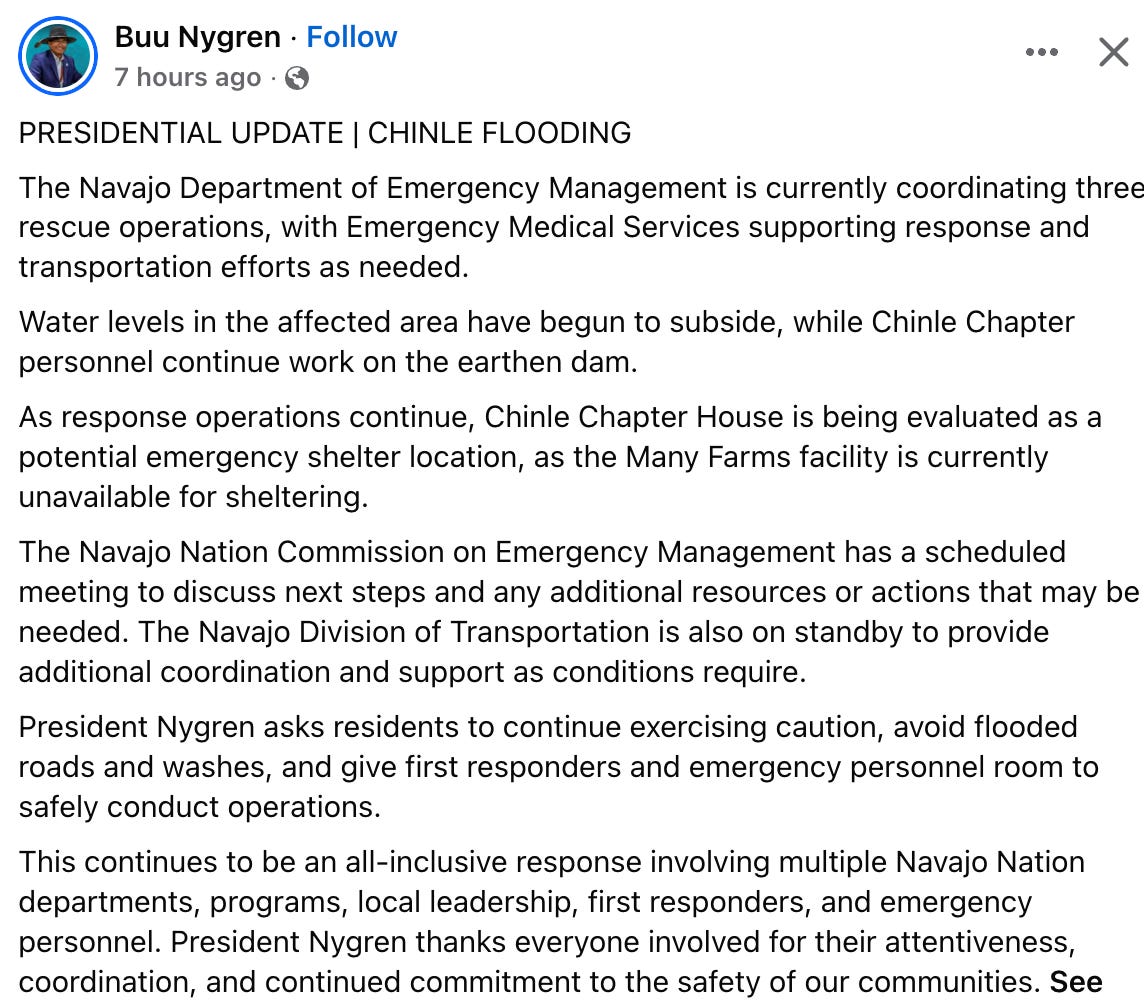
The San Juan River got a nice boost, jumping from less than 600 cubic feet per second at the Four Corners on Sept. 14, to over 3,000 cfs on Sept. 16. And Chinle Creek leapt from zero to over 400 cfs during a similar time period.
More rain is on the way, so stay safe out there!
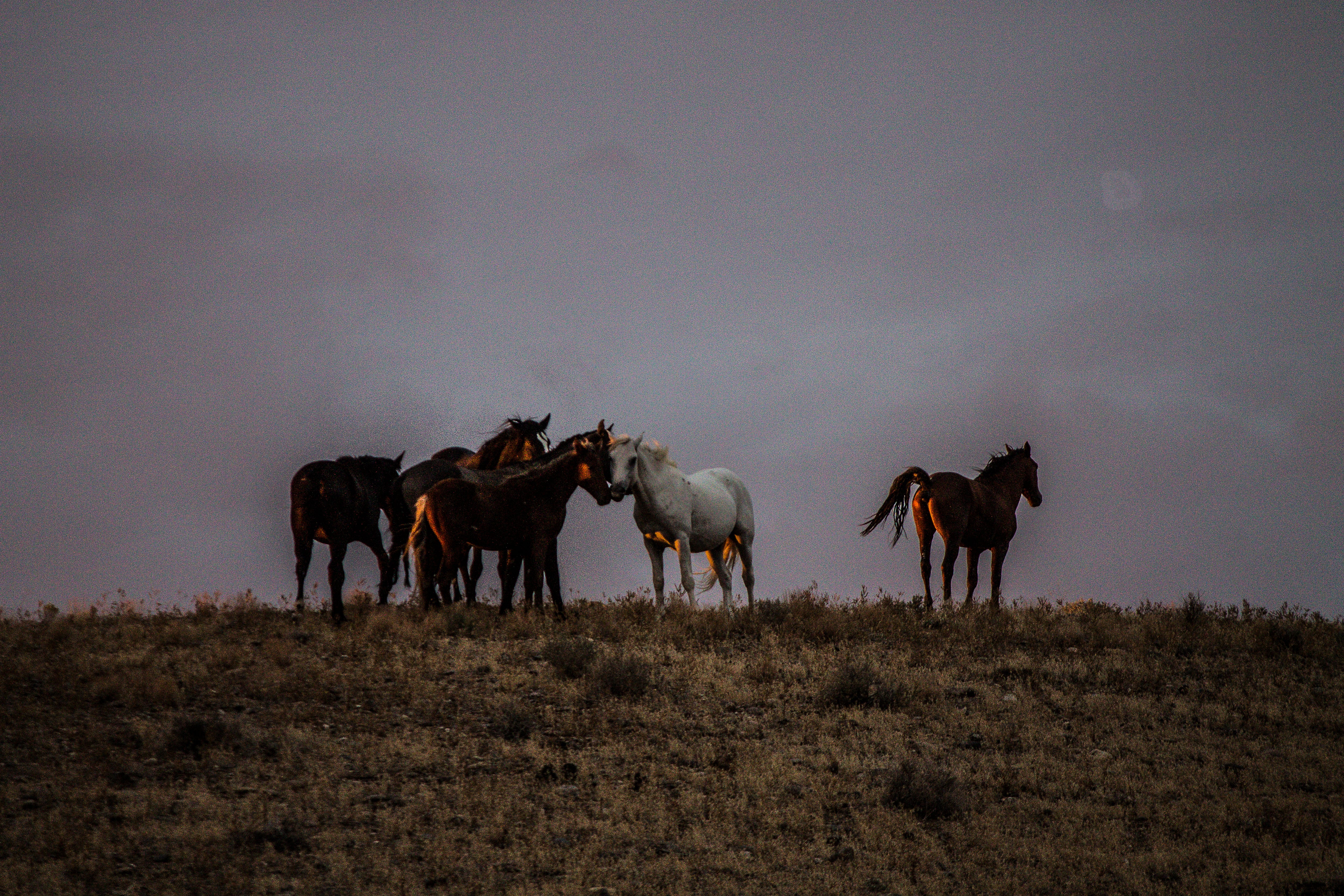
Your beautiful photo of the horses is such a calming counterpoint to the increasing intensity of the "tech bros" mechanical, inhuman energy.
And then there’s all the bots that jam up Wreck. Gov so no one gets river permits. Apply to be denied and Booz Allen Hamilton gets wealthier.