Notes from the Road: Canyons of the Ancients
Notes on a visit to an ancient site -- and contested grazing allotment
🚙 Notes from the Road 🛻
The white horse lies on the hard-packed reddish earth. The black horse stands over her protectively, as if shielding her from the harsh sun or the stiff breeze, redolent of sagebrush. Maybe she is injured, maybe just resting. From my perch some 250 vertical feet above them I can’t tell, even with the help of my camera’s telephoto lens. Not that my assessment matters: The horses probably are wild, and it would be wrong for me to interfere, even if I could.
I return to my investigation of the shallow, circular depression on the summit of the small, but prominent, conical hill upon which I stand. The circle, constructed by ancestral Pueblo people many centuries ago, is about 30 feet in diameter, ringed by stones, with a single taller monolith jutting up from the eastern edge. There is not enough rubble nor is the depression concave enough for it to be a tower or kiva. It’s something my late father might have called architecture with unknown function: a shrine, perhaps, or some sort of celestial or solar observatory or calendar. Maybe it was just a place where one could sit and meditate on the surrounding landscape.
I’m here because last week, as I was poring over the Bureau of Land Management’s map of potentially available grazing allotments, I noticed that the contested Yellowjacket allotment included what’s known as “Jackson’s Castle,” a Puebloan complex of structures that W.H. Jackson photographed in 1874. I had wanted to take a closer look at the allotment, and this gave me the impetus to saddle up el Burro Blanco and head west and into Canyons of the Ancients National Monument.
As I hiked toward the pueblo, jumping from stone to stone so as not to trample any cryptobiotic crust, I noticed the hill and decided to climb it to get a better view. The shrine is a pleasant surprise, the horses below and their enigmatic actions a slightly unsettling one.
***
Anyone heading out behind the Slickrock Curtain in late April should be prepared to share the experience with many other sightseers, hikers, mountain bikers, or whatnot. Ski season is over, the mountains and midlands are too muddy, and the desert hasn’t yet reached inhospitable temperatures (well, okay, it did this March — for a while).
Still, I can’t help but be a little taken aback at the packed parking lot at Phil’s World mountain biking trails east of Cortez, or the massive cluster of cars at the Sand Canyon trail down in McElmo Canyon. As a teenager, back in the eighties, I spent summers in Cortez, riding my bike on the highways and county roads all over Montezuma County (and I’m pretty sure I was the only competitive cyclist in the entire county). Before that, my parents would take us camping up the Sand Canyon road, where even a mile in we’d see no one. (Yes, there used to be a rough public road across the canyon from the current trails).
That Cortez would one day become a magnet for mountain bikers and hikers and that it would have its own bike shop — not to mention a sushi joint — was certainly never on my radar.
***
Despite this winter’s dearth of snow, and the looming water crisis, McElmo Canyon has taken on its characteristic green hue. The cottonwood leaves are out, and dance in the sunlight against a backdrop of pink and beige sandstone, the hay is getting taller. But look closer and you can see symptoms of the drought. Ute Mountain is utterly snowless, even its north face. The fruit tree blossoms have already come and gone, fooled by the March heat wave to emerge early, only to be slain by the hard frost that followed. Pastures that haven’t received irrigation are plagued with dusty patches of bare dirt.
McElmo is a good place to see in one view the effects of private, irrigated land grazing versus arid public lands grazing. The irrigated pastures that line the creek retain a carpet of green, even after cattle have chomped up most of the grass. Meanwhile, on the slopes above the ditches — whether the land is private or managed by the BLM — it looks as if a wide-spectrum herbicide bomb has been detonated, leaving only bare dirt and cheatgrass behind. This year, even the cheatgrass appears to be struggling.
It’s a stark contrast with a few years back when even the most heavily grazed areas were covered with white sego lilies.
I turn off the McElmo asphalt onto a road graveled with fist sized cobblestones, making it a jarring ride, and slowly make my way through the mile or so of private land before entering BLM land and the national monument. On the way, I pass a pile of bones and crusty hides, where at least two cows must have perished sometime in the not-too-distant past.
***
As far as I can tell, there is no trail or established route from this rough gravel road to Jackson’s Castle, so I just find a place before crossing back onto private land to pull off the road and park. In the moon dust on the road is the shallow imprint of what appears to be a bear track, which is less scary than a mountain lion, but I do yell to whom or whatever might be listening that I probably don’t taste very good so please find someone else to eat. Then I leave the road and begin meandering toward my destination, careful to place my steps in the footprints of horses so as not to disturb the fragile soil.
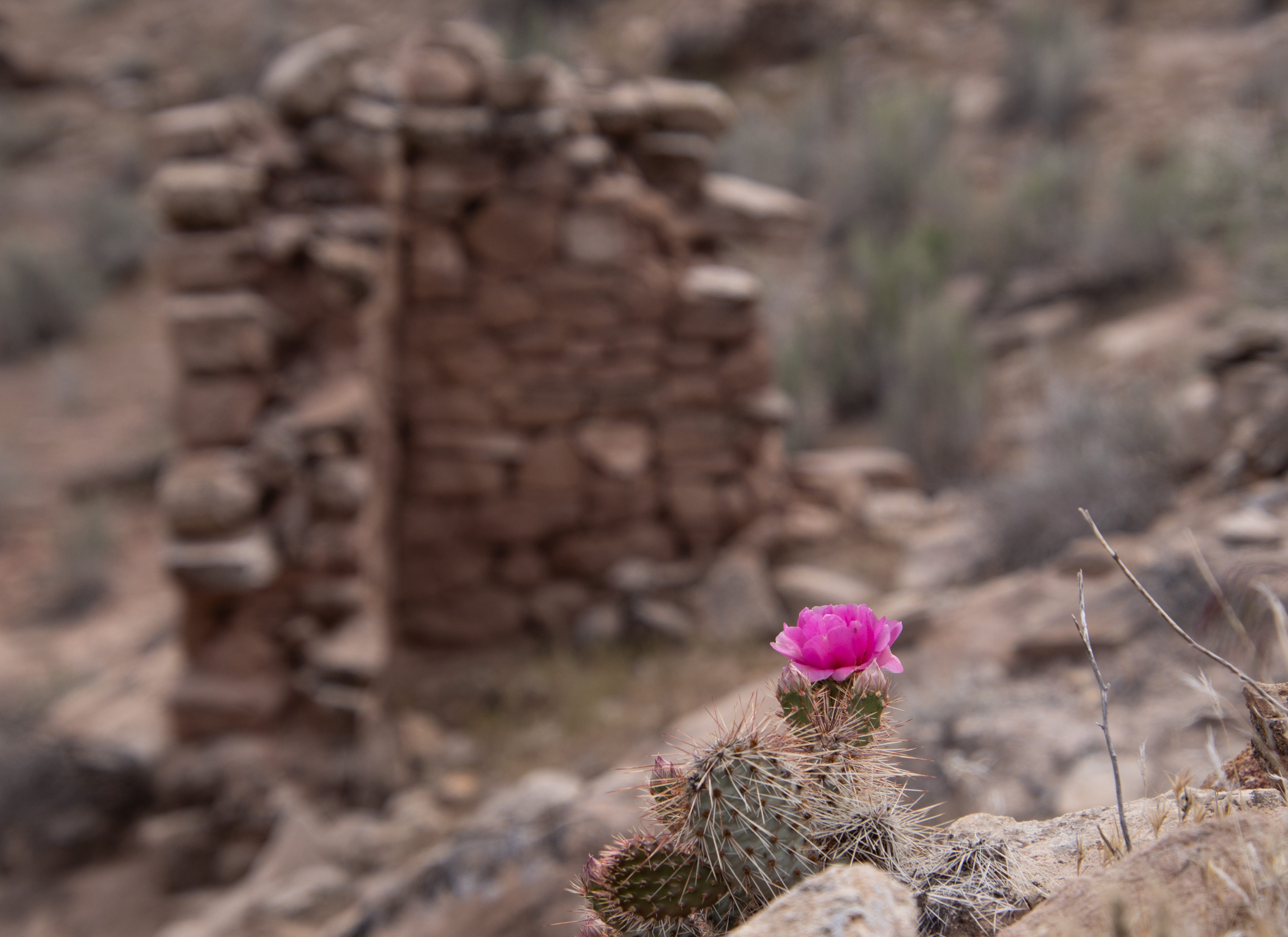
The cacti are in garish bloom. The creamy little flowers of the cliff rose cling to every branch. Here the scarlet spears of the Indian paintbrush, there a daisy, and on a disturbed patch of ground a lone sego lily, its delicate petals fluttering in the breeze.
***
When I reach the pueblo I see why Jackson called it a castle: Though only a few standing walls remain, the amount of rubble indicates it was a substantial complex, with some two-story buildings, perched on a peninsula of sandstone above Yellowjacket Creek on one side, and a large flat area on the other that may have been agricultural fields.
Jackson’s Castle is believed to be from the Late Pueblo III period, meaning it was built about 800 years ago. In a 2014 paper1, Bob Bernhart and Scott Ortman point out the site’s architecture and interaction with the landscape are echoed in that of the Tewa Pueblo people in north-central New Mexico. And that supports Ortman’s theory that the Tewa language and culture originated in southwest Colorado, and “that the characteristic moiety or dual organization of present day Tewa communities was already in place when Tewa ancestors migrated from the Mesa Verde region to the Northern Rio Grande.”
There is, for example, a gap between room blocks in the center of Jackson’s Castle, which could indicate a “moiety-type” dual division of the village. Moiety refers to dualities or a division in half. Traditional Tewa ceremonial and subsistence cycles are divided into two complementary parts, according to the Ortman-Bernhart paper, a division that also shows up in architecture and village layouts.
Tewa cultural landscapes also are typically marked by earth-navel shrines on hills or mountains around a village or settlement — much like the hilltop feature east of Jackson’s Castle. And if you were to stand on one end of Jackson’s Castle on the dawn of autumn equinox, you’d see the sun rise directly over the top of the hill, the shrine, and the monolith on its eastern edge. Also, the village here is down near the canyon floor, from which views are limited. The shrine hill, however, affords a line of sight to more distant landmarks; it may have served as sort of an intermediary between the village and the larger world and surrounding landscape.
***
It appears from the BLM map that Jackson’s Castle is only barely within the Yellowjacket allotment, but that the flat farming area next to it is basically sliced in half by the allotment’s border. Which means that the cows I see off in the brush to the southeast of the site could be on an active, leased allotment, meaning they are “legal.” That said, there’s nothing to stop them from wandering onto the Yellowjacket allotment and the parts of Jackson’s Castle that aren’t atop the sandstone ridge.
Meanwhile, decades of previous cattle grazing — along with the wild horses now — have done quite the number on what were likely agricultural fields associated with the village, wiping out any physical evidence of what might have been there some 800 years ago.
Other sites nearby are surrounded by fences for that very reason, which may be necessary but it also feels like a sort of defacement of its own. Wouldn’t it be simpler and more effective just to keep the cattle out of the area entirely?
***
As I ponder my own relationship to the landscape, I catch a glimpse of movement in the distance. The two horses I had seen from up above are now standing up, and they have a youngster with them. I use my telephoto to get a closer look: the foal is gangly, clumsy on its feet, and something bloody and red hangs from the rear of the white horse.
After a moment of confusion, I understand: From the earth navel above, I had watched a wild horse in the throes of labor. And now she has just given birth.
The wind picks up and the clouds grow thicker. Feels like we might finally get a little rain. I smile a little and amble on back the way I came.
📸 Parting Shots 🎞️


New Evidence of Tewa-style Moiety Organization in the Mesa Verde Region, Colorado by Robert L. Bernhart and Scott G. Ortman


Damn, I liked meandering through that area. One time I drove an old Jeep from the Hovenweep visitors center to Cortez on the backroad with a map from the visitor center showing a number of small structures along the way. Some years ago. All by myself.
Well done