


🌵 PUBLIC LANDS 🌲
One might expect the Trump administration to be humbled by its monumental loss in the midterm elections, to heed the voters’ call and change course on its war on Iran, its arbitrary inflation-driving tariffs, its blatant money-grubbing corruption, its ICE goon squads, and on its crusade to convert public land into an ATM for oil and gas, mining, and now tech corporations.
Alas, this is no ordinary or commonsensical regime. Instead of tempering itself, it’s doubling down on its unpopular and destructive policies, as those who govern by spite are inclined to do.
This week, for example, the Interior Department released its 2026-2030 strategic plan, which again emphasizes its commitment to achieving “American Energy Dominance”— as long as its of the fossil fuel kind — and opening more lands to mining, grazing, geothermal development, and timber harvesting.
It wouldn’t only do this through leasing, permitting, and granting rights of way, but also “land exchanges and direct transfer of lands in support of reliable energy production and transport.” Furthermore: “The Department will work to decrease the size of the federal estate by offering to states, localities and Tribes the opportunity to purchase federal lands.”
Yes, you read that right: Interior Secretary Doug Burgum wants to turn public lands over to corporations to make it easier for them to drill or build pipelines on them, and it wants to sell other lands to states, counties, and tribal nations because they’ve deemed the “federal estate” to be too large. Never mind that previous efforts to transfer public lands out of public hands have been met with broad and intense opposition from across the political spectrum.
Of course, a strategic plan is merely a wish-list, a broad road map of what the administration would like to do. And Burgum has in the past indicated he planned to transfer public lands for housing, yet never followed up on it, perhaps due to the backlash to Sen. Mike Lee’s attempts to do the same through legislation.
Meanwhile, Interior is taking very real actions to undermine stewardship of public lands in quieter, yet consequential ways. Most recently, it announced plans to streamline and weaken the Bureau of Land Management’s land-use planning process to “cut unnecessary red tape.”
Some of the most significant proposed changes concern Areas of Critical Environmental Concern, or ACECs, which are public lands that require special management attention to “prevent irreparable damage” to historic, cultural, or scenic values, wildlife, or other natural systems and processes. Chaco’s Great North Road, which passes through the heavily drilled San Juan Basin oil and gas field, is protected by an ACEC, for example.
Interior proposes eliminating the requirement that ACECs be identified in a draft land-use plan, that proposed ACEC designations be published in the Federal Register, and that they be subjected to an associated 60-day comment period. The new rule would also limit the scope of the protected areas, by requiring that ACECs “shall encompass the smallest area of public lands necessary to protect and prevent irreparable damage of the relevant and important values.”
Additional proposed land-use planning changes include:
To remove the requirement that the BLM prepare an environmental impact statement when it develops or revises a land-use plan.
To bar appeals of land-use plan decisions via the Office of Hearings and Appeals, giving the Interior Department the final say.
To remove rules requiring the BLM publish notice in the Federal Register and open a 30-day public review period at the beginning of the planning process, and eliminate the 90-day public comment period requirement. Instead, the BLM would determine “public participation that is appropriate to the areas and people involved in the specific planning process.”
To require all protests to be submitted electronically.
The BLM is accepting public comments on the proposed changes until Nov. 11, 2027. More information can be found and comments submitted at the Federal Register.
**
On a similarly egregious note, Sen. Mike Lee, MAGA-UT, has taken steps to set up a Senate vote to revoke the Bears Ears National Monument management plan via the Congressional Review Act.
While the Trump administration illegally shrunk the national monument by about 90% this summer, the previous management plan, which pertains to grazing, recreation, and resource management, is still in place. It was developed under the Biden administration in collaboration with the Bears Ears inter-tribal coalition.
Now Lee looks to get rid of the plan, and to bar the agencies from developing a similar one in the future, potentially weakening protections of what remains of the national monument, or even a restored one if and when a court or future administration reverses Trump’s shrinkage.
**
The U.S. Forest Service publishes proposed new public lands grazing rules in the Federal Register that would eliminate public input into permit decisions, open additional lands for grazing, allow some permittees to establish their own benchmarks for forest health, and expands eligibility requirements for grazing permits. Comments will be accepted until Dec. 14. (Federal Register, Western Watersheds Project)
**
The Bureau of Land Management seeks public input on 38 proposed oil and gas lease parcels covering 65,900 acres in northwest Colorado to be auctioned in March 2027. There are two blocks of parcels, one west of the Little Snake River, the other east of the Illinois River. Comments will be accepted until Dec. 10. (BLM)
🐓 REGULATORY CAPTURE CHRONICLES 🦊
Environmental Protection Agency Administrator Lee Zeldin moved last month to rescind Biden-era regulations aimed at reducing methane and other greenhouse gas emissions from oil and gas facilities.
The rules, finally finalized in 2024, phased out flaring on new wells; required leak-detection surveys on a monthly, bimonthly, or quarterly basis (depending on type and size of facility); and required even low-producing wells to pipe associated gases to market or use them to replace other fuels onsite if at all possible. The rules also allowed the EPA to “leverage data collected by certified third parties to identify and address ‘super emitting’ sources.”
The rules not only cut climate-warming emissions, but also reduced pollutants that endangered the health of people living near oil and gas wells and other infrastructure. Plus, they slashed waste, which ultimately reduced energy prices, by pushing operators to market the methane as natural gas rather than venting or flaring it.
Zeldin’s proposal would bring back flaring, rescind the third-party “super emitter” monitoring program, and give operators more leeway in monitoring for leaks and other problems.
The proposed changes are open to public comment until Dec. 16. Submit comments here.
**
Meanwhile, data show that EPA enforcement actions relating to oil and gas facilities and operators in New Mexico, especially the busy Permian Basin, have dropped off considerably during the first two years of the Trump administration, perhaps due to staffing reductions, an ideological shift in agency leadership, or both. “EPA’s lack of enforcement in the Permian Basin makes it more difficult to protect New Mexicans’ air quality,” Drew Goretzka, New Mexico Environment Department spokesman, told Capital & Main. (Capital & Main)
🔋ENERGY/ECONOMIC TRANSITIONS 🔌
Diné advocates and mountain bikers work to establish a trail-based economy on the Navajo Nation, but must overcome thorny access issues to realize its full potential. “As Indigenous communities, we can grow our trails because we see a lot of the trail population. If you look on Strava or these different trail maps,” said Navajo Mountain Bike Festival founder MT Garcia, “there are tons of trails that are highlighted all around the reservation, but the reservation is this dark spot.” (Tó Nizhóní Ání, Yazh Trailz)
**
Gallup, New Mexico’s city council approves Convalt Energy’s proposed Golden Eagle solar cell manufacturing facility on 622 acres within city limits. The two-year construction process is slated to begin in January and the facility is expected to employ 900 people when it is operational. (KRQE)
🤖 DATA CENTER DIGEST 👾
Elon Musk’s firm SpaceXAI proposes a massive data center complex on the Willcox Playa dry lakebed in southeastern Arizona adjacent to the Apache coal, gas, and solar power plant, which has a generating capacity of 626 megawatts. Plans call for the nine-data-center complex to use 6 gigawatts (or 6,000 MW) of power when fully built out, which would make it the largest such facility in the world so far. SpaceXAI plans to invest $3.6 billion on power infrastructure and would begin construction in March 2027 if land-use approvals are granted. (Data Center Dynamics, Arizona Daily Star)
**
Outgoing Alaska Gov. Mike Dunleavy moves to lease a square mile of state land to STAK Energy for a giant gas-fired plant designed to power proposed data centers. The lease hasn’t formally been issued, the developer would still need numerous permits to proceed, and Governor-elect Jonathan Kreis-Tomkins, a Democrat, called for a moratorium on new data centers on the campaign trail. (Anchorage Press)
**
Documents show advanced chipmaker firm TSMC’s fabrication facility in north Phoenix would use about 1,900 megawatts of energy at full buildout, or enough to power some 300,000 homes. The facility also uses about 4.75 million gallons of municipal water daily. (KJZZ, AZ Family)
**
Arizona Public Service officials expect the utility’s overall electricity sales to double by 2041 due to rising demand from new data centers and the chipmaking industry, and plans to bring 2,000 megawatts of new solar, 2,500 MW of energy storage, and 4,000 MW of gas generation online in the next decade along with extending the life of its Four Corners coal power plant in northwestern New Mexico until 2038. (Utility Dive)
**
Google proposes a data center near Cheyenne, Wyoming, with a possible capacity of 2,700 megawatts. It would power the facility with natural gas fuel cells and gas-fired turbines and will “seek to capture the associated” carbon dioxide emissions and store them at Tallgrass Energy’s Eastern Wyoming Sequestration Hub. Google says it will pay for 100% of the power it uses, and will utilize an air-cooled system “to minimize strain on local water resources.” (Data Center Dynamics)
👩🏽🔬 SCIENCE! 🧫
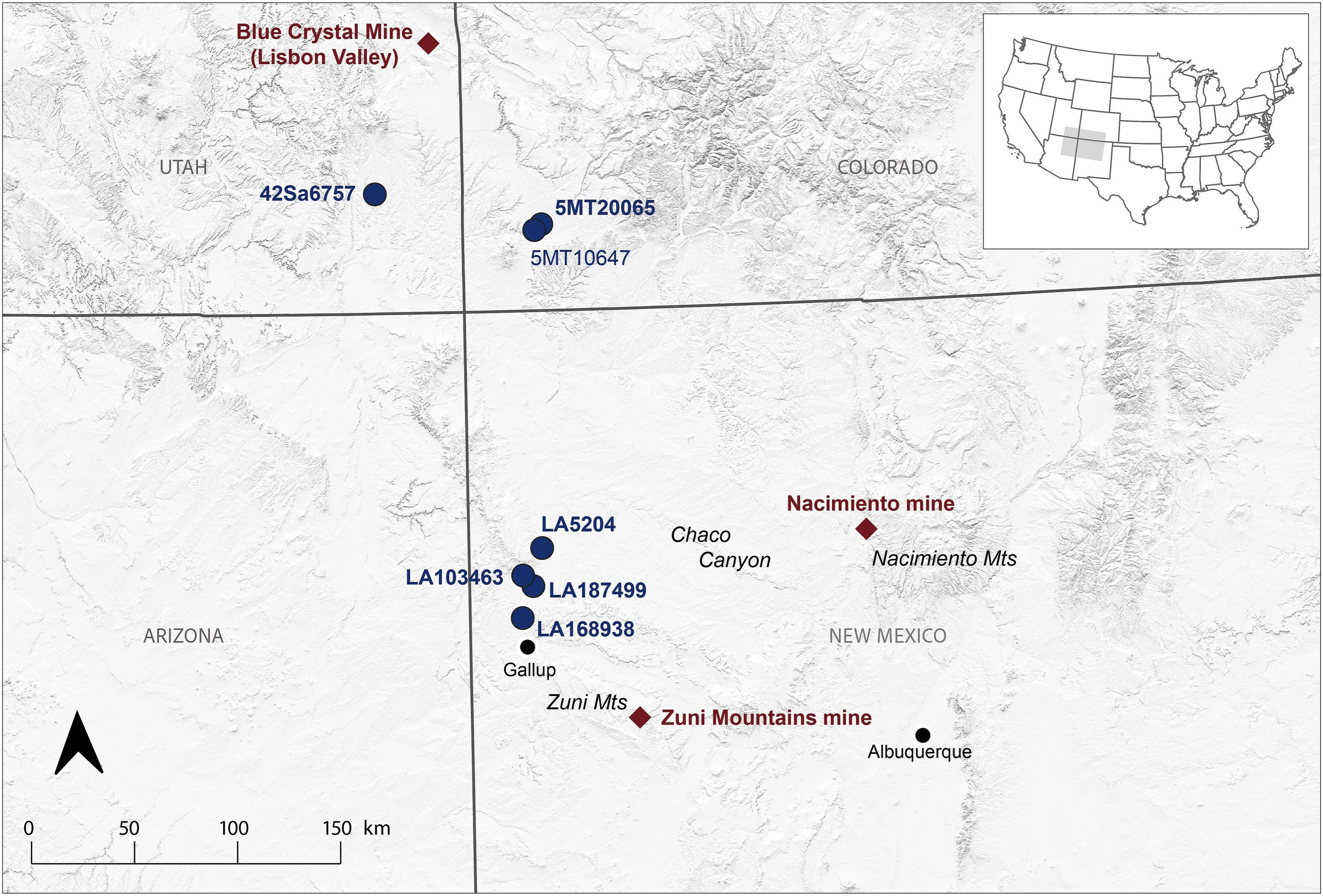
I’ve often written here about how the Lisbon Valley in southeastern Utah has a long history of mining, for copper, uranium (Charlie Steen’s Mi Vida Mine was here), oil and gas, and now lithium. A recent study1 finds that mining has been happening here for far, far longer — like 1,400 years longer — than I suspected.
Archaeological evidence shows that Ancestral Puebloans used a blue-green mineral called azurite as a pigment for painting baskets, ceramics, wooden objects, and for body paint. Caches of azurite spheres have also been documented at numerous Puebloan sites and in burials dating back to the Basketmaker III period (500-750 AD). A new study, Spheres of Blue: Isotopic evidence for the provenance of azurite in the Ancestral Pueblo world, uses isotope tracing to determine from where the Pueblo people may have obtained the azurite.
Their conclusion: Much of the azurite found in the ancient sites probably came from the Lisbon Valley and possibly from a specific site near the Blue Crystal Mine, where evidence of ancient mining has been documented, with other samples likely coming from the Zuni Mountains in New Mexico. “Given the isotopic homogeneity of the spheres (especially in Pb isotope space) and their recovery from widely distributed archaeological sites,” the authors write, “we suggest it is possible that Lisbon Valley was the sole source of azurite spheres in the Ancestral Pueblo world during the Basketmaker III period.”
📸 PARTING SHOT 🎞️
Kari L. Schleher, Alyson M. Thibodeau, Ryan Mathur, Jonathan Till. Spheres of Blue: Isotopic evidence for the provenance of azurite in the Ancestral Pueblo world. Journal of Archaeological Science: Reports, Volume 76, Part A, 2026.
You are the place for invaluable information about our destructive Interior Department as well as much more. Thanks.
Been waiting for this one. Thanks for the recap. So many fucking hits.
This should be updated to January 11, 2027 -- "The BLM is accepting public comments on the proposed changes until Nov. 11, 2027."