Moab seeks bigger crowds?
Plus: Car Chronicles (and a poll)
đ€Ż Oh, the Humans! đ±
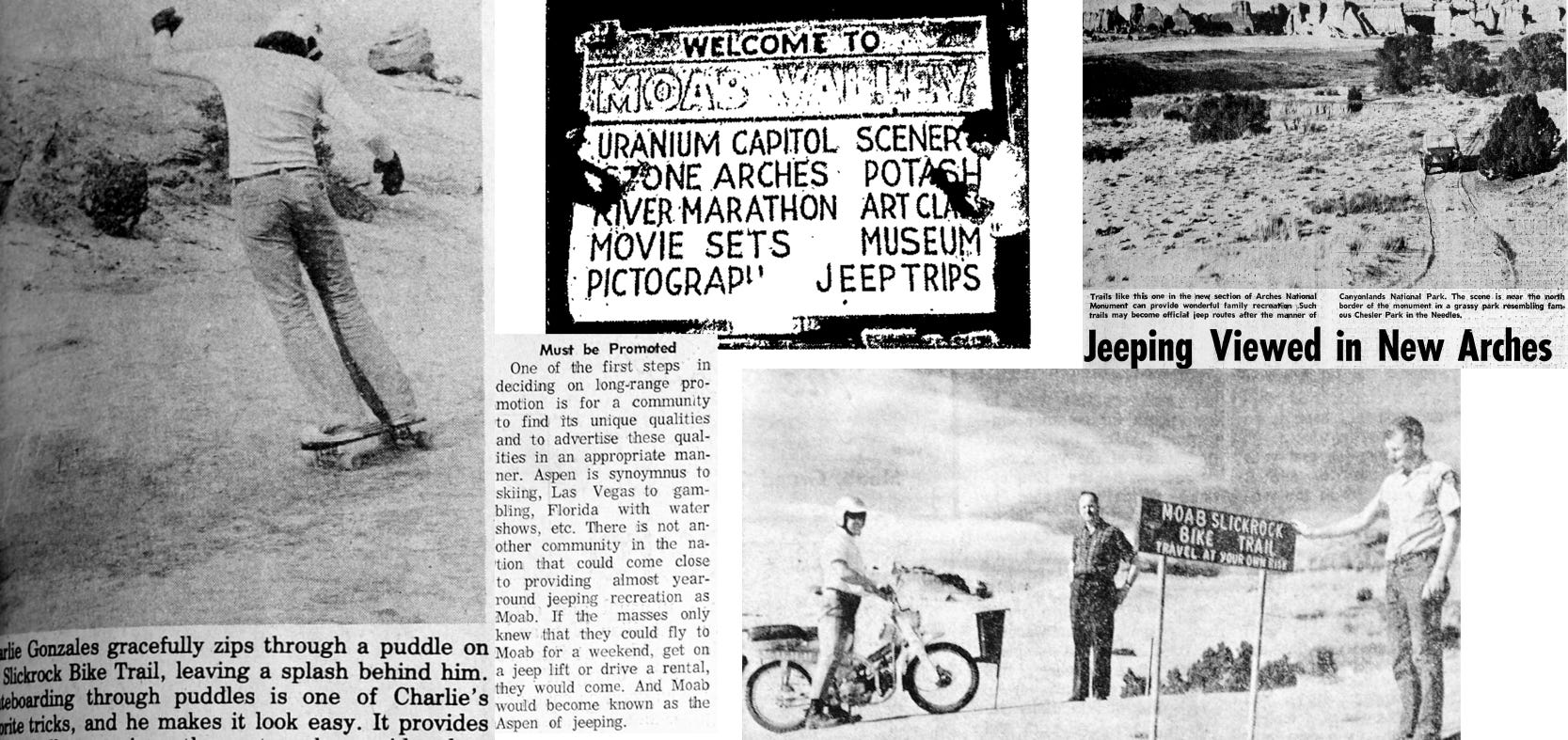
If youâve been to Moab, Utah, anytime in the last decade, but especially in the last five years, you might assume â as I have â that local officials would be striving to dial back the number of visitors rather than increase it. And yet, one Grand County commissioner is looking to make Moab even more crowded by urging Arches National Park to do away with its timed-entry system.
During the high season, which has become just about every season these days, it can take what seems like eons to drive from the south side of Moab (which has sprawled well into the Spanish Valley) to the north side (which reaches to the Colorado River and even beyond), thanks to an uninterrupted stream of traffic. When the cars back up at the Arches National Park entrance, spilling into highway 191, it can bring through-town traffic to a virtual halt. And when all those cars get into the park, they jam up parking lots and the people in them crowd the trails and viewpoints.
In 2022 the park implemented a timed-entry system in an effort to mitigate the crowds. It appears to have worked: After peaking at 1.8 million visitors in 2021, the number of folks entering the park dropped back to a more manageable 1.5 million for the next three years. Itâs worth noting that this is still almost twice as many annual visitors as there were in 2005, and nearly 100,000 more than visited Arches in 2015.
Itâs apparently not enough for the latest crop of Grand County Commissioner Brian Martinez, however, who submitted a draft âAccess and Capacity Enhancement Alternativeâ for his colleaguesâ consideration. If approved, it would be sent to the National Park Service for inclusion in its Arches plan. (Thank you to Allyson Mathis for alerting us to this!). Right off the bat, the draft takes aim at the timed-entry system, stating:
âThe timed-entry reservation alternative has been piloted at Arches since 2022. Grand County considers its impact on visitation, the local economy, and the community to be unacceptable.â
From reading that, one would think that Moabâs tourism industry collapsed after 2022. It did not. The place continues to be crowded as all get out, even this year, when international tourism dropped off somewhat. In fact, Archesâ visitor numbers remained strong this summer even as other Utah parks saw a visitation decline. Meanwhile, the cityâs sales and use taxes and transient room taxes have mostly held steady since 2022. While Arches NP is one of Moabâs main draws, it is not its only one by any means.
The growth machine, however, canât keep churning on steadiness alone. It always needs more. As more people crowded into Moabâs streets and onto the surrounding public lands, more developers built more hotels, glamping resorts, and other lodging establishments. In order to fill all of those new rooms, they now need to draw more and more visitors â including during the once relatively quiet shoulder seasons â regardless of the crowdsâ impacts on the land and community.
So the countyâs draft plan goes against any attempt to ease the crowds through what it calls âdemand restrictions.â Instead, the draft recommends expanding the parkâs capacity, not by enlarging its boundaries, but by increasing the number of parking spots, building new trails and widening existing ones, and implementing a shuttle system. The hope is that cramming the park with more and more visitors will draw more folks to Moab, who will then spend money at restaurants, gas stations, and lodging establishments, and bolster tax revenues â a portion of which must go to marketing the region and trying to increase tourism.
Little consideration is given to how expanding access into currently more remote areas and increasing the number of people in the park at any one time will affect the park and its wonders. Nor does this account for how these impacts on the park may affect visitorsâ experience and therefore numbers in the long term. But then, long-term thinking has never been a trait of Western boom towns, which is often one of the reasons they ultimately go bust.
đ Car Chronicles đ»
On an unseasonably toasty, sunny November day, I cranked the ignition on the Silver Bullet, the 1989 Nissan Sentra Iâve been driving since 2012 and that has served as the Land Deskâs excursion and reporting vehicle, for the last time â or at least the last time for me. It fired right up on the first try, as if trying to prove I was making a dire mistake, and purred steadily as I pulled it from its parking space and into a place that would be more accessible for the tow truck that was on its way.
As I sadly removed the license plates, I considered canceling the tow and the donation. But then I went over the list of items that needed to be repaired, starting with the blown head gasket, and realized that it was time to let go. And giving it to a friend or another person simply would be passing the burden â the glitchy taillights, the driversâ side door that doesnât open right, the leaky trunk, the busted steering boot, the broken heater/AC switch â on to them, which I couldnât do in good conscience. I did briefly toy with welding the car onto the back of the new pickup, but I havenât yet lost all my marbles, so soon abandoned this whim.
So I stood amid falling yellow leaves and watched as the young tow truck guy hooked up the front wheels, lifted them up, and pulled away, my loyal and somewhat rusty steed bound to marginally offset the local public radio stationâs loss of federal funding. I spent the rest of the day in a funk, an irrational one, I know, but real nonetheless, that even a good bike ride couldnât completely cure.
Solstice and the Silver Bullet
Iâd like to be able to say I spent the Summer Solstice out in the desert, watching the sun rise and set at the apex of the ecliptic, or gazing in awe as daggers of light met in the center of a spiral, etched in stone a millennium ago, or simply gulping up the sun as itâŠ
***
Thing is, I hate cars. I donât give a crap whether theyâre old or new or fueled with gasoline, biodiesel, or electricity. Cars fuel sprawl, they drive fossil fuel demand, they spew nasty exhaust and cloud up the skies over cities with yellow-brown smog, their tires disintegrate and pollute the water, car crashes kill about 1.2 million people annually worldwide.
Cars turn normal, friendly people into raging lunatics who go ballistic if a cyclist or pedestrian dares to attempt to share the road with them. Cars turn perfectly fit and healthy people into lazy asses who have panic attacks if a downtown improvement project threatens the loss of even one or two precious parking spaces that might force them to walk a block or two to their destination.
Americaâs car-centric culture prompted the Trump administration to cancel federal funding for bike lanes, pedestrian trails, and street safety improvements because they deemed them to be âhostile to motor vehicles.â Yes, cars make people stupid.
Cars suck.
***
I love my car.
I know, I know, Iâm a goddamned hypocrite.
Believe me, when I was younger I tried to exist without a car of my own. I always rode my bike when I wanted to get around town, and even many a time when I went back and forth between my momâs house in Durango and my dadâs in Cortez. I didnât even get my drivers license until I was 17, which is a year later than just about all of my peers. Even still, I take public transportation when itâs available.
Iâm also a child of the rural West, with an inherent yearning to randomly swerve off the highway onto a gravel road or windy little two-track and follow it to wherever it might lead. My pathological urge for independence makes me want to carry with me everything I might need, from my bike to my camping equipment to my camera to tools to books and food. My car often doubles as my home and office. It takes me out to the canyons, takes me over the passes to visit friends and family, and even takes my music along, too.
Beyond that, and because of it, a car can become a companion, with a life and personality of its own. Thatâs certainly been my experience, at least, beginning with the âLow Rider,â my dadâs 1969 Pontiac Catalina, and continuing with Romeo the Rambler (1967 AMC Rambler station wagon) and Carlos the Corona (1973 Toyota Corona station wagon).
And then there was the Silver Bullet. That thing took me all over the place, on interstates, through the desert, to interviews in far-flung places, through the oil and gas fields, along various stretches of old Route 66, down numerous oil pan-busting two-tracks for which it was not equipped. I also spent a good amount of time tinkering with it to keep it running somewhat smoothly.
Up until its last days, even with 308,000 miles on it, it had plenty of zip, cruised up Coal Bank pass without a chug or a miss, had enough cargo and roof space for all of my stuff, and got about 42 miles to the gallon. Sure, I couldnât drive it at night because of the tail lights. And I had to get up under the dash to switch from Vent-AC to the heater (though the AC did work). And, finally, because I just pushed the poor thing too hard after negligently blowing out the water pump, the head gasket failed.
***
I know you all are dying to know the name of the new Land Desk reporting vehicle, the 1997 Ford Ranger I was gifted by my mother-in-law Hannah. Yâall gave me some great suggestions, many of them related to the Lone Ranger, and I really appreciate them.
Below Iâm going to give you a chance to weigh in. In the interest of full disclosure, Iâll admit Iâm leaning toward El Burro Blanco, the white burro (or, I suppose, the white donkey or white ass ⊠). Thatâs because itâs white, and itâs cute (like a burro), and can carry a lot (like a burro). But I may be swayed by your votes, so chime in, if youâd like.
***
In true car-loversâ fashion, the only therapy that ultimately soothed my heartbreak over the Silver Bullet was to drive randomly around La Plata County backroads in the ranger in the late afternoon while shadows stretched across still-green hayfields while listening to a Bob Segerâs greatest hits CD.


I really feel your pain over the loss of your trusty pony. I went through similar turmoil when parting with my Dadâs 1982 Toyota pickup. He had driven it all over the Southwest, camping out of the aluminum shell with curtains he had sewn and hauling paintings on the top rack he built and bolted on. When I was staying home with an infant and didnât have a vehicle he gifted it to me and he upgraded to a full size Ford F150. I drove the Toyota to all the kid friendly camping and swimming holes in the Four Corners and then when we were able to get a bigger vehicle I gifted it back to my dad. He continued to drive it even when the early signs of dementia started to stop him at crossroads. I think the truck knew which way to turn. I kept it for years after he passed. Until the paper wasps and mice had more of a presence in the cab than I did. When a master mechanic inquired about buying it for a rehabilitation project I reluctantly let it go. It was time for an artist of metal and mechanics to take the wheel.
Cars do suck. They are expensive and deadly and ridiculous egotistical extensions of personality but they are also freedom to go and see and experience the changing light. Iâll never own one I canât sleep in.
I live on an island half the year. Trucks are ruining the island. They are completely out of scale with the environment. "Trucks" went from twd vehicles folks used to go the dump, do yardwork, carry on a trade etc to now the proliferation of 4x4 extra passenger long bed shiny monsters with huge side view mirrors that are lethal for pedestrians and bikers trying to share roadways. They are not all used for "jawbs"- they are some kind of insanity. This insanity is easier to see on an island, a confined geographic. But the insanity called "trucks" is everywhere. That said, congrats on your new ride. Your truck is a fairly pleasant artifact.