Mining Monitor: Trump uranium mine? Or trolling?
Also: A guest post on Glen Canyon Dam
⛏️ Mining Monitor ⛏️
The Bureau of Land Management’s Mineral & Land Records System seems like a strange place to get trolled. But I think it just happened. I was looking through the MLRS to try to get an idea of whether insanely high gold and silver prices, and relatively strong uranium prices, had inspired companies or speculators to stake new mining claims n southwestern Colorado and southeastern Utah, when I came across something that seemed almost satirical.
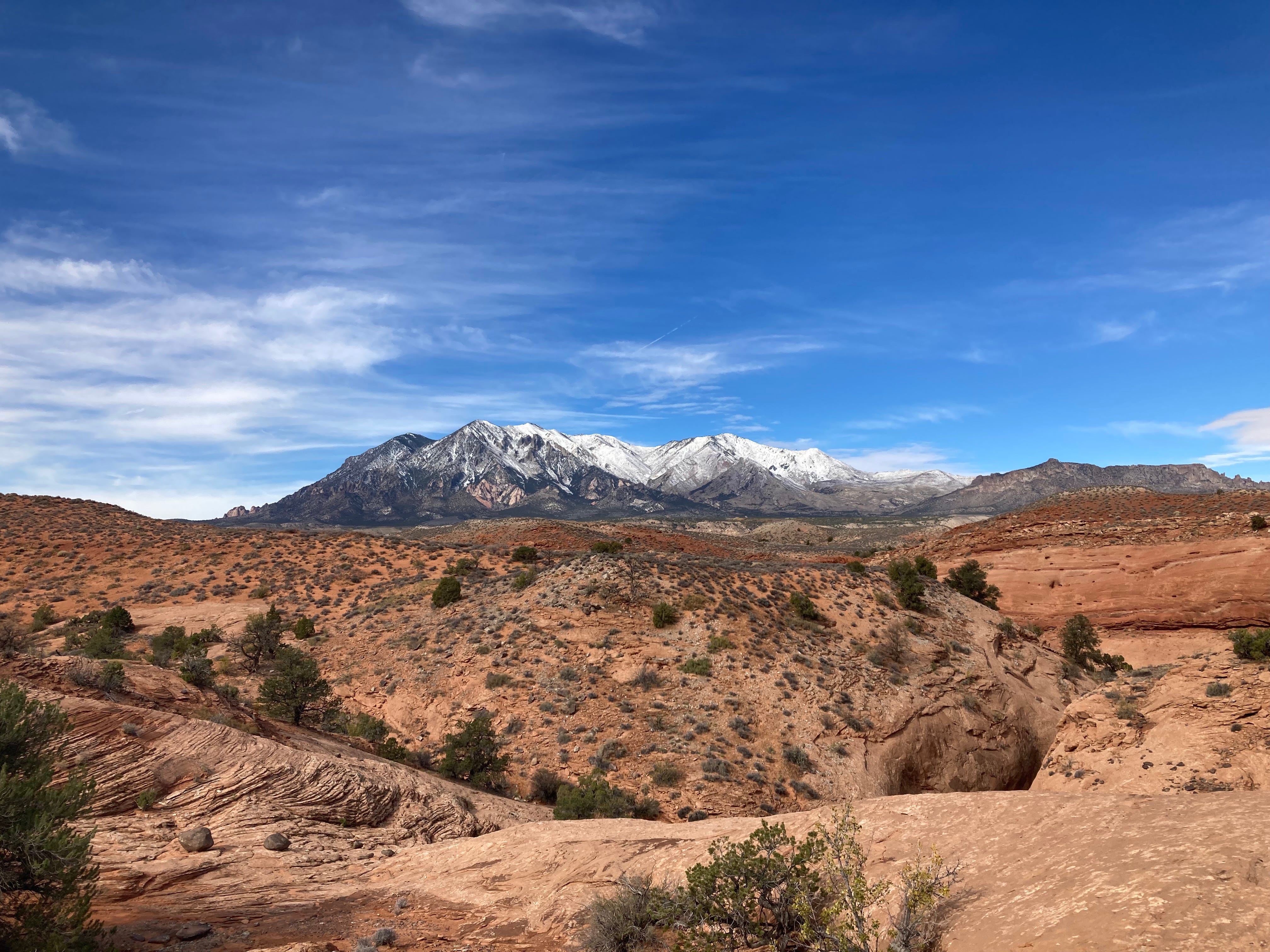
Late last year, Kimmerle Mining Company staked four 20.66-acre lode claims in Garfield County, Utah, on the east slope of the Henry Mountains (just east of Mt. Pennell). The claim’s names? Trump I, Trump 2, Trump 3, and Trump 4.
The Kimmerle family, of Moab, control hundreds of mining claims across southeastern Utah. But they generally don’t mine them, except, it seems, to make a point.
The Kimmerles are the ones who staked mining claims on a mesa just east of Hideout Canyon inside Bears Ears National Monument just months just before the Obama administration withdrew the area from new mining claims. After Trump shrunk the monument to exclude the White Canyon area in 2017, and just before Biden restored the boundaries in 2021, Kimmerle Mining staked five new claims in the area and acquired additional claims from another mining company. Kimmerle Mining promptly filed for a permit to do exploration work there, but the BLM said they had to demonstrate the claims “validity,” or show that they contained “valuable minerals.” The process for doing so would cost up to $100,000.
Shortly thereafter, Kimmerle joined the state of Utah’s lawsuit seeking to eviscerate the national monument, claiming that its establishment had caused him to lose out on mining profits.
No word on whether the firm plans on drilling or mining its Trump claims, but at least we know these folks’ political leaning.
There have been a handful of other notable mining claim locations in the area in the past six months, including:
Platoro West Inc., located in Durango, staked twelve 20.66-acre lode claims southeast of Ouray, Colorado, in the Bear Creek drainage near Darley and Engineer Mountains. The company is registered under the name of William Sheriff, who was recently named executive chairman of Verdera Energy, which has interests in in-situ uranium mining in New Mexico.
CCKC Inc., of Philadelphia, located three 20-acre placer claims in Dolores County along the Dolores River upstream of Rico.
Roughead Resources of Moab (but which has also been associated with a Houston address) staked fifteen 20.66-acre lode claims in the Lisbon Valley of southeastern Utah near the Mi Vida Mine and the Lisbon Valley Copper Mine. At the same time, the company also staked dozens of claims in Beaver County, Utah.
Fermi Metals of Cocolalla, Idaho, staked twenty-three 20.66-acre claims on the southern slope of the La Sal Mountains, just north of the settlement of La Sal. This is near Energy Fuels’ La Sal Complex uranium mines.
Geobrines International, of Littleton, Colorado, staked twenty-five 20-acre placer claims in Grand County, Utah, along I-70 between Green River and Cisco. This adds to a cluster of previously filed claims in the same area. They are probably looking to do lithium extraction.
Utah Brine Corporation, of Omaha, Nebraska, staked seventy 20-acre claims southwest of the community of La Sal in the Lisbon Valley. UBC appears to be a subsidiary of Omaha Value Inc., which has partnered with an Australian critical materials firm Neometals on its Utah Brine Project, which aims to extract lithium and potash.
Antimony Canyon Sovereign Reserve Inc, a division of Australia firm American Tungsten & Antimony, staked nineteen 20.66-acre lode claims near Antimony, Utah, in Garfield County. The plan is to develop an antimony mine here.
In other mining news:
Metallic Minerals has been eyeing and drilling into a copper deposit in the La Plata Mountains of southwestern Colorado. While actual mining may be a long ways off, concerned locals are already coming together to keep an eye on the project and push back, if necessary. The La Plata Mountains and Public Lands Coalition now has about 225 members from the region, according to Dan King, the coalition’s administrator. Metallic Minerals’ proposal was just one of the catalysts for the coalition, and its mission is much broader and more regional in scope.
Gold and silver prices have shot up tremendously over the last year, probably due to the Trump-effect on the economy and the U.S. dollar, which is stuck at a ridiculously low exchange rate. Gold is now around $5,000/oz, while silver is hovering around $100/oz., compared to just $30 when Trump took office. Uranium’s doing well, too, sitting consistently in the $80/lb to $90/lb range.
Which is to say, mining companies suddenly have a lot more incentive to invest in reopening existing, idle mines or even building new ones (assuming they have faith that the high prices will endure). So far, however, it doesn’t seem to have sparked a surge in new mining activity. Even the Revenue-Virginius silver mine near Ouray, which is purportedly ready to produce ore, remains idle.
The uranium sector does appear to be emerging from its long slumber, but mostly in the form of exploratory drilling, smaller companies selling claims to bigger ones, and staking mining claims on the increasingly sparse sections of public land that aren’t already claimed. Anfield continues work on constructing its Velvet-Wood mine in the Lisbon Valley, but it’s still a ways away from production (and its Shootaring mill is still mothballed and unlicensed).
Energy Fuels is about the only firm actually producing conventional ore. According to their SEC filings, they pulled about 1.5 million pounds of uranium from the Pinyon Plain mine near the Grand Canyon and 155,000 pounds from their La Sal Complex in 2025. Their White Mesa Mill recovered 1 million pounds of uranium, which is a heck of a lot more than in the past, but still is far short of the facility’s 8-million-pound annual capacity. Despite all of this, the company still lost $86 million in 2025.
Meanwhile, the silver and gold mining corporations raked in massive profits, including:
Canadian corporation Barrick, which owns major gold mines in Nevada (Fourmile and Nevada Gold Mines) reported an attributable EBITDA of $8.16 billion last year, the “highest shareholder returns” in the company’s history.
Newmont (which jointly owns Nevada Gold Mines with Barrick) reported an adjusted EBITDA of $13.5 billion.
Kinross, owner of Bald Mountain and Round Mountain in Nevada, Fort Knox and Manh Choh in Alaska, and Kettle River-Curew Project in Washington, reported adjusted net earnings of $2.2 billion
Rio Tinto’s “profit after tax attributable to owners of Rio Tinto (net earnings)” $10 billion.
SSR Mining, which owns a big mine in Nevada, only had a net income of $362 million; but that compares to 2024’s loss of $350 million.
Speaking of commodity prices and profits: American oil and gas companies are poised to make out like bandits thanks to the Trump-Netanyahu war on Iran.
Iran produces some oil and gas. But more importantly, it borders the Strait of Hormuz and has threatened any oil and gas tankers that try to pass through it, effectively closing the passage. That could stanch the flow of oil and gas to the global market, causing prices to rise. The West Texas Intermediate, or WTI, crude oil price has shot up to about $76, the highest it’s been since before Trump took office. This will cause gasoline prices to climb, but also make drilling in the U.S. more profitable, and could spur companies to start using the stockpile of public land drilling permits they’ve amassed over the last year or so.
Liquefied natural gas tankers also are unable to get through the Strait to European markets, which will cause prices of the fuel to skyrocket. It could also force European countries to turn to U.S. LNG exporters, which could echo back to natural gas producing states like New Mexico and Wyoming (and also may increase U.S. natural gas prices if the conflict drags on).
Glen Canyon Dam Must Be Modified to Avoid Draconian Water Supply Disruptions
A guest post by Ron Rudolph

Glen Canyon Dam, which impounds the Colorado River to form Lake Powell, is a single point of failure that poses an unacceptable risk to the functioning of the entire river system. Modifying the dam to allow more water to pass through or around it is an essential component of any plan for allocating the river’s dwindling supply.
The dam’s structural flaw limits the amount of water that can pass from Lake Powell downstream to Lake Mead. Lake Mead, the nation’s largest reservoir, is the primary repository of water for the Colorado River’s so-called Lower Basin states: California, Arizona, and Nevada. A paucity of water released from Lake Powell would eventually force reductions in the amount of water extracted from Lake Mead, diminish drinking water supplies for millions, harm agricultural productivity throughout the southwest, and embroil the federal government, seven states, more than two dozen Tribal Nations, Mexico, and others that share the river’s water in a cascade of costly court cases.
Due to Glen Canyon Dam’s physical limitations, when the elevation of Lake Powell reaches “minimum power pool” or lower, the only way to release water from the dam is through its river outlet works.1 The persistent drought in the southwest, and continued demand for the river’s reduced water supply, makes it highly likely Lake Powell will fall to minimum power pool this year. The U.S. Bureau of Reclamation estimated this month that Lake Powell could fall to minimum power pool by late July, and remain there or lower through 2027.2
In addition, the agency’s February forecast estimates that under “most probable inflow” conditions, Lake Mead would drop below elevation 1,040 in June. If conditions do not improve by the agency’s August forecast, mandatory reductions in water use would be required in Arizona, California, Nevada, and Mexico.3 If the annual amount of water let out from Lake Powell is restricted to the dam’s outlet works, it would result in less water reaching Lake Mead than any year this century, and could trigger even larger reductions in Lower Basin water consumption.4 Releasing water from reservoirs upstream from Lake Powell could forestall the reservoir reaching minimum power pool, however, that is a non-sustainable solution, that fails to address Glen Canyon Dam’s fundamental plumbing problem.
In January, the Bureau of Reclamation’s draft environmental impact statement — Post-2026 Operational Guidelines and Strategies for Lake Powell and Lake Mead —proposed several options for managing the Colorado River for the next 20 years. None of the alternatives includes remedying Glen Canyon Dam’s structural flaws.
The Bureau’s proposals have been criticized by some of the largest consumers of Colorado River water who have signaled a willingness to challenge the agency in court. For example, the Metropolitan Water District of Southern California, which serves nearly 19 million people, noted the Bureau’s proposed alternatives “would likely lead to lengthy litigation.”5 The Central Arizona Project, the second largest consumer of Colorado River water, has identified several “legal deficiencies,” including non-compliance with the Colorado River Compact, and failure to adequately disclose and analyze the environmental, economic and socioeconomic impacts.6
Depending exclusively on the river outlet works to release sufficient water through Glen Canyon Dam is bound to fail, like relying on rainfall to grow crops in Arizona or southern California. The Bureau has warned relying on the outlet works would risk water supply disruptions to those who depend on Lake Powell and Lake Mead.7 The Director of the Bureau’s Technical Service Center has advised against using the outlet works as the sole means for releasing water from the dam,8 as previous high-capacity use of them for only 72 hours caused structural damage, which required nine months to repair. Despite the remedial effort, the Bureau concluded the repairs will not prevent future damage.9 The dam’s design flaw led the Arizona Department of Water Resources to conclude the structural limitations of Glen Canyon Dam must be alleviated.10
The calculus for equitably apportioning the diminishing water in the Colorado River is extremely complicated. But one variable in the equation is as obvious as the bathtub ring surrounding Lake Powell: a new system for conveying water sustainably through or around Glen Canyon Dam must be built. Without it, risks to the Colorado River system, and the communities, agriculture and ecosystems reliant on it, will escalate, as will pressure to impose compulsory reductions in consumptive uses throughout the basin.
Ron Rudolph, a former assistant executive director of Friends of the Earth, spent 35 years in various engineering companies, including MWH Global, CH2M Hill, Jacobs Engineering, and Cardno with a career focused on infrastructure development and environmental remediation.
U.S.Bureau of Reclamation, Technical Decision Memorandum, Establishment of Interim Operating Guidance for Glen Canyon Dam During Low Reservoir Levels at Lake Powell, March 26, 2024, page 9
https://www.usbr.gov/lc/region/g4000/riverops/24ms-projections.html
When Lake Mead drops below elevation 1,040, a “Level 2 Shortage Condition,” mandatory reductions in water use by Arizona, California, Nevada, and Mexico are required by the 2007 Interim Guidelines for managing Lake Powell and Lake Mead, and the 2019 Lower Basin Drought Contingency Plan
The Bureau’s guidance for maximum release of water from each river outlet work (ROW) at minimum power pool elevation is 3,185 cubic feet/second (cfs). The agency has determined only three ROWs would be available simultaneously. If three ROWs operate at full capacity, they would release 9,555 cfs. 1 cfs sustained for a year = 724.acre-feet/year. 9,555 x 724.45 = 6,922,000 acre-feet/year. The maximum releases are specified in USBR, Technical Decision Memorandum, Establishment of Interim Operating Guidance for Glen Canyon Dam During Low Reservoir Levels at Lake Powell, March 26, 2024, page 2. The determination that only three ROWs would be available simultaneously in based on USBR, Near-term Colorado River Operations, Final Supplemental Impact Statement, March 2024, page 2-3. The least amount of water released this century was 7 million acre-feet in 2022, based on data from U.S. Bureau of Reclamation, Colorado River Accounting and Water Use Report: Arizona, California and Nevada, 2000-2024
Statement of Metropolitan Water District’s General Manager, Shivaji Deshmukh, January 9, 2026
Patrick Dent, Assistant General Manager, Water Policy, Central Arizona Project, Report on Post-2026 Draft Environmental Impact Statement, February 5, 2026
U.S. Bureau of Reclamation, Near-term Colorado River Operations, Final Supplemental Impact Statement, March 2024, page 1-9, footnote 10
USBR, Technical Decision Memorandum, Establishment of Interim Operating Guidance for Glen Canyon Dam During Low Reservoir Levels at Lake Powell, March 26, 2024, page 9
USBR, Reclamation completes recoating of outlet tubes at Glen Canyon Dam ahead of schedule, June 18, 2025; https://www.usbr.gov/newsroom/news-release/5184
Email from Trent Blomberg on behalf of Tom Buschatzke, Director, Arizona Department of Water Resources, February 4, 2026

