MAYDAY! Snowpack Report
And fact-checking Colorado River claims
⛈️ Wacky Weather Watch⚡️
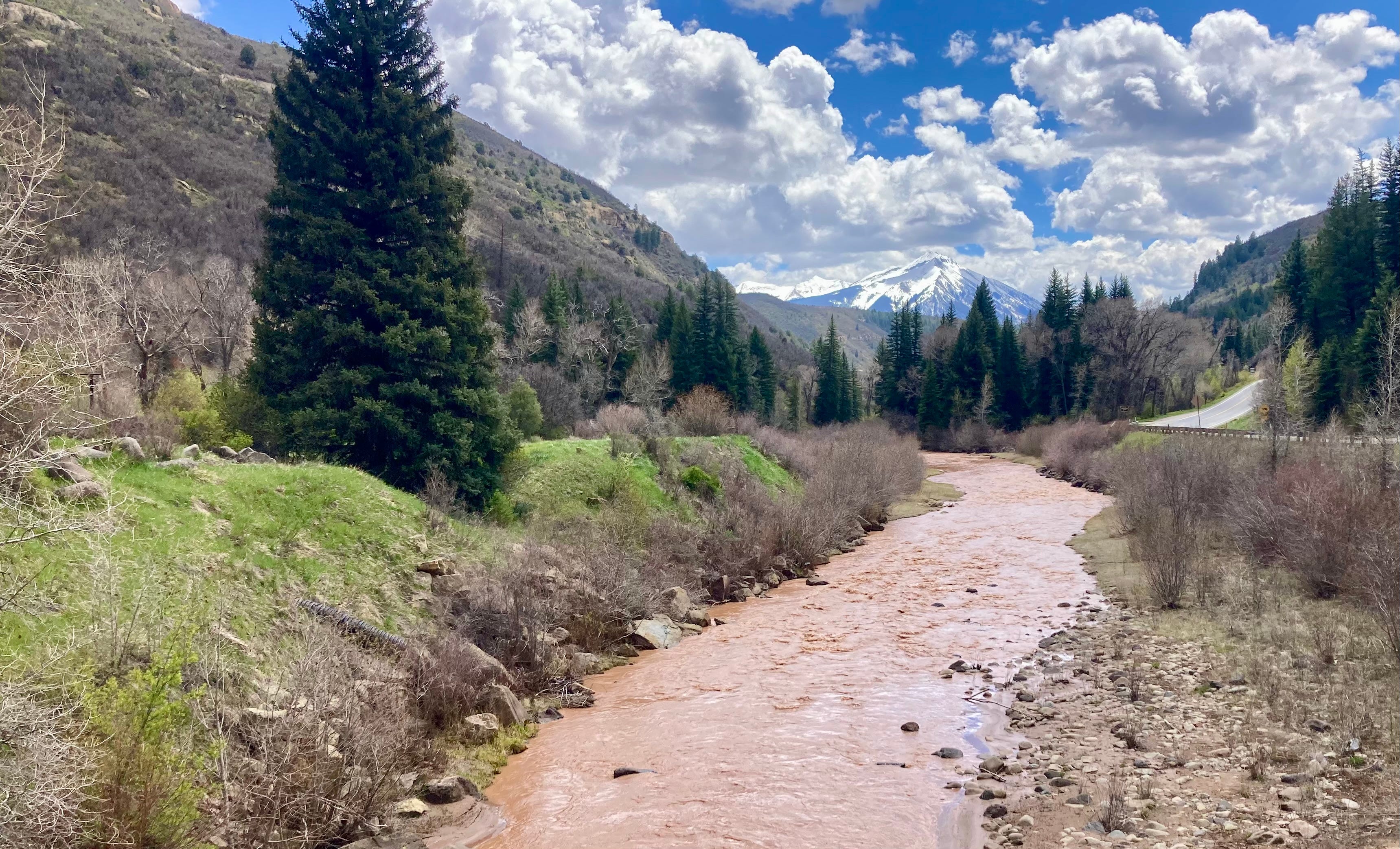
If someone were to be dropped from another planet into the North Fork Valley in western Colorado today, they would be forgiven for assuming there is not a water crisis. A thick carpet of green covers the valley floor, the irrigation canals are filled to the brim, trees are leafing out, the river is running and Paonia Reservoir is almost full, and the mountains are still graced with snow.
I didn’t even come from outer space — I think — and I find the contrast between the news reports of water shortages and restrictions and the on-the-ground situation here to be quite jarring. Is it possible that April precipitation has averted the calamity?

Yes, a series of storms, some quite abundant, have moved through the Upper Colorado River Basin, boosting snowpack and soothing the desiccated earth. It has certainly felt cooler and wetter than normal, but that was mostly an illusion brought on by the abnormally dry winter and the searing March heatwave. And it hasn’t been nearly enough to offset the warm winter and the lack of snow, as the graphs below indicate.
As for the full ditches, I guess you could attribute that to a “make hay while the water is available” sort of ethos. You might as well douse the fields and fill ponds while spring runoff is in full swing and the river still runs, knowing that it may not last beyond June. Meanwhile, Paonia Reservoir’s relatively healthy levels are the result of the Fire Mountain irrigation canal — which relies on reservoir water — being shut down for emergency repairs.
Meanwhile, there is a conspicuous absence here in this agricultural hotspot: There are no blossoms or fruit on apple, cherry, peach, or pear trees. The March heatwave sparked a spectacular orchard super-bloom. That was followed by a devastating freeze that killed all of the fruit, even in orchards where extreme preventative measures were taken, and even “burned” the leaves on some trees. Wacky weather indeed.


🐟 Colorado River Chronicles 💧
Phil Lyman, the former and hopeful Utah politician, recently posted this on Facebook:
Just to sum it up: He’s knocking a federal program that pays willing farmers to voluntarily cut off irrigation to their fields in order to conserve water in an effort to balance Colorado River demand with the shrinking supplies. And he’s blaming it all on California.
Lyman’s general sentiment is not new, nor is it uncommon among water users in the Upper Basin states. In fact, it’s basically a cliché. Since I was a kid I’ve heard folks saying something along the lines of: If we don’t use the water, it’ll just run on down to California, where those L.A. folks will guzzle it up to fill their swimming pools and water their golf courses. It’s a rather simplistic view, and one that doesn’t account for the realities of water law or the way the Colorado River system works. In other words, it’s just plain wrong, and a candidate for Congress — as Lyman is — should know better.
The Colorado River and its users have a problem: Demand for the water exceeds supply, and the supply is continually shrinking. Since boosting supply is not a feasible option, demand — i.e. consumptive use — must be reduced significantly. While everyone must make cuts, agriculture is the river’s largest water user by far, meaning that sector is going to have to make the largest cuts, by volume. This isn’t about demonizing farmers or alfalfa, it’s not about whether Californians or Utahns are more deserving of the water. It’s simple math.
The farm fallowing program is one way to cut consumption quickly by paying willing farmers to voluntarily forego irrigating some or all of their fields on a year-by-year basis. It’s not ideal, but it is legal, voluntary, and can save junior water rights holders, including cities and towns throughout the watershed, from being forced to shut off their water intakes. And in no way is farm fallowing exclusive to Utah. It’s occurring all over the place.
Let’s do a little fact-check of Lyman’s other points:
Farm fallowing in Utah is being done to benefit California, which “demolished its water storage infrastructure.” No and no. The goal here is to leave a little more water in the river, to keep the whole system from collapsing. Any amount conserved in one place will potentially benefit all other river users, as well as the river itself. Foregoing irrigation on a Utah farm, for example, could help keep the taps on in St. George or some other Utah community that relies on the river. Dams have been removed in California, most significantly four structures on the Lower Klamath River. But those were primarily for hydropower production, not irrigation or water storage, and they are far removed from the Colorado River or any associated water storage.
“Paying farmers not to feed us to bail out California’s failures …” Actually, the feds and state and other programs mostly are paying farmers not to grow alfalfa or hay, which feed cattle, and it has nothing to do with California’s “failures.” Indeed, California grows a lot of alfalfa, too, but it also grows all kinds of vegetables — far more than in Utah.
If the water saved in Utah does make it to the Lower Basin and California, then the biggest beneficiary would be … farmers. Most of the water in the Lower Basin goes to the Imperial Irrigation District, where it is used for farming. Those farmers have also been part of the federal fallowing program, and have managed collectively to reduced their Colorado River water consumption by about nearly 1 million acre-feet since 2003.
Lyman calls for eliminating or restructuring federal farm fallowing programs. I’m curious if he’s talked to the farmers about this, especially the ones who may lose their water and be forced to fallow anyway. Isn’t it better to get paid not to grow something than to not get paid for it?
“… fight to end federal policies that separate water from the people who depend on it. Water rights are property rights.” We all depend on water; the California farmers depend on water just as much as Utah farmers do. Furthermore, the California farmers also own their land, they have some of the most senior water rights on the Colorado River, and according to the “Law of the River,” they could likely go to court to force many Utah farmers to stop irrigating altogether, without compensation. The farm fallowing program does not separate water from the farmers, it simply pays them to temporarily forego irrigation.
“… end the war on farm water.” Look, there is not enough water in the Colorado River for everyone. Everyone will have to take cuts, but irrigated agriculture is the biggest user by far, and therefore will have to make cuts in order to balance supply and demand. It’s simple math: All of Las Vegas and southern Nevada use less than one-tenth of the water that goes to the farms in the Imperial Irrigation District.
“… propose that the federal government build and operate desalination plants in California to free up Colorado River water for Utah …” Desalination will likely be a part of the West’s water future, especially for coastal urban areas. But building the plants, and processing and transporting these kinds of volumes of water, would be outrageously expensive and energy-intensive, which would be especially harmful to farmers, who rely on cheap water.
***
The Bureau of Reclamation recently decreased Glen Canyon Dam releases from about 8,200 cfs to a steady 7,000 cfs (without the usual nighttime reductions). This appears to be the lowest sustained releases since the dam was built, and if continued throughout the entire year would lead to only 5 million acre-feet of annual releases, which would make the Lower Basin states even more grumpy and litigation-happy than they already are.
But not to worry, the feds are still on course to release 6 MAF for the water year, because they released about 10,000 cfs during January and February. Still, it’s going to change the complexion of rafting in the Grand Canyon, for sure, and it is certainly pushing the boundaries of the Grand Canyon Protection Act.


