Groundhog confusion as snow drought grips West
Also: On protests, then and now.
🥵 Aridification Watch 🐫
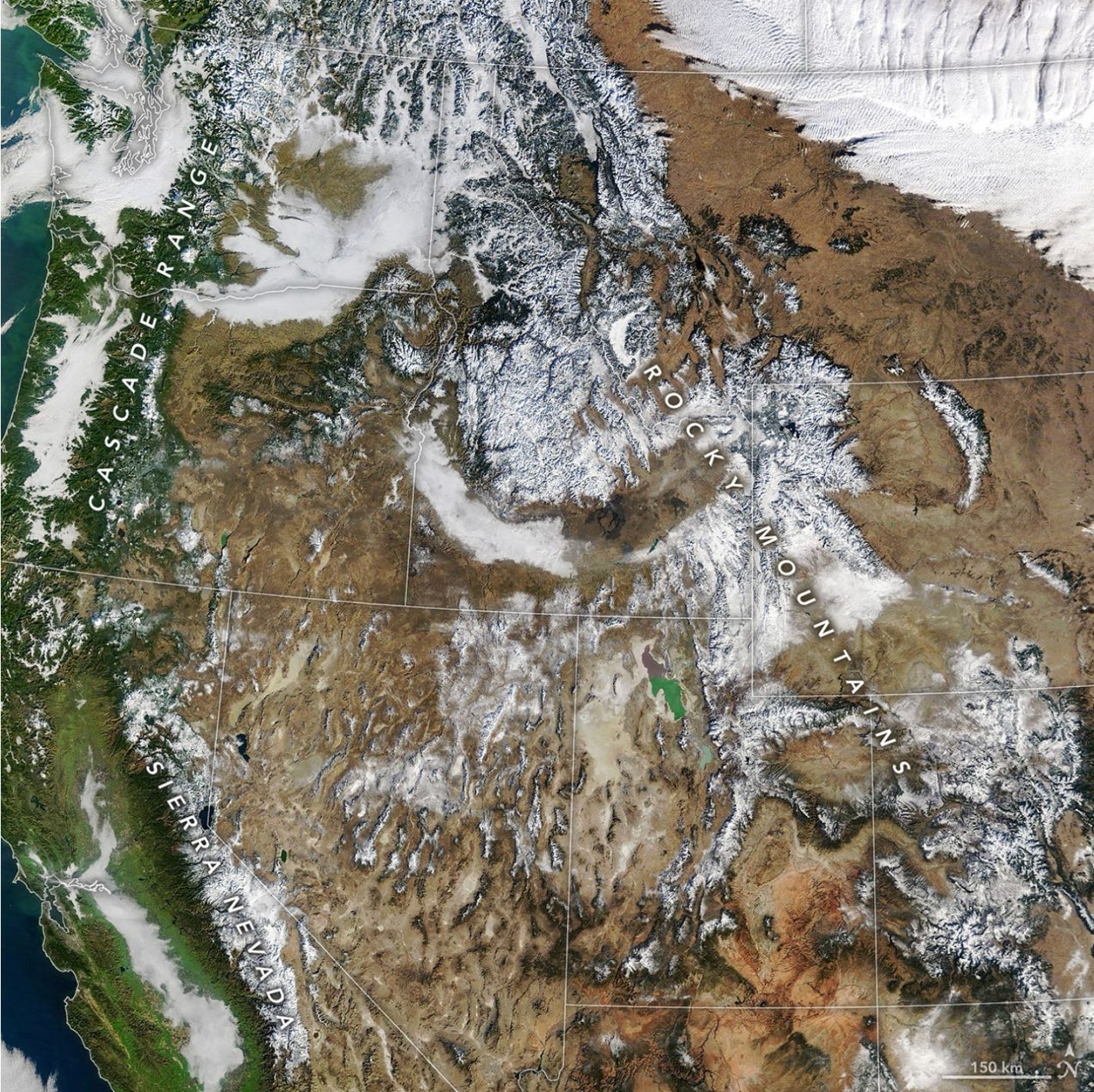
I don’t know if the groundhog saw its shadow yesterday or not (I can never remember whether the shadow is a sign of an early spring or a late one, anyway). But one thing is certain if the little dude was in the Western U.S.: He didn’t see much snow.
Officially, meteorological winter ends in less than four weeks from now. In reality, the snowy season hasn’t really begun in much of the western swath of the nation. The aggregate snowpack at 130 monitoring sites across the Upper Colorado River Basin is at its lowest level for Feb. 1 in the last 40 years. Meaning, yes, it is even worse than in 2002, often considered the Winter of the Colorado’s Discontent, and is on a par with 2018.
The high-country snowy season can last until mid-June, so there’s plenty of time for a rebound, and a return to near normal conditions by April would not be unprecedented. The problem is that this year’s snow drought is the result not only of a lack of precipitation, but also unusually warm temperatures. A rebound, then, would require a major shift in both precipitation and temperature patterns, very soon, which to this amateur weather watcher seems pretty unlikely.

This, of course, is very bad news for the beleaguered Colorado River. The U.S. Bureau of Reclamation’s January projections find that Lake Powell could drop below minimum power pool as soon as this December if the snowpack curve doesn’t veer up sharply in the next several weeks. The Rio Grande isn’t looking much better, snow-wise.
During the summer of 2021, farmers’ ditches in the Four Corners area ran dry as early as June, and the Bureau of Reclamation drew down Upper Basin reservoirs such as Blue Mesa and Flaming Gorge to help prop up Lake Powell’s surface elevation. If current trends continue, this year’s spring runoff threatens to be even slimmer. It could be a tough summer for irrigators, boaters, and anyone else who relies on abundant streamflows.
On protest, then and now
Early on a May morning in 2014, I loaded my camera and notebook and myself into the Silver Bullet — my 1989 Nissan Sentra with a duct-taped window — and headed west to Blanding, Utah. Phil Lyman, a San Juan County Commissioner at the time, was planning on leading a convoy of OHV-riders along a closed-to-motorized-vehicle trail on public land in Recapture Canyon to protest what he called “federal overreach.” I was going to observe and report on the event.
I would lying if I said I wasn’t anxious. After all, this was just weeks after a heavily armed group of yahoos had descended on the Bundy Ranch in southern Nevada to stop Bureau of Land Management agents from rounding up cattle grazing illegally on federal land. If the BLM, or environmentalists, tried to interfere with Lyman’s lawbreaking, it could lead to an armed conflict — and I could get caught in the middle.
I’ve been thinking about that protest, the events that led up to it, and the general political atmosphere at the time. And about the similarities and vast differences of what’s happening today.
After Lyman had posted his plans on the Bundy Ranch Facebook page, commenters’ responses included statements like these:
“The BLM is about to learn they can’t push people around any more in the West. Our backs are up against a wall push back! Yet another case of the federal government taking tyrannical control of the people. They need to be put down and put down hard.”
“Why is the BLM still around? If they so much as throw a stone in your way, light ‘em up. Time to quite defending, being ever gnawed at, and go on offense. … Strike while you are still strongest.”
My unease only grew when I arrived at Centennial Park on the town’s southern fringe, where a pre-protest rally was getting underway. It was peopled by a contingent of locals and an equally large number of out-of-towners, many of whom were part of the Bundy group. This included Ryan Bundy, Cliven Bundy’s son, who circulated pocket versions of the U.S. Constitution, peppered with scripture, published by the National Center for Constitutional Studies, a right-wing organization. And Ryan Payne, a so-called militia leader, who told a reporter that during the Bunkerville standoff he had positioned snipers with their sights trained on federal employees: “If they made one wrong move, every single BLM agent in that camp would’ve died.”
Lyman and others spoke at the event, airing their grievances and reasons for protesting. Like the folks in Minneapolis today, their rhetoric suggested, these people were resisting a federal government that had slipped into tyranny and was taking away their Constitutional rights. “They target a community, they targeted Blanding,” Lyman said, (much as the Trump administration has targeted Democratic-leaning cities) adding that the feds had then sent jackbooted thugs in to harass and intimidate its residents. In the speeches, on the signs, and in comments from the crowd in Blanding, I heard words such as “despot,” “dictator,” “tyranny,” and “gestapo.”
***
“When politicians, community leaders and some journalists engage in that heated rhetoric we keep talking about, when they make the choice to vilify law enforcement, calling law enforcement names like a Gestapo, or using the term kidnapping, that is a choice that is made. There are actions and consequences that come from those choices.” — U.S. Border Patrol Commander Greg Bovino after federal agents killed Renee Good and Alex Pretti in Minneapolis.
***
What inspired such outrage in Blanding? For Lyman and friends, examples of “tyranny” and federal overreach included:
The BLM had prosecuted and fined two local men for constructing an OHV trail in Recapture Wash in 2005, a crime that included chopping down old-growth junipers, building a bridge across the creek, installing culverts, and using heavy machinery to clear a path through the riparian zone that was rich with cultural resources.
Then the BLM banned motorized vehicles on that section of Recapture.
In June 2009 the feds raided several homes of Blanding residents suspected of gathering or dealing in artifacts found on public land in violation of the Archaeological Resources Protection Act. This included at least one SWAT team equipped in tactical gear, responding to a potential threat, though they did not wear masks to conceal their identities. Included among those arrested was James Redd, a local physician. A day later, he killed himself; his family later sued the BLM for intentional infliction of emotional distress and wrongful death, but the case was dismissed.
In 2010, the Obama administration floated the idea of establishing a national monument on public land on Cedar Mesa, west of Blanding, sparking an uproar among the anti-federal land management movement.
And in 2008, the BLM subtly changed its resource management plan from considering all trails on public lands being open to motorized travel unless otherwise closed, to closing all trails unless specifically designated as open to motorized travel.
Lyman had organized this protest, and the Bundy crowd had joined, to push back against this. Was this enough to justify a protest? In my opinion: yes. These people were displeased with the federal government’s actions, so they were exercising their First Amendment right to demonstrate peacefully. And they would — like Henry David Thoreau before them — break the law, or practice civil disobedience and risk fines or jail time, to make their point.
Many of the attendees were also exercising their Second Amendment right to bear arms, from the older cowboy-hatted man with a six-shooter, to the young buck in an “American Venom” t-shirt with an AR-15, to the buzz-cut dude with a “REGULATOR” neck tattoo, a Glock semi-automatic sidearm holstered to his thigh, and a t-shirt that read: “United States Militia … Molon Labe.”
At one point during the pre-ride rally, after a shouted dialogue among the attendees in which they threatened any unfriendly journalists that might be among the crowd, an older man spoke up: “We have a treasure, a jewel, and it has been mugged. It’s been stolen from us by people back east. They have stolen our treasure. We have to stop this BLM police state. They come into our town, raiding our town …”
“You’ve got guns, too, by God, that’s what they’re for,” said another voice from the crowd.
***
“You can’t have guns. You can’t walk in with guns.” — Donald Trump in response to a question about federal agents shooting and killing Alex Pretti in Minneapolis.
***
A little while later, I was hoofing it down Recapture Canyon in an effort to get ahead of the protesters, most of whom would be on motorized three- or four-wheelers. The vehicles are allowed in the first mile or so of the canyon, meaning at that point it would be just a protest, not an act of civil disobedience. If the BLM was going to have its line of riot cops anywhere, it would likely be at the sign marking the motorized closure.
I was only a few hundred yards down the dusty two track when the incessant buzz of two-stroke engines alit on the air. I walked to the side to avoid getting squashed by one of them and snapped photos as one after another buzzed past, their diesel exhaust mingling with the pungent aroma of sage and dust.
A man driving a four-wheeler with a woman sidled up behind him slowed to a stop next to me, causing me to jump. “Hop on,” the man said, motioning to the little cargo area on the back. As we cruised down canyon, the woman asked who I reported for, and whether I was “for us, or against us.” “I’m a freelancer,” I said. “And I’m for the Truth.”
A crowd of OHVers coalesced at the motorized-ban line and my ride slowed to a stop, allowing me to jump off and capture some pictures. There were no flak-jacket-equipped BLM agents here, no riot cops, no tear gas. Just a few San Juan County Sheriff’s deputies, who made no motion to stop or discourage the protesters, even as they continued on past the line in violation of federal rules.
It may strike some folks as off to see a law enforcement officer watching idly as someone breaks the law right in front of them. It’s not. In 1997, the U.S. Supreme Court ruled in Printz v. United States that the federal government cannot compel state or local law enforcement to enforce federal regulations.
**
I continued past the non-motorized line on foot, following in the dust of the OHV convoy. From what I could tell all or almost all of the attendees chose to break the law that day, though most of them stopped at the end of the two-track and beginning of a more primitive trail that passes over archaeological sites.
While I had been anxious about my safety, given the large number of firearms and the intensity of the crowd’s hostility toward the press, I never worried that I would be arrested or detained or tear-gassed by federal agents simply for being present and observing. The same would be true even if I had stayed on the back of the OHV after its driver passed the non-motorized line.
That’s because I was there doing my job as a journalist, and any Democratic government with an inkling of respect for the U.S. Constitution would acknowledge and respect that, and allow me to do my job (while not always making it easy to do so) without fear of government reprisals.
But that was almost 12 years and a few administrations ago. Now, the government is attacking the First Amendment and, really, pretending it simply doesn’t exist. Last month, journalists Don Lemon and Georgia Fort entered a Minneapolis church to cover a protest against the Trump administration’s immigration crackdown, just as I had accompanied the Recapture protesters to cover that event. This time, though, the feds arrested Lemon and Fort and charged them with violating federal law, not long after Trump had reposted a social media post calling for Lemon’s arrest. Prosecutors accused Lemon of peppering the pastor — who also works for ICE — with questions. He was doing his job, in other words, which, under Trump, is apparently a federal offense and could even get him labeled a domestic terrorist.
**
I suppose I shouldn’t be surprised at the Trump administration’s authoritarianism. They promised this, after all, both at campaign rallies and in Project 2025, which the administration has followed closely. But I must say I am a bit surprised that almost none of the folks yelling about federal overreach and tyranny back in the Recapture protest days are speaking up, even mildly.
Lyman is Xeeting about the Gestapo, it’s true, but his target is not masked ICE or CPB agents running amok or even Greg Bovino in his Nazi-esque long coats, but the Utah Department of Natural Resources law enforcement division. Even “Sheriff” Richard Mack, who was a plaintiff in the Printz case, has remained silent or supported the administration’s actions.
It’s disappointing and unmasks the hypocrisy within the Sagebrush Rebellion and its ideological successors. I believe that, early on, the so-called Rebellion’s motives were honest. They saw the public lands as the manifestation of freedom and liberty, they resented having an absentee landlord take those freedoms away, and they stood up to the powers that be — regardless of party or creed — and resisted. But it is now abundantly clear that the movement was long ago hijacked, not only by the extractive industries, but also by the ideologues and demagogues. The old battle cries of Liberty and Freedom and Don’t Tread on Me are no more than empty slogans, the pocket Constitutions that they carry alongside their firearms carry less weight for them than the paper they’re printed on.


This is a great comparison, Recapture Canyon and the minneapolis streets. Concealed carry okay for some, not for others.
Any update on the current status of Recapture canyon?