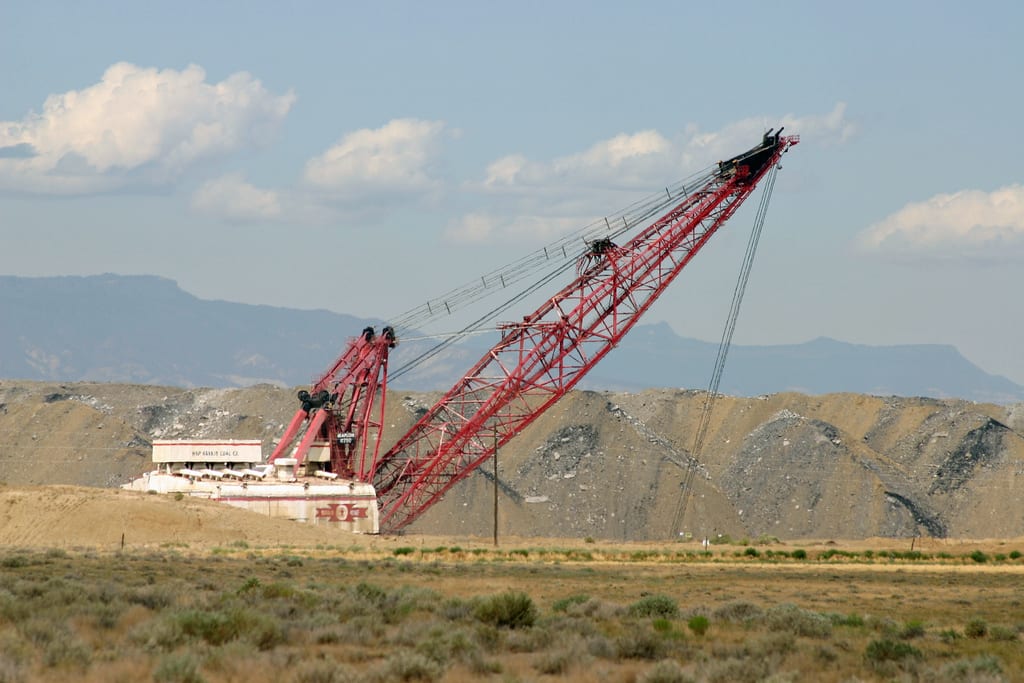
Four Corners coal mine looks to keep operating for 110 more years
Diné CARE pushes back against expansion for mine that fuels Four Corners coal plant

At first glance, I thought it must be a typo.
I was skimming through the Navajo Transitional Energy Company’s application with federal regulators to expand its Navajo surface coal mine in northwestern New Mexico into a previously un-mined section of its lease. The company, which is owned by the Navajo Nation but operates as a separate entity, says it needs the permit to continue to provide fuel to the nearby Four Corners power plant — which is now scheduled to close no later than 2041.
None of this information was unexpected. What seemed to be an error was this line:
“Total mined coal would be 503 million tons, extending the life of the mine to 2136.”
Yes, you read that right. And no, it is not a typo: The company wants the go-ahead to extract approximately 5 million tons of coal annually for the next 110 years.
This has set off alarm bells for anyone concerned about the landscapes and air quality of the Four Corners region. Not only would the mine tear apart another 9,000 acres of land, displace residents and dwellings, and destroy dozens of historic cultural properties, but that coal would also be burned somewhere, releasing climate-warming and health-harming pollutants in the process. Also concerning is the prospect that the Four Corners plant, which has sullied the region’s air for more than 60 years, would continue operating indefinitely.
In the 1950s, looking to meet the post-war growth in power demand — and to induce more of it — utilities across the Southwest teamed up to create a cabal called WEST, or Western Energy Supply and Transmission Associates, which set out to construct six massive coal-fired power plants and accompanying mines across the Colorado Plateau, which would then ship power hundreds of miles to rapidly growing Los Angeles, San Diego, Las Vegas, Phoenix, and Albuquerque across a web of new high-voltage lines.
The power plants, and their unfettered pollution, would be strategically located in rural areas, mostly on or near the Navajo Nation, where the local populace lacked the numbers, resources, or political heft to resist. The whole Big Buildup, was, in essence, an effort to outsource California’s pollution so that L.A. could keep consuming power while also cleaning up its smog-choked skies.
The flagship facility was the Four Corners Power Plant and its accompanying Navajo Mine, which were constructed about 15 miles west of Farmington in the early 1960s by Arizona Public Service, other utilities, and Utah Construction & Mining Co, a subsidiary of Kennecott. The leviathan sat on the edge of the Navajo Nation, atop the Fruitland formation, the carboniferous remains of a 75-million-year-old seaside swamp. Jack Reeves, vice-president at Utah Construction & Mining Co., called the 31,000-acre site next to the Chaco River a “harsh and unproductive landscape.”
But just as the construction cast aside Diné families who had lived and grazed their sheep and horses on that land for decades, so did Reeves’ assessment discount the history and culture that had played out on the landscape for millennia. Construction of the mine, plant, and accompanying reservoir, Morgan Lake, destroyed and covered up remains of dozens of cultural sites, dating from Puebloan times through the present. A reminder of what was lost — a Chaco-era Hogback Great House — sits just two miles away from the eerily green waters of the plant’s evaporation ponds.
The relatively sparse population, along with the dearth of environmental regulations, allowed the mine and plant largely to be built under the radar. But after it came online in 1964 and started churning out juice and some 400 tons of particulate matter per day, along with sulfur dioxide, nitrogen oxides, and mercury, no one could miss the behemoth — even the early astronauts.
“New Mexicans were shocked beyond measure when the Mercury astronauts reported from their capsule that the only evidence of man’s earthly existence noticeable from outer space was the cloud of black pollution rising from the smokestacks of the power plant in the Four Corners region,” said U.S. Rep. Manuel Lujan, a Republican and the uncle of current New Mexico Governor Michelle Lujan Grisham, at a congressional hearing in 1971.

The Four Corners power plant became a symbol of pollution, environmental injustice, and the huge price paid for cheap power. But that didn’t stop WEST from realizing its coal-fired wish list.
After Four Corners came Mojave, Navajo Generating Station, Huntington in Utah, and San Juan Generating Station, just across the river from Four Corners. They all had better pollution control systems than Four Corners did initially, but together they still kicked out thousands of tons of pollutants along with tens of millions of tons of planet-warming carbon dioxide each year, leaving the Four Corners Region to appear as if it had once again been inundated by a vast sea, only instead of water it was comprised of smog. Only the largest of all those slated to be built, the 5,000-megawatt Kaipairowitz plant, which would have sat on the western shore of Lake Powell, eating up coal from land that was later included in Grand Staircase-Escalante National Monument, was not constructed.
Over the years, as federal environmental laws took hold, Four Corners incrementally cleaned up its act — to a degree. And in 2013, it shut down three of its five units, helping to clear up the air over the Four Corners Country. At the same time, the Navajo Transitional Energy Company was formed and purchased the Navajo Mine from BHP Billiton, which didn’t want to be stuck in what seemed to be a dying industry. Meanwhile, Mohave shut down in 2005; Navajo Generating Station went dark in 2019; and the last unit at San Juan was retired in 2022.
The oldest of the bunch, Four Corners, was one of the last coal plants standing, though its days were numbered, as well. Or so it seemed. Most of the plant’s utility stakeholders divested themselves, and Arizona Public Service, looking to get out of the increasingly expensive and unpopular coal-burning business, planned to shutter the facility in 2031.
But then the Big Data Center Buildup came along and threw a wrench into that plan, threatening to increase overall electricity demand by so much that APS decided it couldn’t afford to shutter such a big generator, even a relatively ancient one like Four Corners. Last summer, APS said it would keep operating the plant until “no later” than 2038. The big question raised by this planned mine expansion is whether APS will stick to this new plan, and, if so, what happens after APS withdraws? If Four Corners does shut down, and the mining expansion plan is approved, then where are the additional 475 million tons of coal going to go?
NTEC holds a 7% stake in the Four Corners Power Plant. It is not inconceivable that APS would simply turn over its stake in the plant to NTEC, which might try to keep the plant running to retain the revenues it brings in for the tribe (the firm has toyed with the idea of equipping the plant with carbon capture). But that would leave open the question of who would buy the power the plant generates. Would NTEC feel compelled to create a customer for its coal power by, say, building a data center complex nearby that could also share cooling water with the power plant?
And if the plant shutters, then what? The overview of NTEC’s plan notes:
“Past 2041 it is unknown to whom the coal may be sold, including the location of any potential future customers or the ultimate end-use of the coal, although it is reasonably foreseeable that it may be combusted.”
Coal in big quantities doesn’t have a lot of other applications, so it would almost certainly be combusted — if anyone wanted it. But getting the fuel to potential customers in an efficient and cost-effective manner would require a rail line, the nearest of which is in Gallup, about 70 miles to the south. It is convenient, then, that local economic development officials are proposing a rail spur from Gallup to the Farmington area. While they say it is to facilitate manufacturing, it appears to be mainly to move coal, perhaps to export-terminals and overseas customers. If there is still a market for coal anywhere by 2041, that is.
During a public hearing on the proposal, Diné CARE’s communications specialist Ali Tsosie-Harvey expressed alarm at the plan, especially the desire to keep mining for another 110 years. She called on NTEC to end its reliance on fossil fuels and live up to its name: “I find it almost comical that they literally have the word ‘transitional’ in their name,” she said. “They should be focusing and dedicating their time to comprehensive transition planning.”
NTEC was originally formed by the tribal nation to buy the Navajo Mine and to “exercise sovereignty over its abundant natural resources.” As Tsosie-Harvey alludes to, however, the company is mostly focused on coal — including resources that aren’t anywhere near the Navajo Nation. Its main office is in Broomfield, Colorado, and it owns the Antelope, Spring Creek, and Cordero Rojo mines in the Powder River Basin in Wyoming and Montana.
The Office of Surface Mining Reclamation & Enforcement’s public scoping period ended Feb. 4. Next, it will conduct an environmental impact statement and reach a decision on the proposed mining permit in coming months.
To learn more, see the No Name Permit Application tab at the OSMRE Indian Lands page.
To add your pre-EIS comment, email Flynn Dickinson by Feb. 28 at fdickinson@osmre.gov


