Arizona's Growth Machine keeps churning even as existing communities dry up
Thinking about Grand Canyon river flows
đ„” Aridification Watch đ«
Sometimes it feels like there are two parallel Southwestern United States out there.
One is naturally arid, is getting hotter and hotter by the year and is gripped by the most severe drought of the last millennium or more. Its water lifeline, the Colorado River system, is on the brink of collapse, and communities and farmers from Wyoming to Calexico are facing painful mandatory water cutbacks this summer.
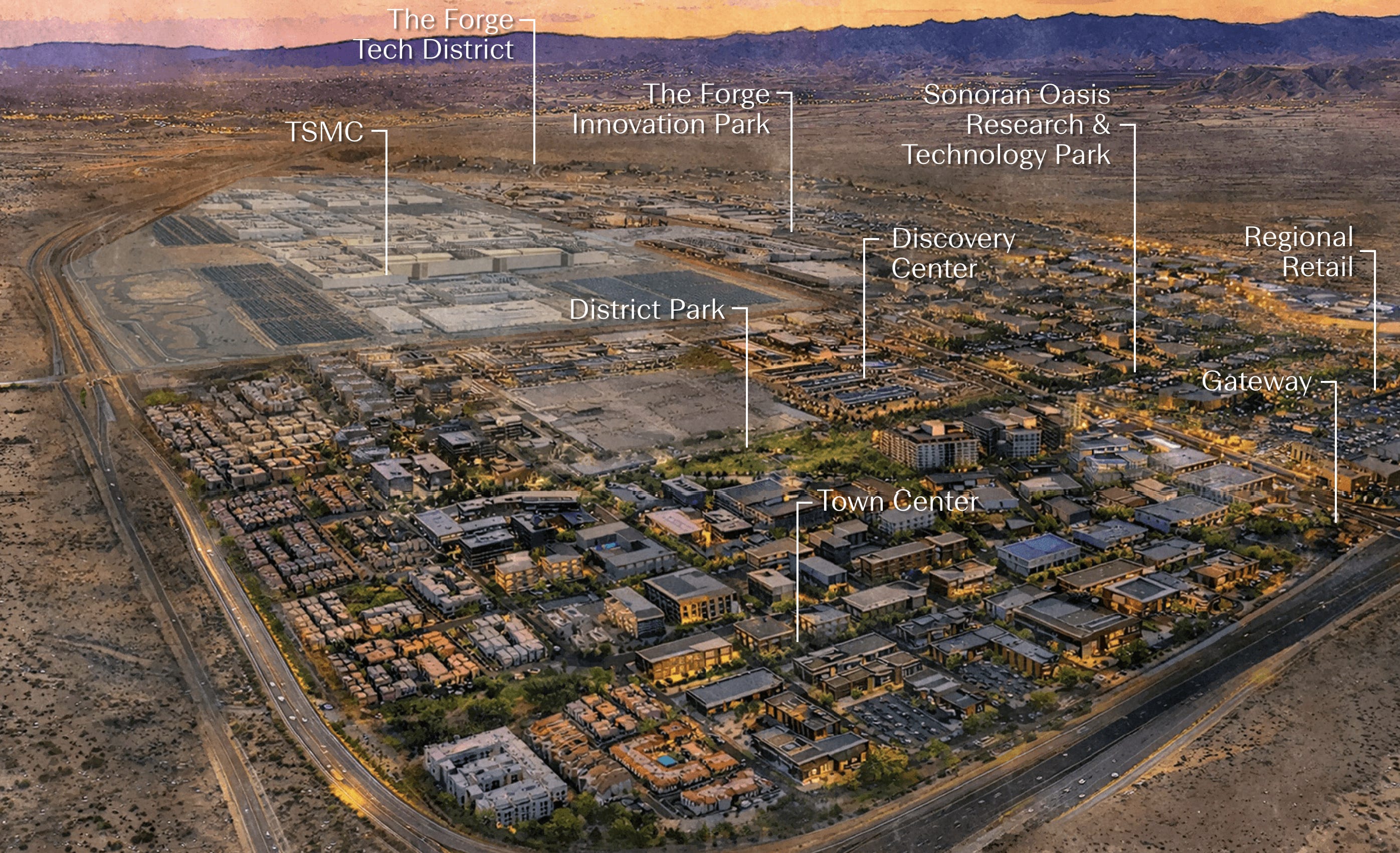
And then thereâs the other one, a sort of fantasy world, or maybe just an oblivious one, in which new water diversion projects like the Lake Powell Pipeline remain on the table, state leaders prepare to go to legal war to protect their statesâ profligate water consumption, and a developer is breaking ground on a 2,300-acre âcity within a cityâ called Halo Vista in North Phoenix.
Halo Vistaâs developers are billing it as a companion development to TSMCâs $165 billion semiconductor fabrication facility complex. It will wrap around the industrial campus (thus the âhaloâ in the name), and plans call for some 30 million square feet of industrial, retail, office, research, and healthcare spaces along with 9,000 or more residential units.
âYou have to think about all the people at full build-out whoâll work in this area â about 60 to 80,000 people,â Greater Phoenix Economic Council President Christine Mackay told AZFamily. âTheyâll work in the Halo Vista science and technology park. They need restaurants, hotels, places to live â and places to shop for what they need.â
Historically, Arizonaâs economy was said to run on five Cs: copper, cotton, citrus, cattle, and climate. Copper is still going fairly strong, most of the citrus groves have given way to housing developments, alfalfa has surpassed cotton, and the beef-cattle have been replaced by dairy factories. Now another C â computer chips â is being added to the mix, as the Phoenix-area experiences a semiconductor manufacturing boom and a coinciding data-center buildup.
The tech industryâs expansion is adding economic diversity, making the city somewhat less vulnerable to 2008-like financial breakdowns. But as Halo Vista demonstrates, it is also feeding Phoenixâs dominant economic force, the Growth Machine. And both the Growth Machine and the data center/semiconductor boom need water, and quite a lot of it. This, in turn, increases Phoenixâs exposure to future water shortages, which seem more and more likely with each passing day.
According to TSMCâs draft environmental assessment, the first phase of its Phoenix fabrication plants will initially use about 4.75 million gallons of water per day, or 5,320 acre-feet per year, which would jump to about 19,400 acre-feet yearly if and when all three phases are built out. But the company says it will eventually install a recycling system that will bring that number down considerably. The 9,000 residential units in Halo Vista would use about 2,800 acre-feet per year (based on Phoenixâs current per-capita water consumption multiplied by a rough estimate of 20,000 people occupying those residences). Halo Vistaâs other industrial and commercial properties will consume an unknown additional amount of water.
So letâs say the whole development, including the âfabs,â will use about 25,000 acre-feet per year â less if the water efficiencies are realized, more if Halo Vistaâs tech district includes data centers or other water-intensive industries.
Thatâs a lot of water, or a drop in the bucket, depending on how you look at it.
On the one hand it is equal to about one-fourth of Nevadaâs total consumptive use from the Colorado River. Yes, the city of sin and excess only uses about four times more water than the TSMC/Halo Vista âcityâ will use.
On the other, itâs far less than the alfalfa farms in Maricopa County â in which Halo Vista is located â use for irrigation each year, which totals something like 500,000 acre-feet.1 And yet, Halo Vista/TSMC, once all built out in 20 years or so, will have a significantly larger economic output than a bunch of hay fields (which isnât the only measure of value or even the most important one, and yet, well, water does flow uphill to money).
So yes, it is possible to sidestep water concerns by pulling out the âwhat about alfalfaâ comparison. But itâs also not all that productive.
Halo Vista, which is being built on a plot of uncultivated state land in the desert, is not displacing an alfalfa farmâs water use. Rather, it represents a new water use piled on top of existing consumption. The water will come out of Phoenixâs municipal system, and therefore officially has an âassured and adequateâ 100-year water supply, which is necessary in Arizona for this sort of development.
Yet thereâs nothing assured about Arizonaâs water future. Phoenixâs water comes primarily from high priority rights on the Salt and Verde Rivers, and from the Colorado River via the Central Arizona Project. But those rights will hardly matter if the rivers dry up: This yearâs Salt River Basin meagre snowpack had vanished by March 1, spring runoff peaked weeks ago, and flows are rapidly falling. Meanwhile, the Central Arizona Project has relatively low priority rights, meaning it will be the first to take cuts as the river shrinks.
In other words, aridification and the Colorado River crisis pose an existential threat to Phoenixâs tech boom and, well, Phoenix, itself, which is one of the reasons Arizona Gov. Katie Hobbs is preparing for a bitter legal fight with the feds and the Upper Basin states over the Colorado River.
The good news for the developers and the semiconductor makers is that agriculture continues to use a lot of water in Arizona. And where there is large consumptive use, there is also more room for increased efficiencies and, if it comes to it, âbuying and dryingâ the farms for their water â which has its own negative consequences. The bad news is that the shortages to come may very well exceed the amount that could be wrung out of the existing farms.
Halo Vista, which is on a 20-year buildout schedule, is far from the only major water- and energy-guzzling development on slate for the increasingly arid West. And maybe itâs not realistic to expect all such development to come to a screeching halt simply because the water may run out sometime in the future. After all, climate change could cause more precipitation; maybe in 20 years weâll be worrying more about flooding than desiccation.
But you would think that planners and policymakers and the developers would at least act in line with our current reality, where resources, especially water, are limited. Halo Vista-esque projects should be required not just to certify an âassuredâ 100-year supply, but they also should have to offset new consumption with cuts somewhere else, whether itâs paying for farmers to install drip irrigation or funding treated wastewater recycling projects.
Continuing to consume water at current rates is one thing. Adding new uses on top of our current overconsumption is quite another.
***
And so it begins. It looks like residents of the small Arizona community of Kearney may lose their water altogether later this summer, making developments like Halo Vista look even more surreal.
The town sent this emergency memo out to residents in April:
Based on current usage within the Kearny water distribution system, we WILL run out of water on or about July 15, 2026. When that happens there will be no water available to any of us for any purpose until we receive a new allotment from the Gila River Water Commissioner. You will turn on your faucet and there will be no water, that is the stark reality we face.
Kearney sits in Arizonaâs âCopper Triangleâ along the banks of Gila River and in the proverbial shadow of the Hayden copper smelter smokestack. The town was established by the Kennecott Mining Company in 1958 to house residents displaced from Ray, Sonora, and Barcelona as the mineâs gaping Ray mine pit gobbled up the communities. Resolution Copperâs proposed Oak Flat mine is also nearby, as is Faradayâs proposed Copper Creek project.
Kearney has a maximum allotment of 610 acre-feet of water from the Gila River. This year, however, extreme drought conditions have brought the allotment down to just .76 acre-feet, forcing the town to impose severe restrictions on use to try to make it last until the monsoon arrives.
As for all the mines surrounding Kearney? Iâm guessing their dealing with their own water issues, but Iâd also wager that theyâre allowed a heck of a lot more than three-fourths of an acre-foot.
đ Colorado River Chronicles đ§
In the comment section on the last Land Desk dispatch, reader wkarls reported on the Colorado Riverâs flows during a recent raft trip on the Grand Canyon. It got me to thinking about how low those flows might go and what that could mean.
The first half of our trip was on 7-9k cfs, the second half on basically 8k constant. Though a âdifferent experienceâ than 20k cfs, it was a great trip as always, with some of the âbigsâ easier, some harder-but all very doable. Commercial operations (w/ their 30foot+ motor rigs) may have a different opinion when the summer starts. This is a multi-million dollar business. How low can the river get and still be run through the GC regularly? We shall see but probably 4k-maybe lower.
Iâve only boated down the Grand Canyon once, back in October and November of 1995 with a group of slightly crazy Salida rafting folks. It was a beautiful, terrifying, sublime â if somewhat debauched â experience. During the trip, releases from Glen Canyon Dam â which make up about 95% of the flow in the Grand Canyon â fluctuated between 11,000 and 16,000 cubic feet per second, a number that was bolstered downstream after a good rainstorm moved through, turning the river that intimidating blood-and-chocolate-milk color. That seemed like plenty of water to me; it was certainly enough to generate waves big enough to toss our little rafts about like toys (did I mention it was scary as hell?).
Somewhat surprisingly, the releases were about the same in September of last year, bouncing between 10,000 and 16,000 cfs, which appears to have been an effort to get the annual flows past Lees Ferry up to about 7.5 million acre-feet to keep the Upper Basin in compliance with the Colorado River Compactâs non-depletion obligation. Then, on Oct. 1, the beginning of the 2026 water year, releases plummeted. This spring theyâve been in that 7,000 to 9,000 cfs range that wkarls mentioned.
Thatâs in line with the Bureau of Reclamationâs plan to release just 6 million acre-feet from the dam this water year: 6 million acre-feet per year averages out to about 8,200 cfs. Thatâs also right in line with the Grand Canyon Protection Actâs operating criteria, which set a minimum allowable release during the day (between 7 a.m. and 7 p.m.) at 8,000 cfs, while the minimum nighttime release is 5,000 cfs.
So, given all of that, we can assume that the flows shouldnât drop much below current levels this summer. Of course, if conditions are worse than expected, then the reservoir could drop to 3,500 feet earlier than anticipated, which could force dam operators to further curtail releases to âdefendâ minimum power pool. If so, then you might see nighttime releases drop as low as 5,000 cfs. If thatâs not enough, then I suppose dam operators would have to go to a run-of-the-river scenario, where flows could plummet to 2,000 or 3,000 cfs, which would make rafting quite interesting.
đž Parting Shot đïž

Based on USDA figures of 82,000 acres planted in alfalfa in the county and a conservative estimate of five-acre feet of irrigation per acre of alfalfa.