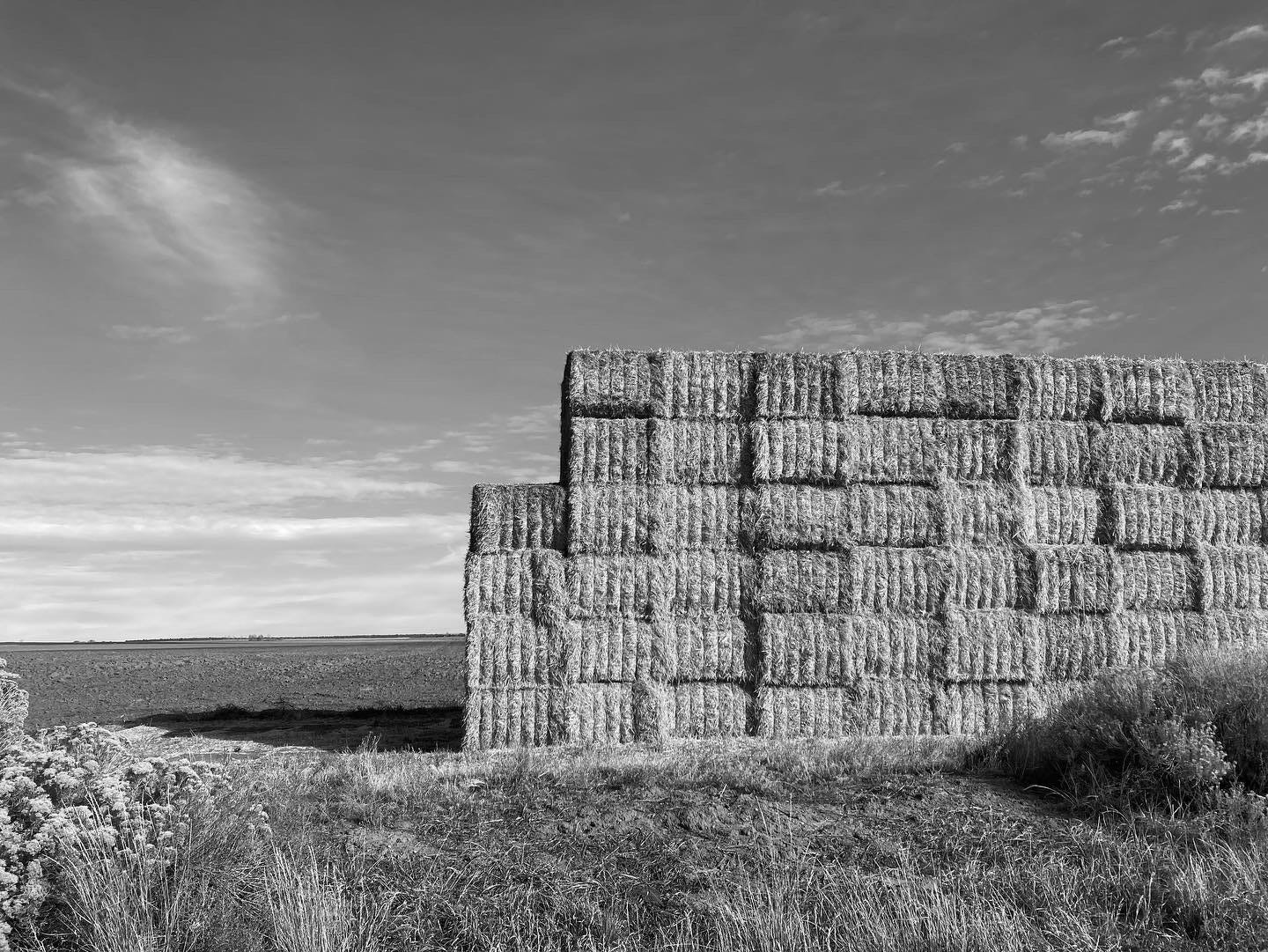
Alfalfa as an agricultural demand response tool
Also:
I started the Land Desk five years ago this month to fill what I saw as a gap in coverage of public lands, energy, climate, water, economics, and communities in the Western U.S. — along with the politics around all of those issues. I certainly wasn’t planning on covering national or partisan politics.
But it so happens that my first dispatch ran four days after the infamous events of Jan. 6, 2021, which had echoes — if not direct connections — to Western land-use politics. So, less than a week after launching, I found myself, well, delving into national partisan politics.
The United States is again in turmoil, the administration is a full-on dumpster fire, and federal agents are executing people in the streets of Minneapolis — and then lying about it and slandering the victim.
To say I’m horrified, outraged, and heartbroken would be an understatement.
I’m not going to offer any analysis here — others have done a much better job than I could. But I would plea with and urge Western elected officials from both parties to stand up and do whatever you can to curb these authoritarian and reprehensible actions, even if it means shutting down the government, and to hold the administration accountable.
***
On a brighter note, it is the Land Desk’s fifth birthday this month. Actually, it was on Jan. 10, and I totally missed it until now. I just want to take this opportunity to thank all of my readers, but especially the Founding and Sustaining Members and the other paid subscribers and “Buy Me a Coffee” supporters who keep this thing — and the Silver Bullet and now El Burro Blanco — going. I couldn’t do it without you.
☘️ Annals of Alfalfa 🍀
Yes, I’m going to talk about alfalfa. Again. Why? Because the Colorado River is on my mind, and as John Fleck, author, former journalist, and Writer in Residence at the Utton Transboundary Resources Center at the University of New Mexico School of Law, once wrote: “Golf and the Bellagio Fountain are easy targets. But if you’re not talking about alfalfa, you’re not being serious.”
That’s because alfalfa and, to a lesser degree, other livestock forage crops, are collectively the largest users of Colorado River water. So, any serious efforts to cut consumption on the river are going to involve alfalfa, in some form or another. In recent years, this has included paying farmers to fallow some of their alfalfa fields and leave the water in the ditches, canals, or the river.
But a report1 published last year2 posits a less extreme solution: Keeping the alfalfa, but watering it less during the summer months in dry years — a practice known as deficit irrigation. The farmer could then sell the surplus water to other users to offset the losses resulting from lower crop yields. The authors estimate that this approach could save up to 3.4 million acre-feet of water annually across the Southwest3, or about 50% of total alfalfa water use.
In some ways, this method is analogous to something called “demand response” on electrical power grids. That’s when large power users, or a collection of smaller users, are paid to reduce electricity consumption during times of high demand to ease grid strain. So, for example, during a heat wave, when everyone’s air conditioners are running full blast, the utility or grid operator would signal a factory, say, or a data center to scale back their operations during the hottest time of the day when solar generation might be dropping off. The targeted drop in consumption has the same effect as increasing power generation would, keeping supply and demand in balance.
Alfalfa is a good crop for water-demand-response in part because it uses a lot of water in the first place, but also because putting it on a temporary water diet won’t kill it. The authors argue that this approach is preferable to fallowing fields, replacing alfalfa with other crops, or even increasing irrigation efficiency. Alfalfa is high in nutrients and digestible fiber, making it a valuable livestock feed; its deep roots facilitate nitrogen fixation; and it has high salt tolerance.
They note that drip irrigation and fertigation (a new term to me that is where liquid fertilizer is applied with irrigation water) have increased crop yields, but have also resulted in “a water savings paradox, especially greater net consumptive use (CU) due to expansion of cropped areas and reduced groundwater recharge and return flows to streams.” Fallowing, meanwhile, has its own unintended economic and environmental consequences, including increased weeds and dust mobilization, loss of green space, and loss of wildlife habitat.
In addition to saving between 16% and 50% of water used to irrigate alfalfa, the authors write, “Summer deficit irrigation could also be an attractive strategy for alfalfa growers particularly if market water prices at the peak of the growing season are high enough to offset the remaining alfalfa cutting revenues.”
It all sounds good on paper, but implementing it in the fields would be far more complicated than simply shutting off the ditches for a couple of months. And whether this approach could actually pay for itself depends on the price of alfalfa, the price of water, and on whether it’s logistically feasible to sell the saved water to someone else.
Still, deficit irrigation is certainly one useful tool for farmers and water managers to consider. Because cuts are coming to the Colorado River one way or another. And it behooves everyone to make it as painless as possible.
📈 Data Dump 📊
Here’s a few alfalfa charts for your perusing pleasure.


🔋Notes from the Energy Transition 🔌
In somewhat related news: The vast and powerful Westlands Water District has voted to move forward on a plan to build up to 21 gigawatts of new solar-plus-battery energy storage capacity on fallow, water-constrained agricultural fields in the San Joaquin Valley. In choosing this path, the water district defied the growing anti-solar backlash that seems to have infected even more progressive areas. And it opened the door for farmers to continue to earn an income on land that they simply can’t farm anymore because the water is no longer there. As a Westlands representative told Canary Media, it will “give farmers another crop to grow, which is the sun.”
***
Rio Tinto’s Kennecott copper mining and smelting operation near Salt Lake City is the state’s largest polluter, spewing about 193 million pounds of toxic chemicals into the air each year. That kind of puts a grimy shadow over the company’s efforts to become more sustainable — like switching from diesel to battery-electric trucks — but it is better than business as usual, I suppose. And on that note, they are bringing online a 25 megawatt solar array to help power its operations, which is notable since they have started to produce tellurium, an ingredient in photovoltaic panels.
***
I have similarly mixed feelings about this next news item: MGM Resorts just acquired more solar power, bringing their onsite and offsite solar-plus-storage facilities combined capacity to a whopping 215 megawatts, allowing the company to meet up to 100% of daytime electricity load at its Las Vegas Strip operations.
“Reimagining alfalfa as a flexible crop for water security in the Southwestern USA,” by Emily Waring, et al.
Hat tip to All at Once by Dr. Len Necefer for alerting me to this study.
This includes all of California, Nevada, Utah, Colorado, New Mexico, and Arizona, and is not limited to the Colorado River Basin.


Thanks for this information